
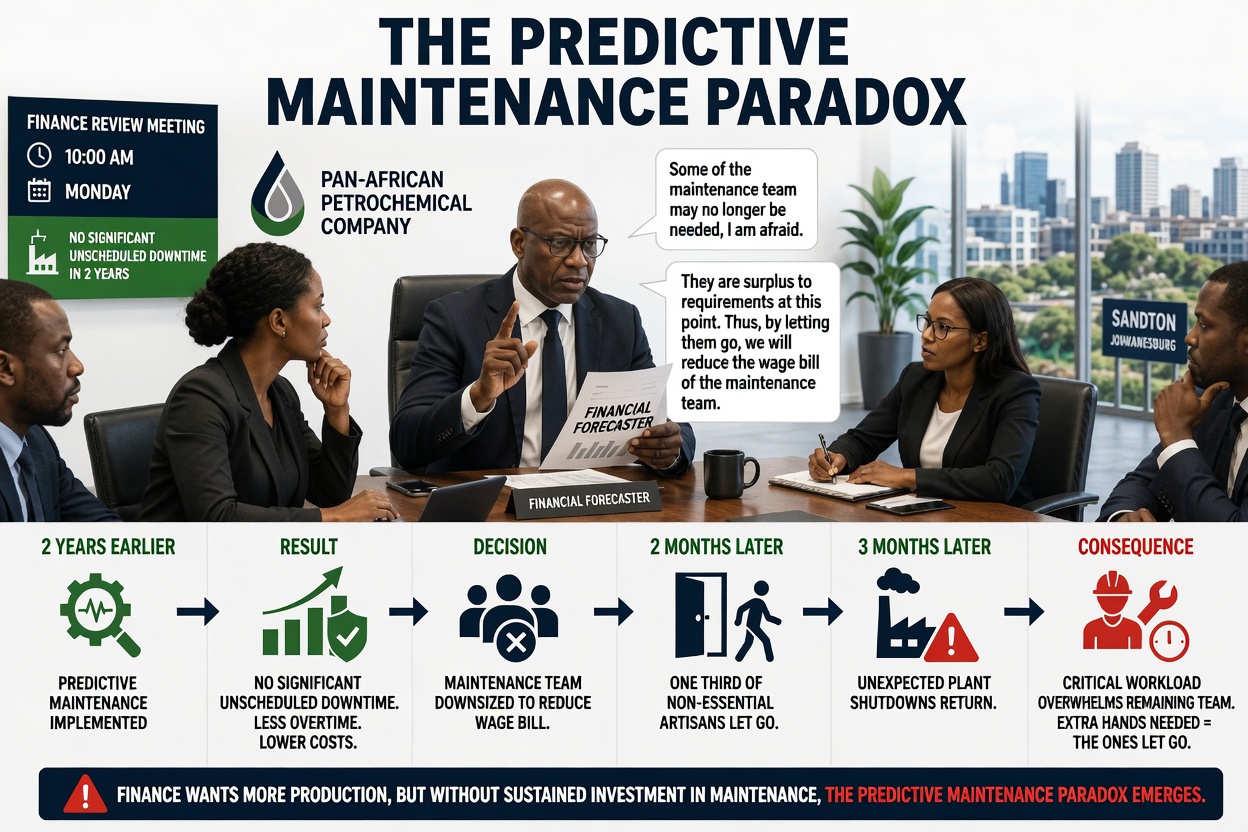

It’s 10:00 am on a Monday. There is a Finance Review Meeting for a Pan-African petrochemical company in a boardroom at an upmarket office park in Sandton, Johannesburg, South Africa.
Management is exploring potential avenues to cut costs.
A stern-faced, bespectacled financial controller notices that the company has not experienced significant unscheduled plant downtime in two years. As a result, employees spend less time on emergency shutdowns and no longer have to work overtime to “douse the fires”.
Proceeding, he decrees that the company should downsize the maintenance team because there are no more emergency shutdowns.
“Some of the maintenance team may no longer be needed, I am afraid.”
“There is no need to be paying people for merely pitching up for work. We are not running a social welfare programme,” remarks the studious, bespectacled head of finance, who then adds, “They are surplus to requirements at this point. Thus, by letting them go, we will reduce the wage bill of the maintenance team.”
Two months later, a third of the non-essential employees are relieved of their duties. Those who actually do the dirty work – the artisans.

Three months later, the unexpected surfaces: the dreaded plant shutdowns.
The maintenance manager informs management that he is overwhelmed by inspection tasks on critical machinery and that the workload requires extra hands. And guess who? The supposedly non-essential artisans.

In some companies, management is so accustomed to emergency shutdowns under reactive maintenance that they believe it is the norm. When predictive maintenance works, they think it is atypical.
Unfortunately, finance departments often find themselves trapped in a predictive maintenance paradox: they expect more revenue from higher production, but are not willing to guarantee the funding required to sustain it.