

Accurate data from level measurement in mining-specific waterand wastewater treatment plants can be the difference between compliance and non-compliance, plant availability and downtime. Consequently, there should be no compromises in the selection and use of reliable instruments.
Where there is a requirement to monitor and measure level in harsh environmental and process conditions, ultrasonic instruments have demonstrated limitations. Radar-based sensors, by contrast, have consistently prevailed, producing real-time data that supports informed decision-making for plant reliability.
The Marketing Manager illustrates to Machinery Maintenance Matters where and why radar-based sensors bridge the measurement gap.
Not all level measurement-related failures in water and wastewater treatment plants are due to inferior instrument quality. Sometimes, they are caused by the wrong instrument choices for specific applications.
Miguel Petersen, VEGA Regional Marketing Manager, makes this observation. He draws on feedback about experiences with contact-based or ultrasonic measurement gained through extensive client engagements in heavy industry across Africa.
Ultrasonic level measurement
Petersen narrows his focus to ultrasonic level measurement, an area where significant challenges are encountered in water and wastewater treatment plants in mining operations. Though widely used and serving the purpose when needed most in other applications, these sensors come with inherent limitations under certain environmental or process conditions.
Prominent limitations
Worryingly, these inherent limitations can significantly affect measurement accuracy and overall plant availability, explains Petersen, underlining the most prominent ones.
a. Sensitivity to atmospheric conditions
Usually, ultrasonic sensors measure distance by calculating the travel time of sound waves, and sound velocity is directly affected by temperature, humidity and air pressure. In mining environments, where temperatures can fluctuate dramatically between day and night or across seasons, this becomes problematic, Petersen points out.
“The variations in environmental conditions introduce measurement errors that require constant compensation. If the compensation is insufficient or the sensor’s temperature reference is inaccurate, readings drift, sometimes without any visible alarm or fault indication.”
b. Dust and vapour interference
Mining water and wastewater treatment plants are typically dusty environments, and process vessels often produce vapour, foam or mist above the liquid surface. These conditions pose a challenge during measurement, relates Petersen.
“When exposed to dust and vapour, ultrasonic signals can be absorbed, scattered or falsely reflected by airborne particles and vapour layers. As a result, the sensor can lose the echo entirely or lock onto a false reflection. This leads to erratic readings or signal loss, neither of which is acceptable in a treatment plant where precise level control is critical.”
c. False echoes and acoustic interference
Agitators, pumps, turbulent inflows and the structural geometry of tanks (such as ladders, baffles and filling streams) all generate acoustic interference that ultrasonic sensors can mistake for a valid surface echo. While filtering algorithms help to a degree, they unfortunately add latency and can mask genuine level changes.
d. Blanking zone limitations
Ultrasonic sensors have what is called a “blanking zone” or blind spot. This is the minimum distance from the sensor face within which the sensor cannot measure.
Petersen illustrates the blanking zone’s hindrance: “The blanking zone limits how close to the sensor the liquid surface can be. In turn, this restricts the usable range of the vessel and can prevent accurate readings at high fill levels.”
e. Performance in aggressive environments
Mining wastewater is often chemically aggressive. Ultrasonic transducers, particularly the piezoelectric elements, can degrade when exposed to chemical vapours over time. Eventually, this affects sensitivity and long-term reliability.
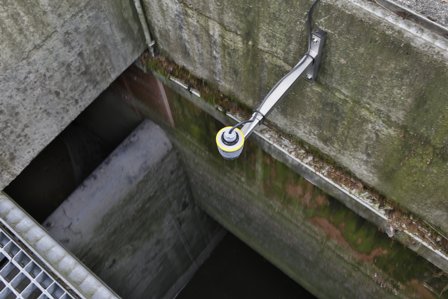
Radar-based level measurement is recommended wherever environmental or process conditions make contact-based or acoustic measurement unreliable
The cumulative impact on plant reliability
Just how do these limitations impact plant reliability?
Challenges with ultrasonic sensors do not just affect individual readings. Unfortunately, they all add up, Petersen says. “Inaccurate level data leads to incorrect pump triggering, inefficient chemical dosing, overflow risk or dry-run pump damage. In a mining water and wastewater treatment context, regulatory compliance, environmental protection and continuous operation are all at stake, and sensor unreliability has real operational and financial consequences.”
Radar-Based Measurement: A More Dependable Alternative
To address the limitations of ultrasonic sensors, mining companies must explore alternative instruments with proven performance in similar environments.
As it is unaffected by temperature, dust, vapour or acoustic interference, radar-based measurement offers a far more dependable alternative.
“Radar-based level measurement is recommended wherever environmental or process conditions make contact-based or acoustic measurement unreliable. In mining water and wastewater treatment applications specifically, several conditions point strongly toward radar as the preferred technology,” Petersen explains, outlining critical scenarios where radar-based measurement has the edge.
i. Harsh or variable atmospheric conditions
Unlike ultrasonic sensors, radar signals are electromagnetic, and they travel at the speed of light. As such, they are unaffected by temperature fluctuations, humidity or air pressure changes.
Generally, wherever ambient conditions are unstable or extreme, radar maintains measurement accuracy without the need for atmospheric compensation.
ii. Dusty or vapour-laden environments
Mining plants are rarely clean. Where dust, condensation, steam or chemical vapour is present above the liquid surface, radar prevails, cutting through without signal loss or false readings. This capability becomes particularly relevant in sumps, thickener tanks and reagent storage vessels, where surface conditions are rarely ideal, Petersen points out.
iii. Foaming or turbulent surfaces
Characteristically, processes involving agitation, aeration or chemical reactions often produce foam or surface turbulence that confuses acoustic sensors. When deployed, radar handles these surfaces reliably, especially guided radar variants, which are immune to surface agitation entirely.
iv. Applications requiring high accuracy over a wide range
In applications where precise level control is critical (for example, in dosing tanks, clarifiers or water storage reservoirs feeding downstream processes), radar delivers. It produces consistent, high-accuracy readings across the full vessel range, without blanking zone restrictions at the upper end.
v. Confined spaces and complex vessel geometries
Mining infrastructure often makes use of sumps, underground reservoirs and tanks with internal structures such as agitators, baffles or inlet pipes. Conveniently, radar sensors with targeted beam angles, combined with VEGA’s advanced signal processing, can be configured to suppress false echoes from these obstructions. This is something ultrasonic sensors manage far less effectively, Petersen notes.
vi. Corrosive or aggressive media
Where wastewater contains acids, alkalis or aggressive chemical compounds, non-contact radar eliminates the risk of sensor degradation from direct media exposure. Where mining operations need a solution for contact applications, VEGA has radar sensors with chemically resistant materials suited to aggressive environments, Petersen affirms.
vii. Remote or hard-to-access installations
Radar sensors are low-maintenance by design. This is advantageous in mining operations where instrumentation may be installed in remote or difficult-to-access locations. Here, the reliability and longevity of radar reduce the frequency and cost of maintenance interventions.
viii. Regulatory and environmental compliance requirements
Operations monitoring return water dams, tailings facilities or effluent discharge points are obligated to meet regulatory and environmental compliance requirements. In these applications, accurate measurement is critical, and the reliability of radar provides the defensible, consistent data records that operations need.
Radar for Critical Measurement Points
“In short, radar is recommended in operations wherever uptime, accuracy and long-term reliability cannot be compromised. In mining water and wastewater treatment, this applies to most critical measurement points,” Petersen concludes, advising mining companies to partner with reputable suppliers of radar-based measurement tools.