
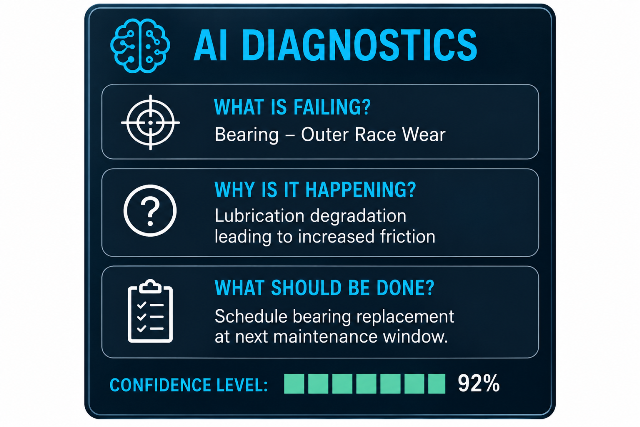

New industrial AI platforms are beginning to tell maintenance teams not only that a machine is failing, but also what is failing, why it is happening and what should be done next.
For years, predictive maintenance has been built around a simple objective: detect equipment problems before they result in unplanned downtime. Sensors monitored vibration, temperature, pressure and motor current, while software generated alarms when values moved beyond predetermined limits.
The technology transformed maintenance, but it also left engineers with a familiar challenge. An alarm could indicate that something was wrong, but not necessarily what had caused it.
The latest generation of AI-powered diagnostics is changing that.
In July, predictive maintenance specialist Tractian introduced an enhanced Asset Library that adds equipment-specific intelligence to its AI platform. By combining OEM asset information with live sensor data, the system aims to improve diagnostic accuracy and provide maintenance teams with more meaningful recommendations rather than simply highlighting abnormal operating conditions.
The announcement reflects a broader trend across the industrial sector. Equipment monitoring is evolving from fault detection to fault diagnosis, and ultimately towards maintenance decision support.
Beyond Threshold-Based Monitoring
Traditional condition monitoring systems compare sensor readings against predetermined thresholds. When vibration, temperature or current exceeds an acceptable level, an alarm is generated for investigation.
While effective, this approach has limitations.

High vibration, for example, could indicate bearing wear, shaft misalignment, rotor imbalance, mechanical looseness, cavitation or inadequate lubrication. Each condition requires a different maintenance response, yet many conventional monitoring systems simply report that vibration has exceeded a set limit.
Maintenance engineers must still interpret the data, review machine history, inspect the equipment and determine the root cause.

For critical assets operating in mines, power stations or processing plants, that investigation can consume valuable time while production remains at risk.
AI Adds Context
The difference with AI diagnostics is context.
Rather than analysing individual sensor readings in isolation, AI platforms evaluate multiple data sources simultaneously. Vibration trends are considered alongside bearing temperatures, motor current, lubrication condition, operating load, historical maintenance records and, increasingly, OEM equipment specifications.
The objective is not simply to recognise abnormal behaviour but to identify the failure mechanism responsible for it.
A centrifugal pump provides a practical example.
An increase in vibration may initially suggest several possible faults. However, if vibration rises gradually while bearing temperatures also increase, motor current remains stable and lubricant analysis indicates metallic wear particles, AI can identify bearing deterioration as the most probable cause.
Conversely, if vibration increases alongside fluctuating flow rates, pressure instability and changing power demand, the diagnosis may point towards hydraulic cavitation rather than a mechanical defect.
Instead of presenting maintenance personnel with several possible explanations, the software prioritises the most likely diagnosis together with supporting evidence.
From Data to Decisions
This evolution represents one of the biggest changes in predictive maintenance.
Maintenance teams have spent years investing in sensors and connected equipment. Many operations now collect enormous quantities of machine data every second.
The challenge is no longer obtaining information.
It is determining which information requires action.
Modern AI platforms are therefore moving beyond condition monitoring towards decision support. Instead of displaying dashboards filled with trends and alarms, they increasingly recommend maintenance priorities, identify probable root causes and, in some cases, suggest corrective actions.
Some systems are also integrating directly with Computerised Maintenance Management Systems (CMMS), allowing diagnostic results to initiate maintenance workflows automatically.
OEMs Are Expanding AI Diagnostics
Tractian is not alone.
Across the industrial sector, major OEMs and technology providers are investing heavily in AI-assisted diagnostics.
SKF continues to expand its condition monitoring capabilities by combining vibration analysis with advanced diagnostic algorithms that help identify specific bearing and rotating equipment faults.
ABB is strengthening its digital asset management portfolio through cloud-based analytics designed to improve equipment reliability across process industries.
Emerson continues to enhance its AMS machinery health solutions by combining sensor data with predictive analytics to support earlier fault identification.
Siemens has integrated artificial intelligence into its Senseye Predictive Maintenance platform, enabling manufacturers to analyse machine health across multiple production assets using cloud-based diagnostics.
Collectively, these developments demonstrate that AI diagnostics are becoming an essential component of modern reliability programmes rather than an experimental technology.
Why It Matters for Heavy Industry
For mining, minerals processing and heavy manufacturing, the implications are significant.
Maintenance departments are responsible for increasingly complex operations while facing persistent shortages of experienced reliability specialists.
At the same time, equipment is expected to operate longer between shutdowns while delivering higher levels of availability.
AI diagnostics cannot replace experienced maintenance engineers.
However, they can reduce the time required to interpret machine data, prioritise maintenance activities and identify developing failures before they become costly breakdowns.
For remote operations where specialist engineers may not always be available on site, cloud-based diagnostic platforms also provide continuous oversight of critical assets from central reliability teams.
The Next Stage of Predictive Maintenance
The next step is already emerging.
Rather than simply identifying developing faults, AI systems are beginning to estimate remaining useful life, recommend optimal intervention windows and evaluate the operational consequences of delaying maintenance.
Some platforms can already distinguish between faults requiring immediate shutdown and those that can safely be monitored until the next planned maintenance window.
As machine learning models continue to improve, AI diagnostics will become increasingly capable of supporting maintenance planning, spare parts management and operational decision-making.
For maintenance managers, the value lies not in replacing engineering judgement but in improving it.
The evolution from fault detection to intelligent diagnosis marks an important milestone in predictive maintenance. The question is no longer whether a machine is operating abnormally. Increasingly, AI can explain what is wrong, why it is happening and what should happen next.
For industrial organisations seeking to improve reliability while making better use of limited maintenance resources, that may prove to be the most valuable diagnostic capability of all.