
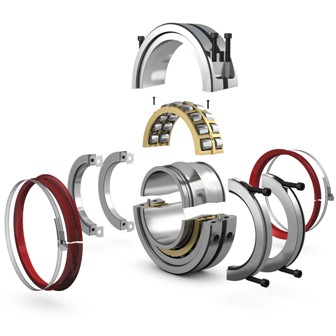

In South Africa’s Northern Cape province, a leading iron ore mine has fitted SKF Cooper 03 Series Split Cylindrical Roller Bearings to conveyor systems to address bearing failures and reduce maintenance downtime.
SKF South Africa Key Account Manager Duncan Mngomezulu explains that the mine had experienced bearing failures that resulted in prolonged conveyor stoppages when replacements were required. Limited access to pulley bearings also made replacement work more time-consuming and disruptive.
“These stoppages translated into production losses for the mine. At the same time, there was pressure to reduce maintenance costs and improve worker safety. Any solution therefore needed to address bearing reliability, access and maintenance time.”
In mining operations, conveyor availability is closely linked to production. Bearing installation, maintenance and replacement need to be completed with as little disruption as possible. At the iron ore operation, the working environment and access restrictions made bearing replacement an important consideration.
The SKF Cooper 03 Series Split Cylindrical Roller Bearings were identified as a potential solution. “This bearing addresses the challenges the mine was facing,” says Mngomezulu.
Before the solution could be recommended, SKF needed to establish whether the mine’s existing bearings could be converted to split bearings. Following a site visit and assessment by the SKF team, conversion opportunities were identified.
The split bearing design allows components to be installed or replaced without removing some of the surrounding equipment that would normally have to be dismantled when working with solid bearings. This can reduce the time required for bearing replacement and maintenance.
Mngomezulu says the split design, together with the bearing sealing arrangement, allows replacement or repair to be carried out on site, including in areas where access is restricted.

“With reduced disruption to shaft alignment and shorter maintenance times, these bearings can reduce mean time to repair (MTTR) by up to 70%,” he says.
The design can also eliminate the need to remove couplings or cantilevered drives for certain bearing replacement activities. This can avoid subsequent realignment work and reduce the amount of maintenance work required around the conveyor system.
Mngomezulu says this is relevant to mining and cement operations, where maintenance work on conveyor systems can expose workers to a range of hazards.
SKF Cooper split bearings are used in applications including conveyor pulleys, bucket elevators, escalators, mixers, agitators and horizontal grinding mill pinions. They are also used in sectors including mining, mineral processing, metals, material handling, cement, pulp and paper, power generation, and food and beverage.
At the iron ore mine, the bearings were selected to address the maintenance requirements of the conveyor systems. According to SKF, the change has reduced maintenance time and improved access during bearing replacement.
For the customer, the expected benefits include reduced maintenance requirements, improved conveyor availability and lower total cost of ownership compared with the previous bearing arrangement.
“The result is higher productivity coupled with improved safety during replacement activities, ensuring our customer benefits from reduced operating costs, stronger production levels and safer operations,” says Mngomezulu.
SKF South Africa provided local technical support, together with application expertise from SKF Cooper, to evaluate the existing bearing arrangements and determine where conversion to split bearings was possible.
Mngomezulu acknowledges Richard Law, Global Product Line and Sales Manager, Supply Chain Ball Bearings & Light Industries, Cooper, and Julian Witting, Lead Senior Applications Engineer, Supply Chain Ball Bearings & Light Industries, Cooper, for their technical support and involvement in the project.