

WearCheck managing director, Neil Robinson: “We have found that the most valuable innovation is not necessarily the most dramatic new instrument or algorithm. Sometimes it is software that prevents a sample being assigned incorrectly. Sometimes it is a flashing LED that guides a technician to the right tube. Sometimes it is a vibration pattern, amplified movement or lubricant trend that gives an engineering team enough warning to intervene before production stops.”
Predictive maintenance is becoming increasingly sophisticated, but the objective remains refreshingly simple: identify deterioration early enough to act before it becomes failure.
For condition-monitoring specialist WearCheck, achieving this means continually improving not only the technologies used to assess machinery, but also the systems, laboratory processes and diagnostic methods that turn measurements into reliable maintenance intelligence.
WearCheck managing director, Neil Robinson, discusses some of the innovation projects his teams have implemented recently. ‘Our ongoing investment in technology, research and development has resulted in increasingly automated laboratories integrated with information technology, while its wider condition-monitoring offering combines laboratory analysis with specialist field-based techniques.
Robinson, however, emphasises the importance of retaining human expertise within the company’s automated processes to ensure continuity of service and fast sample turnaround time, which is a core customer requirement. ‘We strive to strike a healthy balance between automation, AI and human intervention to continue to offer WearCheck’s signature service – reliable laboratory results delivered on time to support data-lead maintenance decisions.’
Here, he describes one of WearCheck’s recent innovations, which illustrates how apparently small changes in laboratory workflow can have significant implications for predictive maintenance.
Reinventing viscosity testing
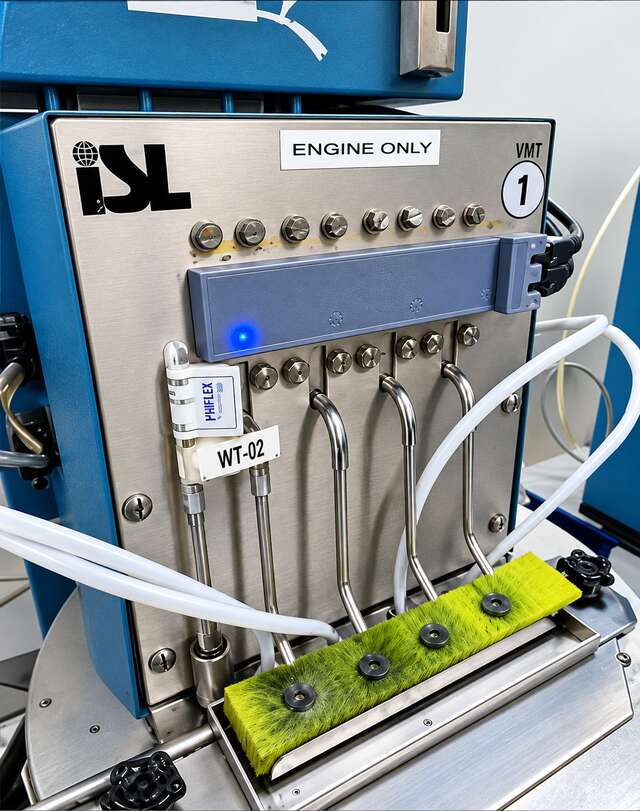
WearCheck has undertaken an extensive development project to improve the operation of its ISL VH1 and dual-solvent VH2 viscometers, which measure lubricant viscosity using the Houillon principle.

Viscosity is a critical indicator of lubricant condition. Changes can point to degradation, contamination or other abnormal conditions, making accurate and repeatable measurements essential when maintenance decisions depend on laboratory results.
Rather than simply accepting the instruments’ original software limitations, WearCheck developed its own solution.

The project began by extracting test data digitally from equipment that originally sent results directly to a printer. Custom software was then developed to display viscosity results electronically, upload results automatically into WearCheck’s database and associate each result with the correct sample number.
The team went further, decoding communications between the viscometer and its original software to understand functions including temperature control, test initiation, cleaning cycles, solvent-valve operation and calibration data.
This enabled WearCheck to create an independent software module providing greater control over the instruments and tighter integration with its Laboratory Information Management System. Older instruments were also upgraded by increasing their communication speed, extending the useful life of robust equipment that might otherwise have been retired because of outdated communications capability.
The result is not innovation for innovation’s sake. Better data capture, fewer manual interventions and closer integration with laboratory systems reduce opportunities for error, improve turnaround time and increase diagnosticians’ confidence in the results on which their recommendations are based.
Taking human error out of the process
A major focus of the project has been reducing the risk of samples being placed in the wrong rack or tube.
WearCheck’s system can control up to four viscometer baths simultaneously from one computer. Sample racks containing 20 samples are digitally tracked, while visual displays show technicians the status of individual tubes during testing, washing, drying and standard checks.
When potential sample-placement errors remained possible, the development team introduced increasingly intuitive visual controls.
An illuminated rack cover and multi-colour LED system now guide technicians towards the correct sample. Lights can be programmed to provide different visual instructions, while dedicated LED indicators above the viscometer tubes identify exactly which tube should receive the next sample. In practical terms, the operator follows the lights from the correct sample position to the correct testing tube.
This combination of automation and simple visual guidance is designed to reduce retesting, prevent sample misidentification and improve laboratory efficiency.
Innovation beyond the laboratory
WearCheck’s innovation strategy extends well beyond fluid analysis.
Through its Asset Reliability Care services, the company applies technologies including vibration analysis, thermography, structural resonance testing, ultrasound, operational deflection shape analysis, laser alignment and in-situ balancing to assess machinery and plant condition. The objective is to detect developing problems, understand their causes and reduce unplanned downtime and catastrophic failure.
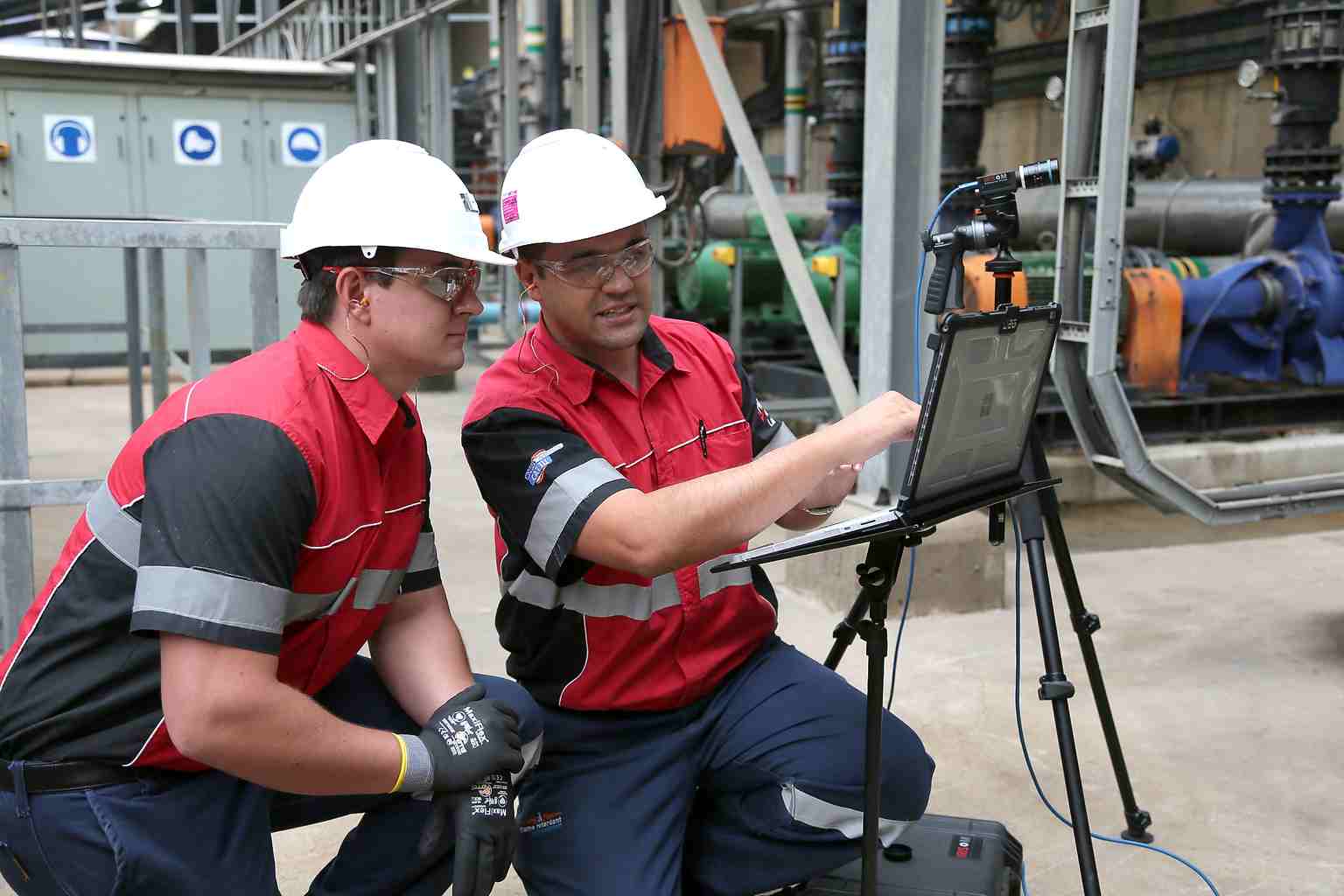
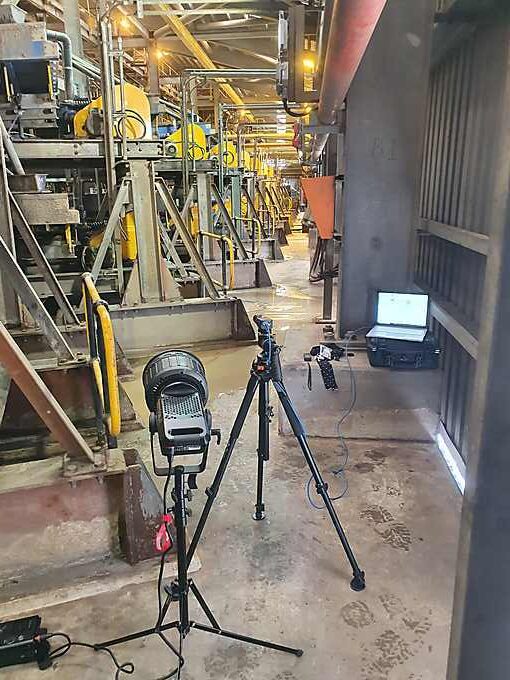
Video motion amplification is one example of how newer diagnostic methods can reveal behaviour that may be difficult to see with the naked eye, and is used to investigate machinery and structural vibration. By processing recorded video, small movements that are difficult to observe directly can be magnified and visualised. This can assist technicians in identifying unusual movement patterns, structural flexibility and areas requiring further investigation.
The findings can be correlated with conventional vibration measurements, ODS (operational deflection shape) analysis and resonance testing to establish the mechanisms contributing to excessive vibration. The technique complements established diagnostic methods rather than replacing them.
WearCheck is also expanding the reliability conversation beyond simply monitoring machinery condition. Its Lubricant-Enabled Reliability approach focuses on keeping lubricants clean, dry and effective for longer, with the aim of reducing unnecessary oil changes, costs and waste-oil disposal.
AI: powerful assistant, not replacement diagnostician
‘Artificial intelligence is another important part of the evolving predictive-maintenance landscape at WearCheck’, said Robinson.
‘WearCheck’s position is that AI can add significant value by recognising trends, filtering large datasets, identifying anomalies and helping prioritise areas of risk. However, the company cautions against treating AI as a substitute for experienced diagnostic judgement.’
Different condition-monitoring technologies provide different perspectives on a machine. Vibration reveals mechanical behaviour; oil analysis provides information about lubricant condition, contamination and wear; thermography highlights abnormal heat; and ultrasound or acoustic techniques can provide warning of friction, turbulence or electrical activity.
AI can help specialists identify where to look, but the interpretation of what those signals mean in the context of a particular machine still requires technical knowledge and experience.
That combination of technology and human expertise is ultimately what modern predictive maintenance is about.
‘We have found that the most valuable innovation is not necessarily the most dramatic new instrument or algorithm,’ said Robinson. ‘Sometimes it is software that prevents a sample being assigned incorrectly. Sometimes it is a flashing LED that guides a technician to the right tube. Sometimes it is a vibration pattern, amplified movement or lubricant trend that gives an engineering team enough warning to intervene before production stops.’
‘WearCheck’s approach is therefore to keep refining both sides of the equation: better technology to generate more reliable information, and experienced people to turn that information into practical maintenance decisions.’
After 50 years, WearCheck is still proving that the smartest way to predict the future is to listen carefully to what the machines are saying today.
Visit www.wearcheck.co.za or contact WearCheck on marketing@wearcheck.co.za or +27 (31) 700-5460.