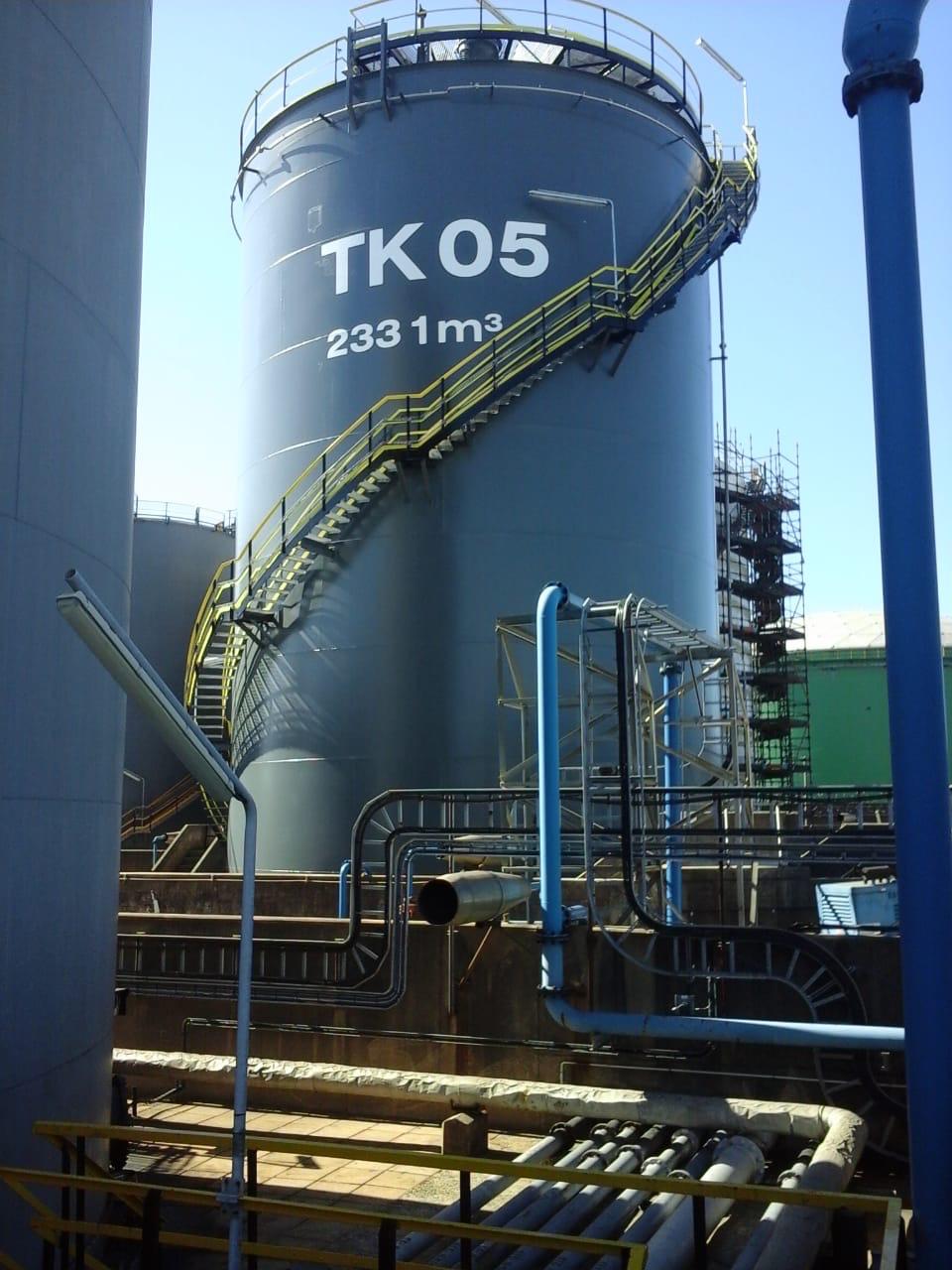

The replacement of two carbon steel storage tanks for a major base oil storage facility in Durban, KwaZulu-Natal, has been completed, marking a major milestone in Aurex Constructors’ growing tankage and terminals capability. The project involved the methodical demolition of two existing tanks and the construction of two new API 650-compliant base oil storage tanks, Tank 5 (2 331m³) and Tank 7 (1 479m³).
The project was executed within a fully operational brownfield environment, requiring Aurex to work under strict operational and permitting conditions while maintaining uninterrupted site activities for the customer.
“This was a flagship project for our Tankage and Terminals division,” says Renier Carstens, Operations Manager of Tankage and Terminals, Aurex Constructors. “The complexity lay in delivering new tanks safely while operating within an active storage terminal where operational requirements and emergency access routes had to remain functional at all times.”
Advanced construction methodologies drive efficiency
Aurex applied a hydraulic jacking system using a top-down construction philosophy, allowing welding to be performed in a stationary position, significantly improving efficiency, safety, and construction quality.
The jacking methodology also reduced the overall site footprint by minimising scaffolding, equipment, and labour-intensive activities. Automated welding technologies were also deployed as part of Aurex’s ongoing drive toward greater automation and improved delivery certainty.
“While we have constructed tanks using conventional methods before, this project demonstrated how targeted investment in advanced technologies, and specialised expertise can improve delivery efficiency and safety performance,” says Clive Garner, Industrial Project Solutions Director, Aurex Constructors.
Overcoming challenging site conditions
The project team managed several execution challenges, including adverse weather conditions which required ongoing adjustments to construction sequencing and daily work planning. In addition, the existing civil tank bases required intervention and redesign during the project, introducing programme impacts that were managed through revised timelines.
“A robust working relationship with the customer supported effective decisionmaking throughout the project, enabling alignment on permits, access, and sequencing to minimise disruption and maintain progress,” says Carstens.
The demolition phase itself also required rapid adaptation. Initial demolition methodologies were revised on site, with teams using plasma cutting techniques to safely dismantle and remove tank sections manually within the constrained operating environment.
Safety performance integral
Safety was a defining feature of the project, with the team achieving 168 000 injury-free manhours. Successful pre-commissioning and handover supported smooth transition from construction into commissioning and operational product introduction.
“Delivering safely in highly regulated environments is non-negotiable,” highlights Carstens. “Our teams consistently met both operational and safety expectations.” Garner adds, “Safety performance is the result of culture, leadership, and discipline. Our teams continue to demonstrate professionalism in complex project environments.”
The project also delivered significant local economic impact, with 95% of the workforce sourced locally. Structured training, induction, and safety programmes supported skills development throughout the project lifecycle.