


MMM: In the previous interview, you said maintenance managers should not entirely depend on OEMs for advice on stocking spare parts inventory. Could you elaborate?

AC: Of course, the OEMs need to be used, and their manuals are a good starting point. However, one must remember that they will generally advise a spares list to be much larger than what is required.
Why? Because they are in the business of selling equipment, which includes spares. Remember, their first priority is the bottom line – increasing revenue.
MMM: I was at a mine where one of the overland conveyors was down due to the lack of a spare part from its most ‘trusted’ overseas supplier. Is there a way mining companies can hedge against encountering such situations?
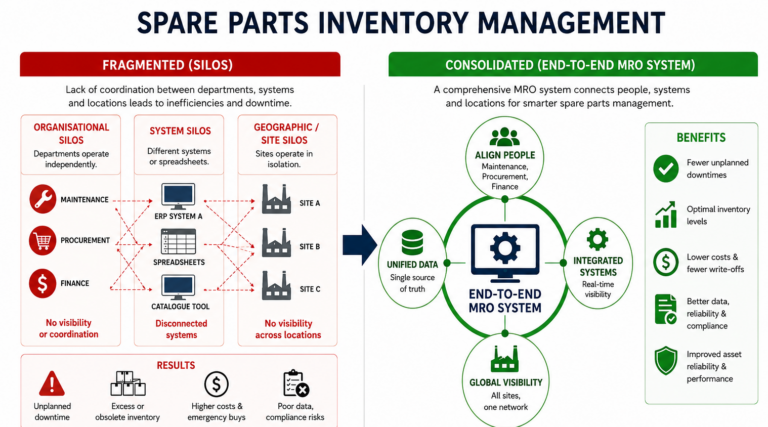
AC: Yes, there definitely is. Before any spares are ordered and put into stock, a detailed criticality analysis (CA) of the operation should be carried out. From this CA, one determines the spares holding requirements, not only for critical and insurance spares, but also consumables. If a piece of kit has very high criticality, ensuring the min/max numbers are correct from the outset with a robust early warning system.
MMM: Is this problem pervasive?
AC: The situation you have just mentioned has been experienced a number of times throughout Africa with pump spares. In most cases, the pumps were from a particular supplier, and spares became an issue worldwide.
Fortunately, there are other companies who have cottoned on to this and have stepped into the gap. These companies now supply replacement parts that are interchangeable with the “name brand” pumps, which come in at a much lower price and with shorter delivery times.
MMM: How can mining companies mitigate the risk of a situation where a spare part from a single supplier halts production?
AC: Mines can mitigate this situation through a criticality analysis and a very robust min/max reporting system.
This approach was successfully implemented at a large mining house I consulted for. I had section engineers take physical stock checks of critical spares on a monthly basis.
This demonstrated that there is more than one operation within the group, and that commonality of spares is a great mitigating factor.
MMM: Another situation that has been observed is where a mining company has signed a contract granting an OEM exclusive supplier rights. How can companies avoid the risks associated with this arrangement from the outset?
AC: By ensuring there is a service agreement with an “escape clause” and a clause which covers any situation where spares are not available, as written into the supply agreement.
MMM: Do you have any advice on terms that mining companies can include in contracts with suppliers?
AC: Not in detail. However, I would do a risk assessment with the legal and supply chain people to ensure all bases are covered.
MMM: Could they consider replacement parts manufactured to OEM standards, or, as some refer to them, parts ‘made to OEM specifications’?
AC: Definitely! The days of an OEM holding an operation to ransom are over.
MMM: Speaking of OEM standards, some suppliers advise against sourcing replacement parts. Without sounding cynical, could this be driven by commercial interests?
AC: As I said from the outset, the OEM wants you to buy their spares. In all honesty, with advances in fabrication technology, it is very seldom nowadays to find pirate parts that are of such low quality that they cannot be justified. Instead, what one does need to watch for is the issue of the OEM not honouring warranties if pirate parts are used.
MMM: To what extent could such advice be justified?
AC: If the cost is significantly cheaper than the OEM’s, or if there is a much longer lead time – in other words, readily available spares. Consider the potential loss in production revenue versus the warranty not being honoured.
MMM: In general, what advice would you give mining companies, or any heavy industrial operation, on preventing situations where spare parts shortages halt production and result in significant revenue losses?
AC: Without saying a mouthful, all I can say is: ensure that a criticality analysis is done.
Spares reviews should be conducted with an independent consultant, not an OEM. This should apply to all spares: critical, insurance, and consumables.
Last but not least, ensure the maintenance philosophy and maintenance tactics are data-driven, not purely historical.
As a parting shot, I always advise clients in the mining sector this: Don’t Put All Your Spare Parts in One Supplier’s Basket.