
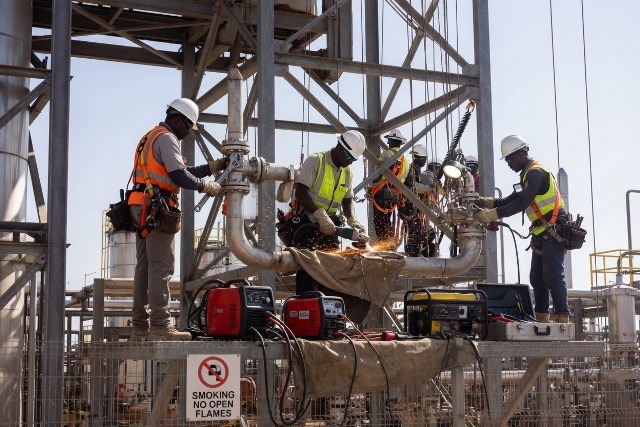

One of the root causes of fall-from-height incidents in mining and petrochemical environments is the disconnect between access systems and safety controls, resulting in maintenance teams failing to safely access their work areas. This leads to costly compliance breaches.
The most effective way of mitigating this risk is integrating access and fall protection systems and ensuring that planning and execution are thorough. Access to technologies has also simplified implementation.
Tasha Sheppard, Managing Director of Empire Height Safety, highlights this in an interview with Machinery Maintenance Matters.
Typically, maintenance shutdowns in petrochemical and mining environments require teams to work at height to carry out critical tasks. Therefore, safety and efficiency are central.
Relevant regulations
Given the risks involved, with respect to South Africa – and the same applies to other jurisdictions in the region and beyond – organisations are obligated to comply with relevant regulations enacted to ensure employee safety. These are:
- The Occupational Health and Safety Act (OHSA) Act No. 85 of 1993, on safe workplaces, which is enforced by the Department of Employment and Labour
- Construction Regulations, 2014, apply to any work-at-height construction work on structures, such as maintenance, renovation, repair, and installation work. Every employer is required to prepare a written Fall Protection Plan identifying hazards and specifying control measures prior to the commencement of work.
- South African National Standards for work at height safety encompass: SANS 1808, which specifies requirements for safety harnesses and lanyards used in fall protection; SANS 50795 (EN 795), which covers anchor devices for securing personal fall protection systems; SANS 10147, which defines standards for portable ladders, including design, load capacity, and safe use; and SANS 1973, which sets requirements for industrial safety helmets in workplace environments.
Commendable effort, but lapses persist
Among operations in South Africa, there is commendable effort to take the necessary measures to comply. However, it is not uncommon for lapses to be observed that lead to fall-from-height accidents. In the end, organisations are left to deal with fatalities and severe injuries of their employees; worse still, the ensuing reputational damage and penalties.
The burden of preventable incidents
It is unfortunate for organisations to bear the burden of incidents that, by following best practices, should have been prevented, reflects Tasha Sheppard, Managing Director of Empire Height Safety, a member organisation of the Institute for Work at HeightSouth Africa, an umbrella body for working-at-height practitioners. EHS is the provider of access and scaffolding solutions to organisations in heavy industry, including mining and petrochemicals in South Africa and neighbouring countries.
A peculiar trend
Sheppard reveals that EHS has observed a peculiar trend in the causes of incidents recorded during maintenance shutdowns: the disconnect between access systems and safety controls. This manifests in a myriad of ways, she adds, citing the following as the most prominent:
I. Inadequate or poorly designed access systems (for example, caged ladders, platforms, walkways) leading to unsafe or improvised access;
II. Congestion and bottlenecks due to limited or poorly positioned access points;
III. Fall protection systems (lifelines, anchor points) installed without considering how personnel actually access and move through the work area;
IV. Overloading or misuse of systems due to poor coordination between teams; and
V. Rushed or incomplete inspections during high-pressure shutdown timelines.
The abovementioned lapses can have a significant impact on compliance, Sheppard emphasises. “In many cases, shutdown delays and safety risks stem from challenges personnel encounter to safely and efficiently reach their work areas.”
Root causes of fragmented planning and execution
Sometimes, there are situations where appropriate access systems are identified and safety controls followed, an organisation can still fall short of SANS compliance, despite well-intentioned efforts. In most cases, this can be attributed to six root causes (gaps) that contribute to fragmented planning and execution, Sheppard points out.
“First, the tendency to treat access equipment and fall protection as separate compliance items instead of a single engineered system.
Second, late-stage implementation, where safety and access are addressed after shutdown planning is already finalised.
Third, the use of non-certified or incorrectly specified systems.
Fourth, a lack of competency in design, installation, and inspection.
Fifth, poor documentation and lack of traceability.
Last but not least, standards are often applied in isolation, which creates gaps between what is compliant on paper and what is safe and practical on site.”
Mitigating potential failures
To mitigate potential failures and enable compliance, there is no alternative to thorough planning and discreet execution using an integrated and proactive approach. On what this entails, Sheppard underlines the following steps:
a) Engaging engineered access and fall protection specialists early in the planning phase;
b) Designing systems that combine safe access (ladders, platforms, walkways) with appropriate fall protection measures;
c) Aligning system design with actual workflow, task sequencing, and personnel movement;
d) Using certified, application-specific systems installed and signed off by competent personnel;
e) Implementing strict inspection, maintenance, and recertification protocols, as well as incorporating rescue planning into the overall system design.
“Generally, when access and fall protection are engineered together, both safety outcomes and operational efficiency improve significantly. When planning and execution are meticulous, workflow goes without glitches and SANS compliance is achieved,” concludes Sheppard, calling on reliability professionals to follow due process prudently.
Shifting Towards Integrated, Engineered Access and Fall Protection
Integrated Technologies are transforming how industries manage their operations from design to execution. In the fall-at-height safety space, this is no exception.
There is a distinct trend: modern technologies have occasioned a shift towards integrated, engineered access and fall protection systems. This is particularly more pronounced in four areas: modular access systems for rapid deployment during shutdowns; engineered ladder and platform systems compliant with SANS requirements; advanced lifeline and anchorage solutions designed to integrate with access structures; and digital tools for inspection, certification, and compliance tracking.
For industrial operations implementing maintenance shutdowns, the technology has brought the capability of consolidating disparate processes. “The key shift is towards integrating these technologies into overall project planning rather than applying them as standalone solutions, particularly in high-risk and regulated environments,” states Sheppard.
She has noticed that clients prefer the integrated approach as, increasingly, they recognise that safe and efficient work at height depends not only on preventing falls, but also on providing proper access to perform work effectively. Consequently, addressing both elements together reduces risk, minimises delays, and improves overall project performance.
This is why, cognisant of this, Empire Height Safety Solutions focuses on delivering compliant, engineered solutions that integrate safety access equipment and fall protection into a single, site-specific system aligned with operational requirements.


