

When it comes to significantly improving the up-time, availability, reliability, performance and productivity of hoists, ABB Ability™ Smart Hoisting is the ideal solution. “It is an add on to our existing portfolio to monitor the performance and integrity of a hoist, record performance, monitoring any issues that may occur and generating alerts if anything is out of the set parameters,” explains Mike Davis, Global Product Manager for ABB’s hoisting business.
The system incorporates advanced monitoring features on critical KPIs for improved decision-making and optimised mining operations. “The general idea is to monitor certain critical KPIs that contribute to cost-savings and predictive maintenance,” adds Jaco Truter, Technical Product Manager.
ABB Ability™ Smart Hoisting can also be applied to optimising the duty cycle, such as the time it takes for a load to be lifted and lowered, as well as how long the hoist waits for material at the bottom. For instance, is the hoist now waiting slightly longer than usual? Identifying these process inefficiencies is crucial, as they directly impact the overall capacity of the machine, which is designed to operate 24/7, with routine maintenance lasting about an hour per day, depending on the original design specifications.
“If the machine is not operating around the clock as intended, we need to determine the cause. Is the delay due to material issues, or is the hoist waiting unnecessarily? Research has shown that even small adjustments can result in significant long-term savings,” says Truter.
Two different solutions are available, namely cloud and island. The former provides the highest level of data visualisation and KPIs. It is accessible from any device with 24/7 digital monitoring support via the ABB Collaborative Operations Center (COC). The latter is an on-site solution providing similar features, same KPIs and local support.
“With the growing focus on cyber security, some of our customers prefer to keep all their data onsite, which is why the island solution was developed,” says Davis. “We follow a precise setup process on-site, ensuring the hardware includes firewalls and VPN tunnels that make data corruption virtually impossible. From a cybersecurity standpoint, we implement the best practices when connecting to the Internet to ensure robust protection,” adds Truter.
ABB Ability™ Smart Hoisting leverages advanced analytics to extract valuable insights from asset and process data at customer sites. By seamlessly integrating data from the ABB Ability™ NGX Hoist Control with ABB’s advanced digital services, KPIs can be monitored and recommendations made as how to optimise any hoisting system.
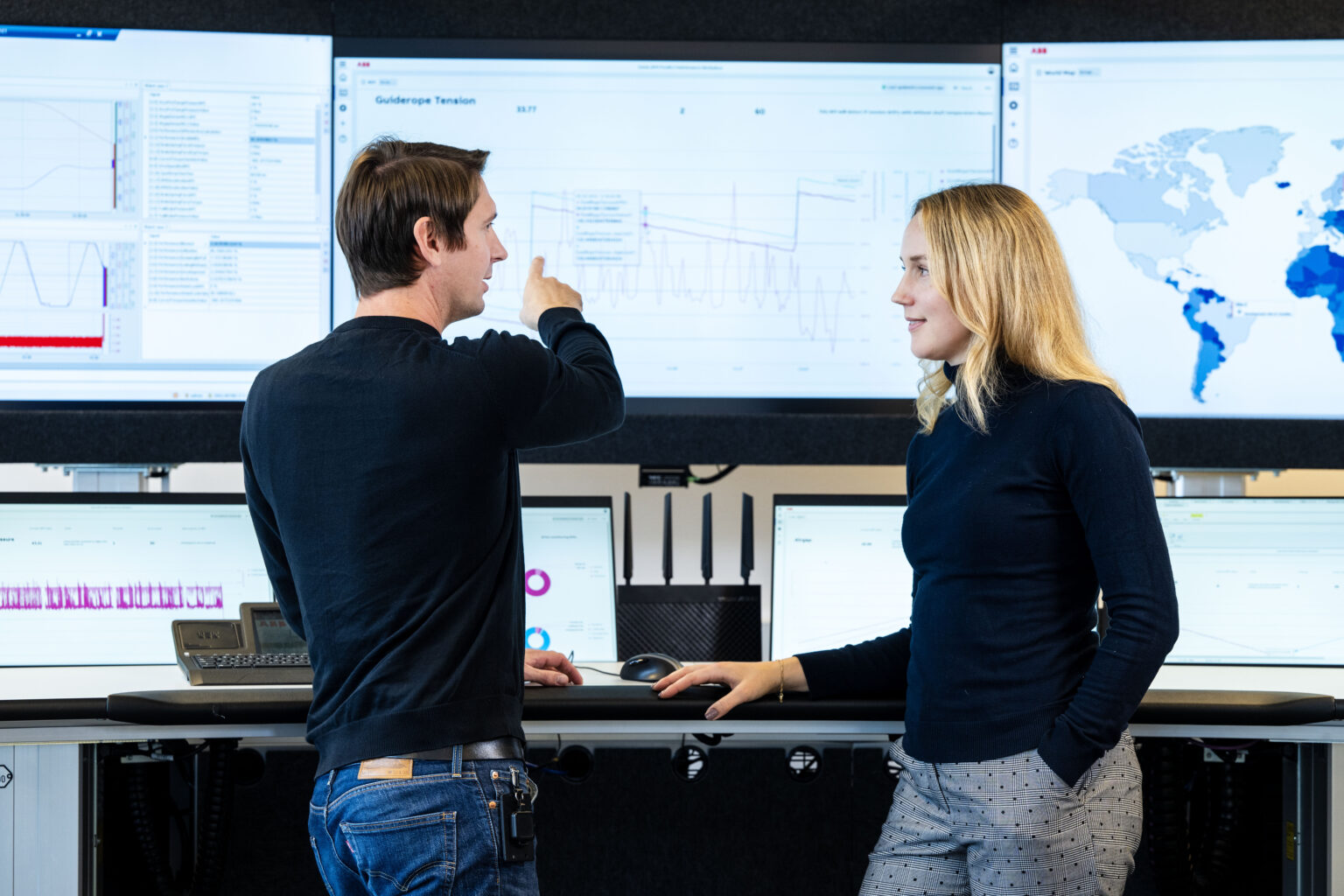
The true value of data analytics is realised when experts interpret the findings and determine the best course of action. The experts located in ABB Ability™ COC play a pivotal role in identifying opportunities for improvement and detecting potential issues.
Routine monitoring and analysis are conducted through dashboards designed to highlight production shortfalls, maintenance concerns, and safety risks. By aggregating data from multiple sites and collaborating with experts in real-time, ABB helps mining companies worldwide boost productivity and efficiency in their hoisting operations.
The ABB Ability™ Smart Hoisting system identifies, categorises and prioritises KPIs across three key areas:
Hoist Performance: It monitors KPIs like hoist capacity and motor speed, triggering alarms if deviations exceed site-specific thresholds, notifying site personnel and ABB experts for remote monitoring.
Safety Brake System: It analyses emergency stops to ensure proper retardation, preventing issues like rope slip or overwinding, and monitors brake valves to avoid unplanned stops.
Hoist Supervision: It tracks position checkpoints and overspeed margins, ensuring proper hoist protection and preventing unwanted imbalances.
ABB Ability™ Safety Plus for hoists solutions can transfer performance data and test results to our advanced digital service ABB Ability™ Smart Hoisting for further analysis. The field data (speed, position, brake pressure, temperature, time, actuator position, etc.) is sensed and subjected to analysis to then allow site engineers to identify any discrepancies or plausibility and take remedial actions.