

Some organisations consider lubrication such a simple task that they assign it to the least-skilled employee on the team. There is no prize for guessing the outcome of this decision: lubrication-related equipment failures, which come at a high cost in the form of replacement and repair expenses, as well as significant process downtime.
In light of this, Lubrication Engineers South Africa advises plant managers to adopt a proven approach: filling the skills gap in lubrication. The company calls on them to implement comprehensive training for all employees who directly or indirectly handle lubricants, in addition to instituting and enforcing quality assurance standards.
By Jimmy Swira
Seven times out of ten, more or less, when rotating equipment like pumps fails in a plant, the root cause is likely to be lubrication-related. Even more intriguing, over 50 percent of those cases are related to human intervention. Lubrication Engineers South Africa shares this statistic.
To put it more bluntly, failure could be down to the competence (or incompetence) of lube technicians or personnel tasked with lubrication.
Cross-contamination related failure
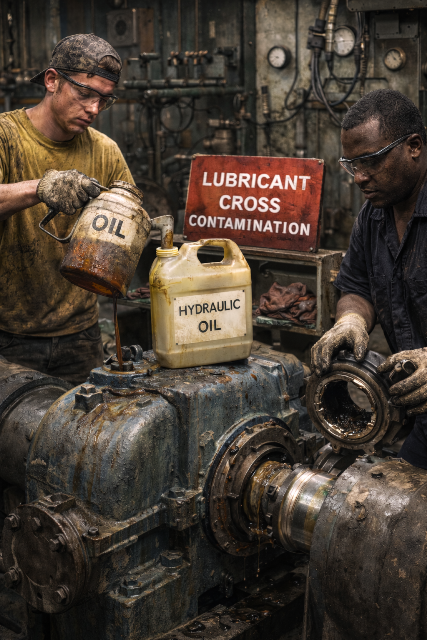
Colin Ford, Managing Director of Lubrication Engineers South Africa and member of the Southern African Institute of Tribology (SAIT), notes: “Most often, it is cross-contamination of lubricants that we find has led to failure. There are also instances of incorrect storage, as well as under- or over-lubrication.”
A skills problem
Truth be told, failure is inevitable when the tendency is to leave the actual task of lubricating machinery to the lowest-skilled operator in the team, Ford adds. “Operators might be given a list of tasks to undertake in sequence and tick off, without being given the ‘how’s’ or ‘why’s’ for each task. However, to be fair, the task is done to the best of the operator’s ability, without knowing the consequences of mistakes – until a breakdown happens.”
Compounding matters for some companies is that even their most experienced staff are more familiar with traditional methods of lubrication, mainly manual. However, the demands of reliability-centred lubrication (RCL) require at least a basic understanding of modern practices and technologies.
Filling the knowledge gap
Fortunately, this situation is not beyond redemption, assures Ford, highlighting two practical ways companies can fill the knowledge gap: instituting and implementing standards, and training.
i. Standards
Organisations should implement a standard that is conveyed to all personnel directly or indirectly involved in plant maintenance, Ford suggests. “From the operator doing the work right through to the finance and buying departments that sign off orders, everyone should work to the same standard. It should be treated the same as Health and Safety standards: everyone who enters the plant goes through induction, and maintenance regimes should work the same way.”
ii. Comprehensive Training
Comprehensive training is central to lubrication, Ford states. “We do not only offer training to our sales team. We include our store manager, finance staff, and delivery drivers to ensure everyone is working off the same page. We also offer this training to our customers and their staff. Cradle-to-grave thought processes within every division should be central to an organisation,” he demonstrates LE SA’s approach, indicating that the training’s ultimate objective is to hone essential competencies in handling core areas in lubrication management.
Core areas in handling lubricant management
Lubrication Engineers (LE) prioritises the following core areas in lubricant management training:
1. Delivery and storage
Training always begins with the delivery and storage of lubricants. Quite often, lubricants are supplied to customers in “old” containers, which can immediately imply that sub-standard lubricants are being delivered. In addition, emphasis is placed on handling lubricants in the storage area to avoid mixing them up. On the significance of this practice, Ford illustrates: “The wrong lubricant in the wrong store can cause confusion and end up being used incorrectly. Once in stores, we recommend colour-coding lubricants to avoid misuse.”
2. Colour coding
Colour coding (or shape coding for those who are colour blind) on machinery helps the operator identify which lubricant goes into which piece of equipment. Education on this practice is essential, Ford stresses. “Implementing colour coding without explaining the reason to operators is as ineffective as buying sub-standard lubricants. Keeping lubricants clean and dry from start to finish will alleviate the majority of breakdowns.”
3. Automated lubrication and correct sample collection
Other important aspects of training are novel technologies like automated lubrication and why it is implemented, and taking oil samples correctly and why this is advisable. Regarding the significance of training in raising awareness and acquisition of new technologies, Ford indicates: “Good operations should always have a ‘new technologies’ forum to discuss emerging technologies, practices, and ways to implement them in the plant.”
Ongoing improvement practice
The reality, though, is that any form of training, though well-intended, is never adequate at any point in time as new challenges always arise. These provide new learning experiences. For this reason, it is paramount that organisations keep their employees up to date with the fast pace of change in the field, and so continuous improvement is integral.
“As with health and safety, when accidents occur, investigations take place and systems are modified to prevent recurrence. The same approach should be applied to lubrication teams whenever breakdowns occur or expected service life is shortened. Calling in specialists to help identify the root cause of failures can also assist in determining the correct way forward,” Ford underlines the significance of continuous improvement to turn skills-related lubrication failure into competence.
Lubrication Engineers South Africa offers training in areas such as storage, colour coding . The company covers all aspects of the cradle-to-grave lifecycle of a lubricant so that organisations can improve reliability and ultimately their bottom line.


