


At the Qurayyat Independent Water Plant in Oman, failures in the offshore intake and outfall system threatened the reliability of critical infrastructure supporting the desalination plant.
The 200,000 m³/day seawater reverse-osmosis facility was partially commissioned in 2018 when significant failures emerged in the newly installed marine system. Two of the four large-diameter HDPE pipelines separated on the seabed, with sections floating to the surface.
Although the plant continued operating partially through the compromised infrastructure, full commercial operation could not be achieved.
WSP was appointed at the end of 2020 to investigate the failures, assess the existing infrastructure and develop a solution that would allow the marine system to be rebuilt while the plant remained operational.
Establishing what had failed
Before a replacement strategy could be developed, the condition and configuration of the existing infrastructure had to be established.
The project was complicated by incomplete marine as-built information, buried infrastructure and limited access to some components. The condition of the remaining pipelines also had to be assessed to determine which sections could safely be retained.
“Before designing a replacement, we needed a reliable picture of the infrastructure already in place. That was more difficult than it sounds,” said Marthinus Retief, Director & Deputy Sector Lead for Maritime, WSP in Africa.
One of the key investigations involved an internal inspection of approximately 1.9 km of pipeline using a remotely operated vehicle (ROV) with a tether exceeding 2 km.

The inspection identified important information about the existing system, including level discrepancies introduced during the original construction. These findings were incorporated into the hydraulic design and helped determine which components could remain in service.
The investigation formed part of a wider assessment of 11 potential solutions, which were developed, costed and evaluated before the preferred rehabilitation strategy was selected.

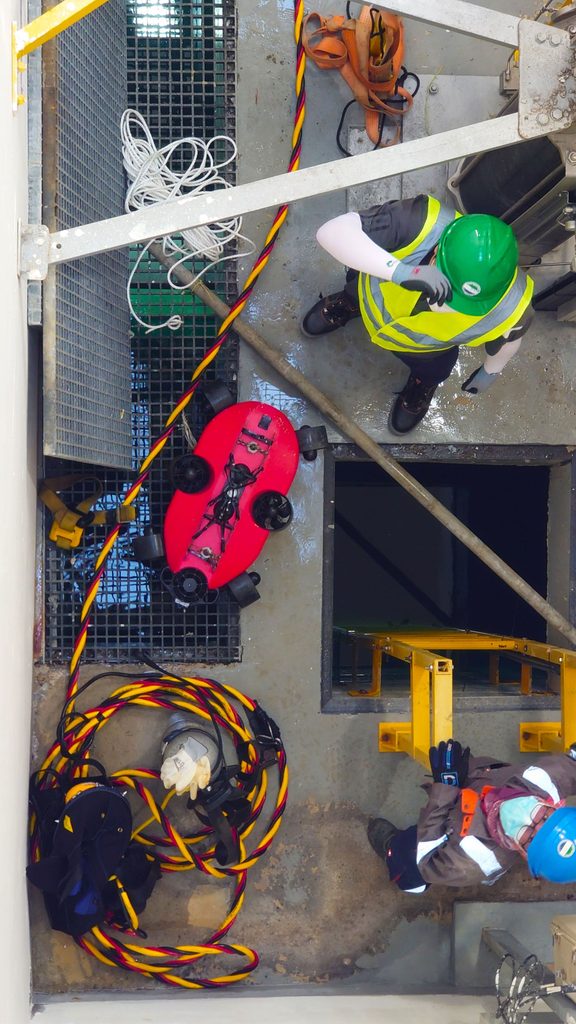
5 ROV for internal pipeline inspection ((Image credits: WSP)
Designing for reliability
The marine environment presented another major consideration. Real-time metocean data and numerical oceanographic models were used to assess waves, currents and other loading conditions.
The design also considered extreme conditions associated with tropical cyclones and potential tsunami waves originating from the Makran subduction zone north of the Gulf of Oman.
The final solution involved rebuilding two 2.5 m-diameter intake pipelines and two 1.8 m-diameter outfall pipelines. Each HDPE pipeline extends approximately 900 m offshore, terminating at an intake structure or brine diffuser.
“Hydrodynamic stability was a key consideration because the design loading varies along the pipelines with water depth, pipe angle, and wave behaviour. Concrete weight collars were therefore used to stabilise the pipelines on the seabed,” said Retief.
The two offshore intake towers were also designed with installation and loading requirements in mind. Each structure is approximately 5.8 m in diameter, 12.4 m high and weighs around 230 tonnes. Rather than installing each tower as a single unit, the structures were divided into three segments, reducing the marine lifting requirements.
Working around existing infrastructure
Rehabilitation of an existing marine system inevitably involves uncertainties, particularly where information about buried infrastructure is incomplete.
The locations of four buried offshore pipeline flanges were initially unknown. Historical records, diver accounts, construction photographs, ROV data and satellite imagery were used to establish their likely positions.
“The locations of four buried offshore pipeline flanges were initially unknown. Our team, together with the client and contractor pieced together partial historical records, diver accounts, previous construction photographs, ROV data, and satellite imagery to narrow down their likely positions,” said Gerhard Kapp, Resident Engineer on the project site.
Once the existing flanges had been exposed, the connection strategy was revised. Spool pieces were designed with sufficient tolerance to accommodate alignment differences between the existing and new pipeline systems.
The approach reduced the construction risk associated with connecting the new infrastructure to the existing system.
Maintaining plant operation
One of the biggest challenges was rebuilding the marine system without disrupting the operating desalination plant.
The construction programme included approximately 240,000 m³ of seabed dredging to install the four pipelines. Dredging created the potential for elevated turbidity to affect the temporary intakes supplying the operating plant.
Continuous offshore monitoring stations and heavy-duty silt curtains were therefore used to monitor and control the risk.
“No plant production was lost as a result of the dredging works, and the project recorded no noteworthy environmental incident during the 20-month construction period,” said Kapp.
The marine works also involved underwater connections, diving operations and heavy marine equipment working alongside existing infrastructure.
Restoring the system
The four new seabed connections were completed six days ahead of schedule, allowing commercial-operation testing to begin earlier than planned.
The Qurayyat Independent Water Plant achieved its official Commercial Operation Date on 28 November 2025, 92 days ahead of the required date.
The marine works formed part of a wider restoration programme valued at approximately US$80 million, which was required to bring the facility to full commercial operation.
The project demonstrates the challenges involved in restoring reliability to critical infrastructure when the original failure mechanism is not immediately clear, asset information is incomplete and the plant cannot simply be taken offline.
For maintenance and reliability teams, the lesson extends beyond desalination plants: effective rehabilitation begins with understanding the condition and failure history of existing assets, followed by a risk-based decision on what should be retained, repaired, modified or replaced.
The Qurayyat Independent Water Plant Marine Works project subsequently received a Highly Commended award in the Technical Excellence – International Project of the Year category at the 2026 SAICE National Awards.
This information for this article has been sourced from a press release submitted by Ink & Co on behalf of WSP Africa and adapted for Machinery Maintenance Matters