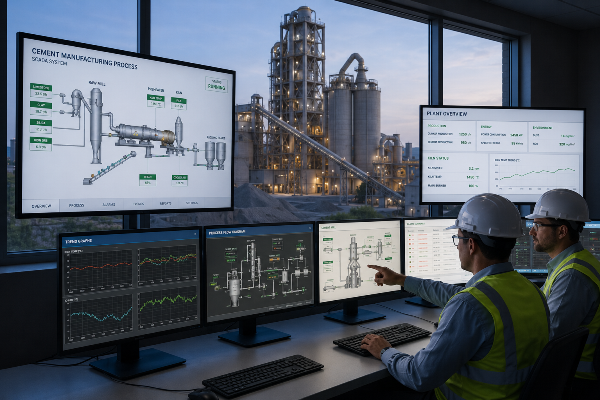

Consistently collecting and interpreting data is critical to optimising efficiency and productivity when operating and maintaining boilers. Remote monitoring systems – particularly for large steam users – are integral to both effective management and safety according to Dennis Williams, Commercial Director of leading operations and maintenance service provider,Associated Energy Services (AES).
Williams explains: “If we do not measure it, we cannot manage it. If we do not analyse it, we cannot act on it. Through understanding what we are seeing in the data, we can make improvements and troubleshoot issues effectively.”
In the past, on-site boiler operators acted as ‘overseers’ (and still do when companies rely on variable solid fuels). Today, AES’s bespoke remote monitoring system (RMS) transmits alarms and notifications digitally. This allows AES experts, operating remotely, to view data from on-site operations and identify any required actions.
All-inclusive remote monitoring
“We strongly recommend that all manufacturers maximise the use of control systems and remote monitoring system technology as fuel costs, emissions controls and other pressures all benefit from better control, even on stable steam loads,” Williams advises.
Unfortunately, although many manufacturers rely on state-of-the-art production management systems and visualisation tools for recording and analysing production data, many do not include their boilers into these systems or the data is not analysed and learnings are not looped back to boiler controls.

On South Africa’s older boiler plants, control systems can be updated to ensure stable operation within dynamic systems and direct activities. AES’s RMS provides added value as a critical user interface which records, transmits and stores data from boilers for analysis. Although these control systems operate independently, the systems combine to provide pivotal technical and operational insights.

“It is easy to forget that the generation and use of steam from a boiler – a pressure vessel – is a potentially dangerous activity and that suitable care, skill and caution should be exercised. AES has over 25 years of steam boiler operations and maintenance experience; as well as detailed management systems covering occupational health and safety (OHS) and the environment,” he points out.
The same goes for downtime, which ratchets up production costs within companies that are already battling high input costs: “Every input can have an impact on operations, so data is key – from the change in flue gas temperature to the variations in fan current draw. After an incident, we must understand the root cause and prevent a recurrence,” he adds.
Steam demands and energy management
AES utilises its RMS on all outsourced client sites. Each user has a unique steam demand profile, based on individual operational requirements: “A mismatch in steam demand versus supply manifests in a change in steam system pressure. If less steam is generated and supplied, versus production demands, then the steam pressure will drop. A better control system, operated according to an advanced control methodology, will allow the boiler system to react quicker – providing more efficient combustion – and therefore supply the steam timeously, maintaining steam pressure while also achieving efficient use of fuel,” Williams explains.
AES frequently discovers that manufacturers incorrectly rely on a single fuel-to-product usage ratio to capture energy metrics and performance.
Additionally, failure to undertake regular – and correct – energy management assessments hasmassive safety implications, Williams warns – and failure to conduct comprehensive and accurate operational performance evaluations also results in higher operating costs (fuel and maintenance), increased plant downtime, a higher carbon footprint and reduces the lifespan of plant.
As effective energy management requires consistent effort and intervention, AES’s excellent experience, expertise, systems and methodologies are constantly applied – including via remote monitoring.
Equilibrium through remote monitoring
Furthermore, if multiple boilers work together to meet on-site steam demand, a strategy is needed to co-ordinate these, forming a balanced boiler management system.
Although control systems are required for every boiler – and manual intervention can be impractical, unsafe and illegal – the complexity and sophistication of control systems varies. A bespoke AES load balancing system together with remote monitoring ensures an essential equilibrium.
This applies especially to production facilities such as food and beverage production and batch manufacturing – where steam demand fluctuates significantly – especially if fuel is highly variable and there are frequent equipment changes.
“Control is about minimising the variation between ideal operating parameters (percentage of excess air, fuel delivery rate, feed water temperature and flow) and the actual operating parameters achieved under operational loads. Inefficiencies need to be minimised, to maximise stability of steam pressure and optimise combustion to minimise emissions,” Williams explains.
Steaming into the future
AES is continually expanding the capabilities of its systems and processes – especially when it comes to the RMS. An example of this is the integration of stack camera feeds to provide a record of emissions performance.
“Our RMS has really become a ‘must-have’, integral part of the clients’ sites which AES manages, for effective boiler maintenance and management,” Williams concludes.