


Organisations often commit the folly of approaching maintenance the same way and expecting different results – frustratingly, to no avail. For instance, even headhunting the most skilled engineers and other critical talent doesn’t improve reliability.
To address this problem, Allan Champion, Managing Director of Champion Asset Care & Supervision (CACS), urges organisations to return to the basics of maintenance planning: shared responsibility, individual accountability, and continuous improvement.
By Jimmy Swira
Isn’t this baffling?
Some industrial operations have the tried and tested Enterprise Resource Planning software and other most advanced remote monitoring tools, the cream of talented personnel, and a substantial OPEX budget. Yet, despite having these assets, they face intermittent, unscheduled shutdowns at their mission-critical plants with worrying persistence. And at a huge cost, considering the downtime, costly equipment replacement and repair costs.
Then, why do the organisations seem to fail to do a basic root cause analysis to get to the bottom of the problem?
Not peculiar
To Allan Champion, Founder & Managing Director of Champion Asset Care & Supervision (CACS), this is not peculiar. In his over 35 years of experience, he has reviewed the maintenance cultures in diverse organisations in mining and heavy industry in South Africa and the region.
Based on his observations, he describes the nature of significant reliability challenges as rather systemic than technical, attributing them to the lack of shared understanding and a collection of basic issues.
Significant challenges
Based on his observations, Champion describes the nature of significant reliability challenges as rather systemic than technical, attributing them to the lack of shared understanding and a collection of basic issues.
-
Lack of shared understanding
Generally, there is a lack of understanding between operations and maintenance, which is manifest through ongoing conflict. This perpetuates a reactive, firefighting culture.
As a result, planning and scheduling discipline deteriorates, and outdated or poor-quality data is frequently used to configure CMMS systems. “Generally, where there is lack of shared understanding, maintenance teams remain busy, but ineffective reinforcing the well-known ‘busy fools’ adage,” Champion laments.
-
Other common challenges
In addition to the lack of understanding are the following common challenges:
· Poor supervision
· Maintenance tactics developed without proper asset criticality analysis
· Over-maintenance
· Ineffective spare parts management
· Repeat failures
· Superficial or “watered-down” Root Cause Analysis (RCA)
Champion observes that, more often than not, these problems are bound to occur when organisations assume that relying heavily on technology and individual technical skills and cutting-edge technology can deliver consistent maintenance and ensure asset reliability.
Capability is not competence
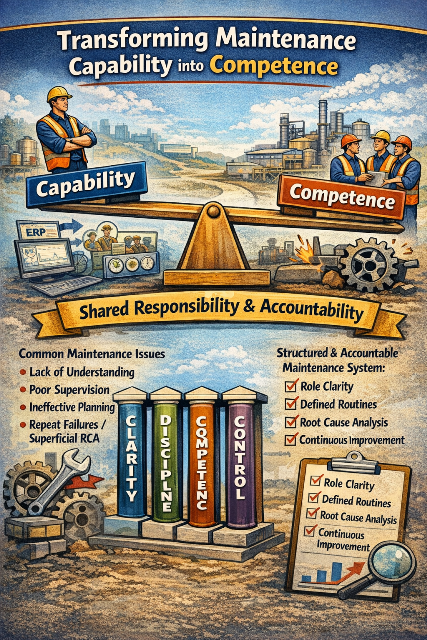
Debunking the flawed approach, he stresses: “Capable individuals do not make a competent team. An operation can have individuals with the required technical skills yet lacking the organisational systems to help them turn those skills into consistent results. In other words, capability is not competence.”
In many cases, Champion adds, the following basic elements are overlooked in maintenance plans of operations experiencing chronic problems:
· Clear role definition
· Defined decision rights (responsibility without authority is ineffective).
· Structured maintenance routines.
· Leadership alignment through a coherent maintenance strategy
The attitude problem
Another problem pervasive in operations is the misplaced approach to implementing maintenance plans. More often than not, maintenance plans are treated as documents, rather than embedded behaviours and routines that define how work is done every day. Small wonder, many plans, though well-structured, fail.
'Building Capability, Not Dependency'
Unfortunately, such is the reality of modern maintenance. Fortunately, it can be addressed, assures Champion, illustrating how CACS helps operations turn around their maintenance.
On how CACS transforms the capability of personnel into competence, Champion explains: “At Champion Asset Care & Supervision (CACS), our focus is on building capability, not dependency. We work alongside on-site teams, embedding practical systems and behaviours until the desired outcomes become the normal way of working.”
Four core pillars
The consultancy’s approach is anchored on the following four core pillars:
· Clarity – Clear asset strategies, role definitions, and decision frameworks
· Discipline – Structured planning, scheduling, and execution routines
· Competence – Targeted skills development aligned with role requirements
· Control – Practical performance metrics with the right KPIs driving the right behaviours
The ultimate outcome is to ensure that the personnel take ownership of the maintenance plan to ensure meticulous implementation.
Champion highlights three focus areas that this entails: “Our gap assessments are focused on supervisory capability and understanding; we prioritise mentoring and coaching rather than classroom-only training (courses transfer knowledge; mentoring builds capability); and we ensure a solid understanding and practical application of basic RCA.”
The building blocks
Every block should be in place in building capable teams. Champion mentions the vital ones:
“First is leadership behaviours. This is what leaders prioritise, tolerate, and reinforce.
“Second is work management discipline encompassing planning, scheduling and backlog control.
“The third one is role clarity and accountability, which necessitates effective cooperation between production and maintenance.
“Last but not least is continuous improvement, whose objective would be ensuring effective cooperation and elimination of repeat failures.
“In the end, capability improves when people understand why the work is done, not just how.”
Assessing progress
It is one thing implementing measures, totally another achieving the desired outcomes. Aware of this, CACS has devised measures to assess the level of progress made (if any), Champion states. “We deliberately balance lagging and leading indicators. The lagging indicators entail availability, reliability, and maintenance cost performance. Leading indicators involve schedule compliance, backlog health, and failure elimination effectiveness. In the end, this balanced approach ensures both results and behaviours are measured.”
‘Standard principles, not solutions’
CACS is cognisant that operations may be similar, but each has unique maintenance challenges. “It’s a fact that, while asset classes and processes may be similar, each operation’s context – commodity, operating philosophy, workforce maturity, and risk profile – is unique,” Champion acknowledges.
Accordingly, the consultancy handles this by applying standard principles, not standard solutions. This involves carrying out a structured diagnostic to assess maintenance maturity, operational constraints, supervisory competence, and operational culture. From there, bespoke interventions tailored to the specific operation are developed, while remaining aligned with recognised best practices.
Champion Asset Care & Supervision (CACS) is based in Johannesburg and services clients in South Africa and the region.