

Dissolved Gas Analysis is used mostly for fault detection in transformers, and it is critically important that the analysis is accurate.
For power utilities and heavy industry, a failed transformer is rarely just a maintenance incident; it is a production outage, a grid constraint, and a safety risk. Dissolved Gas Analysis (DGA) is one of the powerful laboratory tools used for identifying transformer faults before they become failures.
Transformers help to transfer electricity over long distances, often playing key roles in the infrastructure of a region and ensuring power supply to cities, industrial plants and other critical users. Therefore, implementing a condition monitoring programme that facilitates early detection of faults and potential failures is very important.
Over many decades, specialist condition monitoring company, WearCheck, has invested in laboratory equipment, test methods, interpretation frameworks, and digital reporting that make DGA faster, clearer, and more actionable for asset owners who need predictable uptime.
Gert Nel, transformer division manager for WearCheck, outlines how his team has tailored DGA for wind and solar generators, utilities, mining, metals, petrochemicals and manufacturing; what the technique detects; how results are turned into ranked interventions; and the milestones that have helped customers transition from calendar-based oil testing to predictive maintenance.

Nel emphasises that it is important that a range of tests is conducted, rather than only DGA, to gain a holistic view of a transformer’s health. ‘A complete picture of the transformer’s condition emerges when DGA is combined with oil quality testing (dissolved water content, acidity, dielectric breakdown voltage, interfacial tension (IFT), inhibitor content, Tan Delta, DC resistivity, metals) and furan analysis (paper ageing markers such as 2-FAL). This data helps us sharpen the diagnosis from “something is wrong” to “this is what is wrong, here’s the risk, and here’s the next step.” This article, however, focuses largely on DGA.’

What DGA does - and why it matters
Electrical and thermal stresses inside an oil-filled transformer break down insulating oil and paper into characteristic gases: hydrogen (H₂), methane (CH₄), ethane (C₂H₆), ethylene (C₂H₄), acetylene (C₂H₂), carbon monoxide (CO) and carbon dioxide (CO₂), among others. The pattern and rate of change of these gases reveal failure modes long before external symptoms appear. Dissolved Gas Analysis provides the data on the pattern and rate of change.
Says Nel, ‘Dissolved Gas Analysis is used mostly for fault detection in transformers, and it is critically important that the analysis is accurate. By analysing the gases dissolved in the transformer’s oil, we gain important clues about the health of the transformer.
‘DGA saves transformer operators money on avoidable repairs, time, and helps avoid greater problems such as interrupted power supply. It also helps prolong the life of the transformer.
Nel explains the process, ‘Small amounts of gases are formed in the oil when a transformer is in operation. Using DGA, hidden problems inside the transformer are revealed by detecting the gases in the oil.
‘Some of the common transformer problems and the associated gases include oil overheating (ethane and ethylene), insulation paper overheating (carbon monoxide, carbon dioxide, and acetic acid gases), air ingress (oxygen and nitrogen), and partial discharge (hydrogen gas and carbon monoxide gases), sparking and arcing type of faults (methane and acetylene).
‘The early detection of potential transformer faults enables remedial action to be implemented, and major failures averted. It is always better to plan a shutdown rather than have a sudden failure.’
Different fault processes generate different gas “fingerprints”. For example:
- Partial discharge (PD): typically elevates H₂ and modest hydrocarbons.
- Low-temperature overheating (hot spots in oil or paper): rising CH₄/C₂H₆ at lower ratios.
- High-temperature thermal faults (arcing at windings or leads): ethylene and, at severe levels, acetylene.
- Cellulose degradation: elevated CO/CO₂ ratios and trends indicating paper ageing.
- Tap-changer distress: gas signatures that, together with oil quality data, flag diverter-switch issues.
DGA is sensitive enough to detect micro-faults, and repeat sampling lets engineers distinguish “background” gassing from an emerging defect.
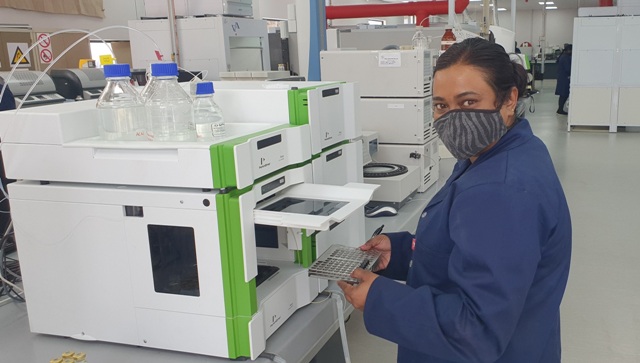
furan analysis on transformer oil using a state-of-the-art HPLC
(high performance liquid chromatography) instrument.
Tailored for utilities and heavy industry
Power utilities and energy-intensive plants face specific practicalities: large fleets with mixed vintages, constrained shutdown windows, harsh environments, and the need to justify interventions with evidence. To accommodate varied operating conditions, WearCheck’s DGA service is designed around four pillars:
-
Sampling discipline that fits the plant reality
WearCheck provides sampling hardware, step-by-step procedures, and refresher training to ensure representative draws – from main tanks, on-load tap-changers (OLTCs) and sister units – while minimising air ingress.
-
Fast, repeatable analytics
Laboratory DGA by gas chromatography is performed with rigorous quality control, repeat measurement where anomalies occur, and flagged re-runs when atmospheric contamination is suspected. Dissolved water content is quantified by Karl Fischer titration for accuracy at low ppm.
-
Interpretation frameworks that engineers trust
Results are interpreted using recognised methods (ratios, key gas analysis, total dissolved combustible gas thresholds, and multi-factor fault mapping), applied as guidelines and tempered with fleet context, oil history, operating duty and recent switching events. For OLTCs, WearCheck uses tailored rules that separate arcing behaviour from main-tank thermal trends.
-
Actionable reporting, not just numbers
Reports rank units by risk, highlight rate of change, and recommend next actions (accelerated resample, thermal scan, targeted inspection, OLTC service, dielectric refurbishment, load reduction) with suggested timeframes. Reporting dashboards group assets by site, class and criticality.
on transformer oil samples using a GC (gas chromatograph), in the company’s Durban laboratory.
Milestones on the journey from testing to prediction
WearCheck’s transformer team has logged several practical milestones that have changed how customers use DGA:
DGA accreditation
In 2025, WearCheck earned IEC 17025:2017 accreditation to certify DGA results for transformers, following an assessment by SANAS (South African National Accreditation System).
The company’s Johannesburg transformer oil testing laboratory now has IEC 17025:2017 accreditation for testing DGA, dissolved water content, acidity, dielectric strength, and PCBs (polychlorinated biphenyls). Accreditation for the Durban laboratory is on the cards for Q1 2026.
Nel is proud of his team’s achievements. ‘WearCheck is pioneering the way in transformer maintenance in Southern Africa, and this SANAS accreditation is a powerful attribute for our laboratories.’
Additionally, the company has launched regular training courses for clients. Nel conducts a four-hour online training course every three months, covering the tests, why they are conducted, what data the results provide and a deep dive into the report. Full-day on-site transformer training courses are also available and have been conducted in South Africa and other African countries, where WearCheck’s transformer services are used.
Furthermore, WearCheck regularly invests in state-of-the-art laboratory equipment for its transformer laboratories to ensure that sample turnaround time is kept to a minimum. Accuracy of results is always a major priority, and instruments are regularly calibrated to ensure standard data is produced. All WearCheck’s transformer oil testing laboratories participate in local and international Proficiency Testing Schemes to ensure validity of results.
Case studies and sample frequency
Nel recommends that for routine transformer maintenance, the transformer oil is sampled once a year. If any potential issues are flagged, samples should be tested every three months. However, there are exceptions, and scheduled maintenance is always preferable to catastrophic failure.
- Client A depends on a transformer to keep a very large operation going. DGA is currently being conducted on the transformer oil every seven days, because the transformer exhibited potentially problematic gas levels. However, to shut the transformer down would cause major workflow stoppage. While a new transformer has been ordered, the existing one must work until the replacement arrives, therefore frequent monitoring is necessary and critical.