
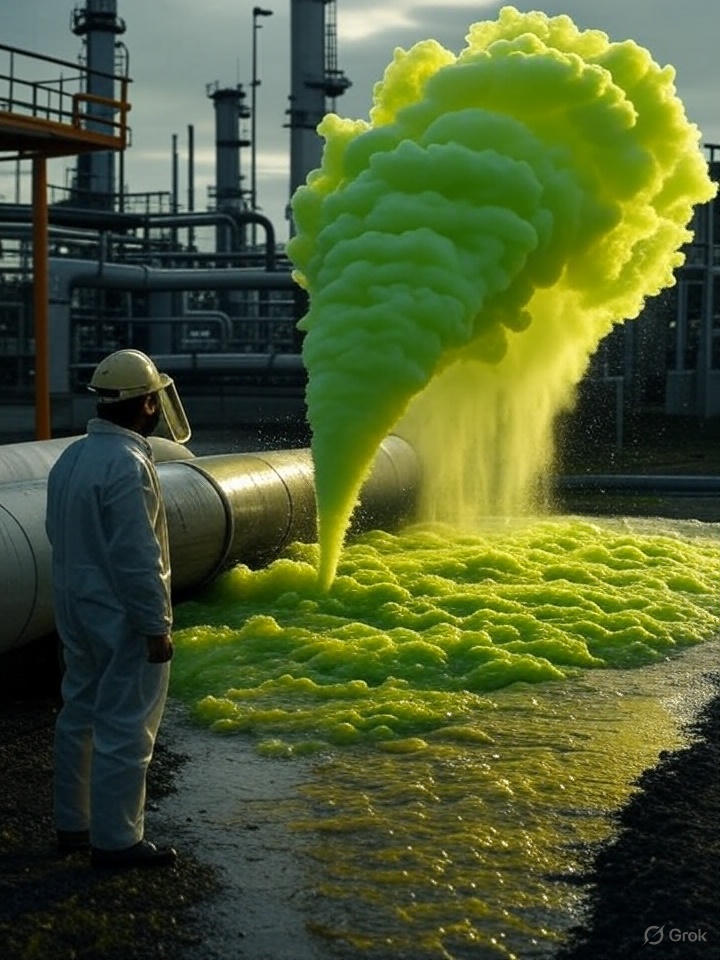

An overlooked defect in a pressure vessel can result in catastrophic downtime, financial loss, and safety risks.
The good part is that adherence to best practices, guided inspection planning, and the correct use of non-destructive testing (NDT) can prevent failure/can minimise the occurrence of failure.
It is down to making the right decision.

By Jimmy Swira
Ask any reliability manager: there is no worse feeling than dealing with the consequences of a problem that could have been avoided by following best maintenance practices from the outset. It is that sinking regret of “I should have done better.” Worse still is the heavy burden that follows when the issue results in significant financial losses or safety risks.
This could apply to a seemingly minor defect – overlooked or undetected – in a petrochemical plant in Mozambique or a smelter in Zambia’s Copperbelt. The pressure vessel (PV) could be a tank, pipe, or similar structure.
So, how can such situations be avoided?
“Stick to the basics,” aptly responds Mark Digby, Training Manager at the Southern African Institute of Welders (SAIW), stressing the importance of having a comprehensive inspection plan in place.
This assumes the pressure vessel passed all fabrication requirements: done by a competent person, in line with applicable standards, and was certified fit for operation by a qualified third-party inspector during commissioning.
Even so, perfect fabrication is not enough. Typically, once in operation, the vessel is exposed to stress, fluctuating temperatures, corrosion, and material fatigue. These factors gradually degrade performance.
The reality is that, without ongoing inspection and maintenance, even the most perfectly built vessel can become a serious operational risk. In fact, it is better to err on the side of caution.

Ongoing maintenance critical
Wear and tear is inevitable during service. That is why it is critical to implement a well-structured maintenance plan. This helps ensure operational availability by maximising uptime and minimising downtime.
With proper planning, early signs of material degradation due to corrosion, creep, or embrittlement can be detected and addressed before they escalate.
Otherwise, if left unchecked, such issues can halt operations and result in costly downtime. This could be an unpleasant experience to bear for the reliability and maintenance team at the height of production.
Tools for Effective Pressure Vessel NDT
Hence, the decision to do the right thing is entirely in the hands of reliability and maintenance managers. Various non-destructive testing (NDT) methods are available. These can be incorporated into predictive maintenance programmes to mitigate failure, Digby points out.
“Ultrasonic wall thickness testing assesses remaining thickness over time. Magnetic particle or dye penetrant testing helps evaluate the surface condition of the material. And manual or phased array UT testing focuses on highly stressed areas of welds and load-bearing structures,” he explains.
Interventions must be sought timeously before problems worsen. “In-service inspection planning should start even before the vessel is taken offline. While the plant is still operational, techniques such as infrared thermography can be used,” Digby suggests.
As the industry cliche of choice goes, “No one size fits all”, the appropriate method depends on the location of potential flaws and the expected failure mechanism – whether surface or subsurface – according to fracture mechanics assessments.
Key takeaways
The long and the short is – Pressure vessels may appear robust, but beneath the surface, time and stress are always doing their work, unnoticed.
Granted, perfect fabrication ensures that a tank or pipe is in good condition. However, it does not guarantee protection against the risks of deterioration.
With a rigorous inspection regime and a proactive approach to in-service maintenance, reliability managers can prevent minor flaws from becoming major failures. It is important to stick to the basics, such as planned inspections, proper fabrication oversight, and appropriate NDT methods. In high-risk environments like heavy industry, best practice is the line between uptime and avoidable disaster.


