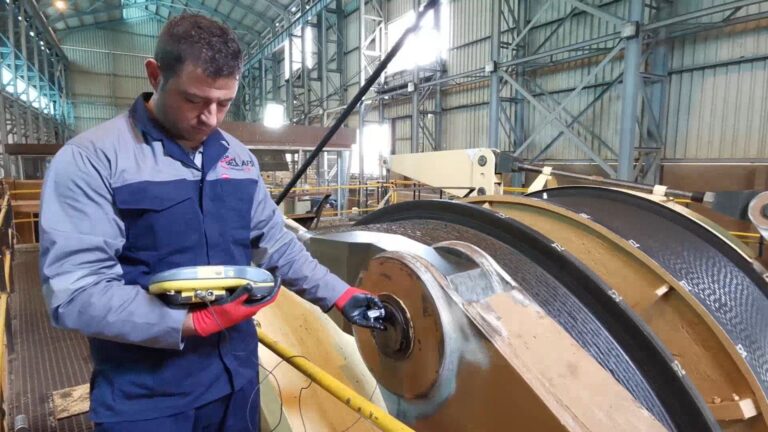

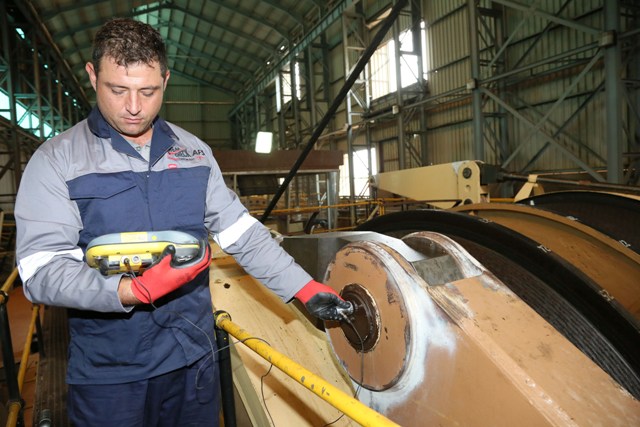

While scientific analysis of used oil samples remains the core business of condition monitoring specialist, WearCheck, a wide range of complementary assessment techniques enables the company to provide a holistic view on the health of an asset.
The company’s asset reliability care (ARC) division incorporates specialist monitoring techniques such as rope testing, technical compliance and non-destructive testing (NDT).
“The NDT approach features a variety of testing techniques through which the properties and condition of a component or system are evaluated without causing any permanent damage to it,” explains Adri Ludick, NDT manager for WearCheck.

‘NDT is typically used in critical component assessments, machine condition assessments, and inspection of ancillary equipment such as main vent fans, compressors, mills, pumps and conveyors.
“One of the jobs of the WearCheck NDT team is to deliver quality assurance and quality control assessment of new components as well as refurbished ones.
“We can conduct various NDT tests, depending on the component in question. Our selection of NDT tests includes eddy current testing, magnetic particle testing, liquid penetrant testing, radiographic testing, ultrasonic testing and visual inspection,” says Ludick.
The main advantage of NDT methods is that they do not permanently alter the test object undergoing inspection, making NDT a valuable tool that can save both money and time in a condition monitoring programme.
The selection of which techniques to deploy depends on the machine, the suspected problem/s or evident faults, and the circumstances in which the component operates. In some cases, just one technique is sufficient, while in others, two or more assessments are conducted, to validate results and assist maintenance teams to make informed decisions.
Some of the NDT techniques include the following:
Eddy current testing
This detects surface defects, such as early-stage cracks, on metallic machine components, and is used across a wide range of industries, from aerospace to beer brewing.
During the testing process, a high-frequency electric current (an eddy current) is induced into the material, then the response of that eddy current field is measured. The information is processed to yield a profile of the component.
Defect-free material has a very specific “fingerprint”, therefore, when the test results are compared to this, the presence of defects can be assessed.
When it comes to cracks, the earlier they can be detected, the less potential damage they can cause to the component. Eddy-current testing can detect crack initiation at extremely early stages.
An advanced option is the phased array eddy current testing, which creates a 3D picture of the component, giving a more visual insight into anomalies.
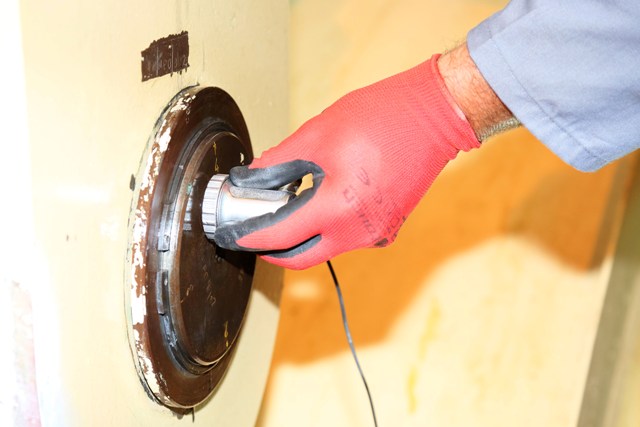
Here, ultrasonic testing is conducted with a single crystal probe. The WearCheck technician assess the internal composition by means of ultrasonic waves being inducted into the material of the brake component shaft to ensure no defects are present.
Magnetic particle testing
This is a similar application to eddy-current testing, in that both techniques detect surface cracks on magnetic materials. This is used across a wide range of industries.
The process in this test is to magnetise the component and then saturate it with a very fine magnetised ink or a fine powder.
Any anomaly in the surface being tested causes a concentration of the magnetic field around it, therefore drawing the magnetic ink to the crack and making the defect visually detectable. (Eddy-current testing requires the interpretation of a signal on an oscilloscope screen.)
An advantage of magnetic particle testing is that it can be used to test very large surface areas, very quickly.
Liquid penetrant testing
This is typically performed on non-magnetic materials (e.g., copper, aluminium), and is essentially a non-magnetic version of magnetic particle testing.
It involves a five-step process. Firstly, the surface is cleaned of all foreign material. Next, it is saturated with a non-harmful penetrating ink. The surface does not have to be horizontal. Thirdly, the penetrant is wiped off the surface of the material. Fourth, a developing chemical is applied over the ink. The developer draws the penetrant from any cracks to form a visible indication. In the fifth step, the component surface is visually examined during and after the development process and results are recorded.
This method is used to test such items as vehicle components and ventilation fan blades.
Radiographic testing
This is similar to X-rays done on humans and uses different types of X-ray sources which penetrate the material and display onto an X-ray plate behind the component. It is a widely used technique which detects sub-surface defects which cannot be detected visually.
For thinner materials, such as a metal plate, a weak X-ray source is used, while thicker components (e.g., ventilation fan) require a stronger X-ray. The X-ray sources are contained in a “bomb”, which is aimed at the target.
Radiographic testing is often used on welds to test the integrity of the bond between the weld metal and the parent metal. Using an electronic form plate instead of a photographic form is a new trend in this technique.
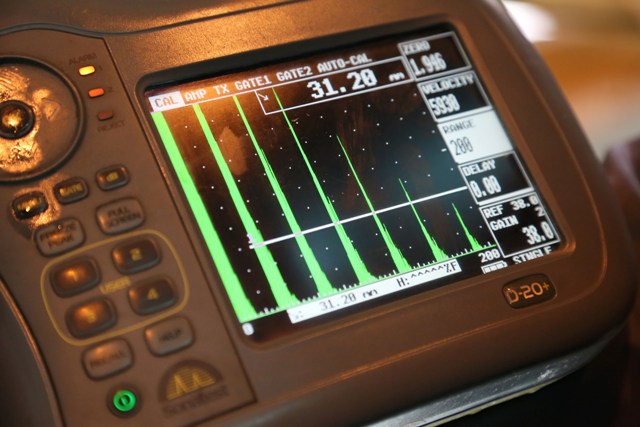
On this ultrasonic testing machine, the reading is displaying a background echo of the brake component and any variations inside the material of the brake component, during NDT testing by WearCheck.
Ultrasonic testing
Just how a “fish finder” on a fishing boat reveals the depth and size of the fish, this uses similar methodology, allowing technicians to see sub-surface defects in both metal and non-metal components.
During the process, an ultrasonic flaw detector instrument fires ultrasonic pulses into the material, and simultaneously detects the reflection. By measuring the time difference between the pulse and the reflection and knowing the speed of sound in the test material, you can pinpoint the location of the defect.
It is widely used across all industries to detect anomalies.
An advanced option is phased array ultrasonic testing, where, instead of one pulse, 64 pulses are fired into the component. By fine-tuning the pulse-strength, we can “steer” the beam in different directions. The advanced option enables us to get a 3D picture of the component, instead of merely a pulse on a screen.
Visual inspection
WearCheck’s highly experienced, well-trained technicians conduct a multitude of visual inspections on a range of components daily. Their eyes are conditioned to recognise early-stage defects which are visible, and to identify potential “hotspots” which require further testing.
In addition to traditional used oil analysis, many other fluid samples are analysed in WearCheck’s laboratories – fluids such as greases, coolants, fuels and more. Trace elements in the fluid samples provides important clues about the wear patterns of the component, enabling maintenance teams to address any concerns before catastrophic failure occurs. In addition to this and the asset reliability care services, the company’s technicians also perform transformer oil testing, water testing and lubricant-enabled reliability services.
Ludick highlights the benefits of regular condition monitoring, “By ascertaining the health of machinery on an ongoing basis, potential failures can be averted before they occur. With today’s technology, we can predict impending disasters in advance, giving the time for repairs to be conducted at an early stage.
“The major benefit of this process is that the availability of machinery is significantly higher than without condition monitoring. Making a small investment into a programme which includes NDT generates notable returns to the bottom line, as equipment availability is enhanced, which has a ripple effect on the entire production line.”
For more information, please visit www.wearcheck.co.za, email marketing@wearcheck.co.za or call WearCheck on +27 (31) 700-5460.