
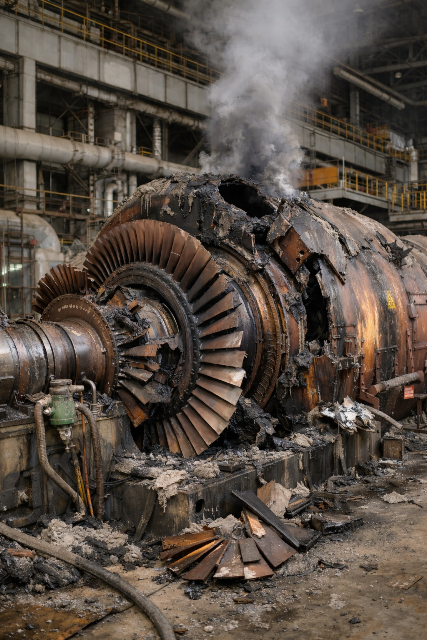

When you schedule maintenance for your mission-critical equipment but fail to do it, you are only postponing the inevitable , and often at a colossal cost.
By Jimmy Swira
By You won’t be faulted for thinking that the great Albert Einstein had the African heavy industry in mind when he coined that gem of wisdom: The folly of doing things the same way and expecting different results.
Some companies experience frequent equipment failures that disrupt production, yet do not revise their approach to maintenance. This beggars belief: Why would they ignore logic?
Grounds for undermining maintenance
The grounds on which different organisations make decisions that undermine pertinent maintenance programmes vary, but the following are the most common:
1. Budget limitations (or lack of it)
There are cases where the finance department in an organisation doesn’t consider maintenance a top priority. Funding requests may be summarily rejected: ‘We don’t have the funds for that’, or the more polite alternative: ‘funds don’t permit. So, this may only be possible in the next quarter, and – even then – we can’t really guarantee’.

The situation becomes worse when a new CEO embarks on a cost-cutting spree targeting operating expenditure (OPEX), and the maintenance budget is identified as an easy target. Available financial resources are then channelled toward areas deemed essential or core.
Ostensibly, this approach is regarded as a viable cost-saving measure. However, it is only a matter of time before any envisaged gains – if any – are negated. That is when the reality of total failure cruelly wakes the prudent finance team out of the slumber of self-deception.

The South African Institute of Tribology (SAIT) highlighted this in an article published by Machinery Maintenance Matters in mid-2025. The association lamented the tendency of management to reduce maintenance budgets under the pretext of prudence. More often than not, the decision to be penny-wise ends up being pound-foolish. What seems like cost-cutting often creates far greater liability, compounding risk.
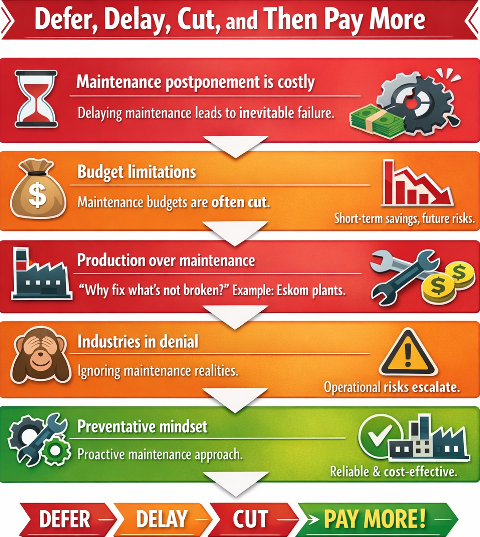
2. Uninterrupted production over maintenance (deferment)
In some operations, the focus is on increasing production as long as equipment is running, and maintenance is not seen as urgent. The production team assumes it can be rescheduled at another convenient time.
However, this turns out to be perpetual. The prevailing mindset is: ‘Why attempt to fix what’s not broken?’
Delaying the replacement of a spare part at the normal price can end up grounding the entire system. The costs – both for repairs and component replacement – are colossal, not to mention revenue lost during downtime. For example, a wastewater treatment plant pump that could have lasted a decade may require premature replacement.
A classic case of deferment is the maintenance management of South Africa’s coal-fired power plants. In 2018, during a parliamentary inquiry into Eskom, former CEO Tshediso Matona attributed the culture of maintenance deferment as the root cause of Eskom’s power plant failures.
Referencing Eskom, Mfundo Nkosi from the Department of Mechanical and Industrial Engineering Technology illustrates the impact clearly: “Assets in poorer condition require more maintenance, so deferred maintenance leads to increased future needs. There are also implications for capital expenditure on renewal.”
Industries in denial
The moral is simple: there is no cutting costs or deferring scheduled maintenance. Doing so only compounds risk from the present to the future.
Yet, despite this reality, many industries remain in denial, adhering to outdated maintenance practices.
Preventative maintenance mindset
On the contrary, when companies take a preventative approach to managing their power plants, the outcome is always different: they stay on top of operations, their equipment is available and reliable, and production objectives are met. They face a clear choice: Do this, or‘Defer, Delay, Cut, and Then Pay More’.