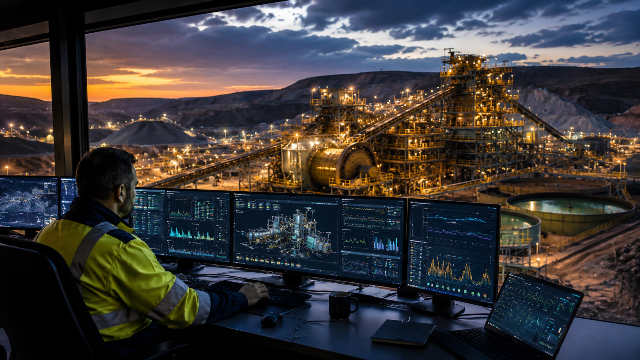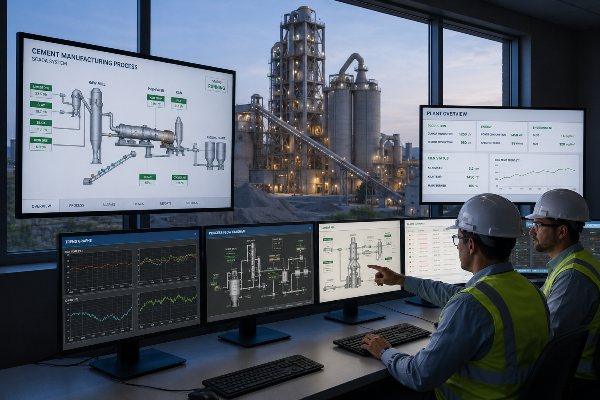

No doubt, remote monitoring through Remote Operation Centres (ROCs) has opened up many possibilities for predictive maintenance of mission-critical equipment in African mining and heavy industry. However, in the real world, it is not feasible to deploy this approach across all equipment: logistics simply won’t allow it. Thus, organisations can only prioritise equipment deemed most valuable and scale up later as and when necessary.
If you follow industrial project news, one of the topical items, in one way or another, relates to the increased adoption of Remote Operation Centres (ROCs). These ROCs enable effective monitoring, management, and control of mission-critical equipment in power plants, mining operations, and oil & gas facilities in remote locations across Africa. ROCs help maintenance teams carry out predictive maintenance with minimal involvement of on-site personnel.
So far, companies that have adopted this approach boast increased efficiency, enhanced safety, reduced emissions, and improved regulatory compliance.
Fearful of missing out (not to be left behind), other organisations are following suit and considering incorporating ROCs as part of the digitisation of their respective plant maintenance programmes.
Prudent Planning and Meticulous Implementation
While there is substantial – and growing – evidence of the benefits of digitisation, organisations planning to adopt it need to be prudent in their planning and meticulous in implementation. Otherwise, they may find themselves burdened with an insurmountable task.

This is the advice from two specialists at dss+ in a Teams interview: Gerhard Bolt, Principal: Climate and Sustainability (Sub-Saharan Africa) , and John Michael Kern, Global Marketing Content Strategy Lead.
Their views resonate with what other thought leaders say about shifting equipment management from a manual, people-centred approach to remote monitoring. This shift is often hampered by transition bottlenecks, even when applied to just a few pieces of equipment in plants.

Carefully Curated Alignment and Communication
Essentially, tech adoption succeeds when mining companies invest in carefully curated alignment and communication from the outset, Wertheim states.
“Consider the end user and reverse-engineer a positive message where they know they are an important part of the big picture and have a direct line of communication with the support team, both on-site and off-site. This helps drive measurable business outcomes almost immediately. This approach is vital as teams are far more likely to accept change when they feel heard, valued, and genuinely better off.”
Transformation Bottlenecks
In particular, some of the common transformation bottlenecks include (but are not limited to):
i. Older machine models
Most plants use a combination of old and new equipment, with some older models over twenty years old. Unlike newer ones, these legacy assets often lack built-in sensors, digital interfaces, and communication ports. Retrofitting them with IoT sensors, temperature probes, or vibration monitors is feasible for a few selected units, but scaling this to a large inventory becomes an intricate and daunting task.
If an organisation decides to proceed, the effort is costly and time-consuming -often impractical mechanically or electrically. In many cases, the costs far outweigh the benefits.
ii. Non-interoperability
Equipment in operations typically comes from different vendors, each using proprietary protocols, data formats, and control systems (for instance, from Siemens, Rockwell, Honeywell, ABB, Yokogawa, and others). This variety requires a single monitoring platform that can communicate with all of them, demanding extensive integration.
In most cases, however, full integration is not possible due to inherent non-interoperability across brands. This remains the single biggest obstacle organisations face when moving to remote monitoring.
iii. Connectivity problems or limitations
When companies consider remote monitoring, they often envisage seamless, almost glitch-free performance. In practice, the reality in remote plant locations is quite different. Most often, the following challenges arise:
- Limited or no internet connectivity, or insufficient bandwidth, and
- Harsh conditions – such as heat, dust, vibration, and corrosive atmospheres- that degrade devices. Dealing with these issues generally requires installing reliable networks, which can be disruptive and expensive.
iv. Cybersecurity and access-control risks
When organisations think about remote monitoring, exposure to cyber risks like ransomware attacks rarely comes to mind first. Yet this threat cannot be downplayed. While most recognise the need for secure architecture, they are equally aware that it does not come cheap and is a complex process to implement.
v. Data overload
Data is good, but not when there is too much of it. Large plants typically feature hundreds of motors, pumps, valves, conveyors, and other equipment. Imagine managing the real-time collection, transmission, and storage of data from all of them, not to mention unavoidable issues like leaks, corrosion, and blockages.
Kern has this to say on data overload: “It seems like the greatest issue is how to actually get some insights out of too much data created. It is hard for people to understand what the data is saying and how it can be useful for operational leaders and executives in making decisions.”
Strong Remote Visibility
That said, information from organisations keen to share indicates strong remote visibility over critical assets and major production lines using IIoT platforms, advanced SCADA, or digital twins. However, so far, complete coverage of remote monitoring for all equipment remains far-fetched.
The Feasible Approach
Generally, the most feasible approach is to identify critical equipment that can be part of the remote monitoring ecosystem and focus efforts there.
Stressing this point, Bolt calls on mining companies to be realistic when embarking on digitisation: “It’s very important that there must be clear value cases defined by digitalisation efforts. Don’t be over-ambitious and think you are going to create a digital twin of your entire mine and its value chains.”
Starting Small and Scaling Up
Instead, Bolt advises that mining companies should start small and scale up as needed. “At the outset focus on high-value use cases, for instance, enhancing safety (protecting people and equipment), boosting productivity, and improving environmental compliance.”
“From a safety perspective, for example, adoption of autonomous vehicles can remove people from hazardous environments. Fibre optical cabling for conveyor belts can detect issues before they halt operations. In such cases, the ultimate benefit is significant financial savings through preventing catastrophic failure.”
On the whole, the gist of the message: In the relentless pursuit of improved predictive maintenance via remote monitoring, it is crucial for organisations to balance the possibilities of emerging opportunities with the reality of what can actually be implemented.
Humans Will Remain Vital
Humans will feature prominently in industry’s digitisation drive. In an article published by Machinery Maintenance Matters, Annemie Willer, manager of WearCheck’s ARC (Asset Reliability Care) division, highlighted this point.
Willer argued that it is incredible to believe digitisation can completely replace humans in maintenance tasks. “You can install ten pumps from the same OEM, running under the same process conditions, in the same plant, with the same lube, and still… they won’t age the same. One might run clean for six years. Another might seize up in eight months. And no amount of sensor data is going to tell you why – not reliably.”