
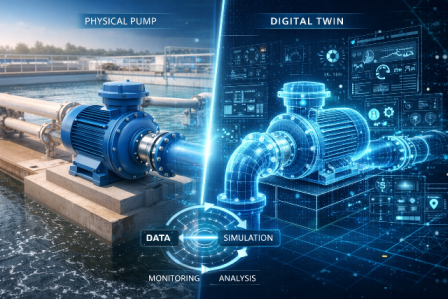

As the metaphor goes: “You can’t make good wine from bad grapes,” a digital twin is only as good as the data it is provided with; it must be an accurate, living reflection of the physical world it represents.
By Nishandra Baijnath
Digital twins’ reputation precedes, and with good reason. It is a highly effective tool that offers real-world scenarios within a virtual environment, allowing a myriad of segments like utilities to gain predictive insight and overall operation efficiency, to name but a few.
In fact, according to a report by EY, digital twins offer a futuristic opportunity for utilities to redefine operational strategies and enhance performance
But as the metaphor goes: “You can’t make good wine from bad grapes.” Digital twins are only as good as the data it is provided with; it must be an accurate, living reflection of the physical world it represents.
Whether it is electrical utilities or industrial plants, the above disconnect often stems from a communication failure, if you will, between the design, construction, and operations phases of a project.
As systems are designed, built, and modified, the data (that underpins the digital twin) often fails to stay synchronised. This, in turn, creates inconsistencies that undermine the digital twin’s credibility as a single source of the truth.
Where is the breakdown?

For one, the tools typically used for design and build aren’t always integrated with the system used for operations and maintenance. This lack of integration – between the platforms used during the different lifecycle stages – sets the stage for serious disconnect.
Typically, one would start with design baseline but as construction progresses, there are always adjustments or minor changes that lead to the creation of an ‘as-built’ version.

Unfortunately, this as-built data is seldom fed back into the design system which means by the time an implementation has moved into the operate-and-maintain phase, the digital model is already outdated.
The digital twin is therefore gradually drifting from reality. And the impact is significant: inaccurate modelling affects protection coordination, outage planning, and real-time network analysis.
A ripple effect
When the physical network evolves but the virtual model doesn’t, even small discrepancies can lead to major operational blind spots.
A digital twin allows operators to perform ‘what-if’ analyses, testing fault conditions, reconfiguration options, or future upgrades in a risk-free virtual space. But if the real-world network has changed and those updates haven’t been reflected in the digital twin, the simulations lose their reliability.
For example, in a distribution network where ring main units (RMUs) provide redundancy, the digital twin must accurately reflect every feeder and interconnection. If field changes are made during fault isolation or maintenance without updating the digital model, operators may unknowingly rely on incomplete or outdated data during network restoration.
Closing the loop
To bridge this gap, Schneider Electric’s ArcFM, part of our Digital Grid portfolio, offers a practical solution. ArcFM extends Esri’s (Environmental Systems Research Institute) ArcGIS geospatial platform by embedding electrical design intelligence into this data, enabling real-time updates and collaboration across design, construction, and field operations.
ArcFM connects traditional siloed workflows from planning-design-construction-operations ensuring all teams work from the same accurate data model.
It therefore integrates the electrical aspects of the network, allowing construction teams and field operators to update designs directly from the field using smart devices. When a line is rerouted or a component replaced, the field team can immediately update the network map.
These updates are then sent back to the design office, which consolidates the change, ensuring that the digital twin remains aligned with the physical grid.
This integration supports a living digital twin that evolves with every change in the field or system.
The mobile (ArcFM Mobile IX) and web (ArcFM Web IX) applications in ArcFM extend access to field crews for real time asset updates whilst providing web users the ability for lightweight mapping and decision support.
But building a reliable digital twin requires more than just technology, it demands process discipline and collaboration. Here, we recommend three key best practices:
- Integrate lifecycle data platforms — ensure seamless interoperability between the design, GIS, and operational systems.
- Enable real-time field updates — allow field service teams to record as-built changes using mobile tools connected to the central database.
- Establish data governance and validation, therefore, implement workflows for verifying and approving changes to maintain model integrity.
A digital twin is not a static model, it’s a living, evolving ecosystem which is why it must accurately and continuously reflect the ever-changing conditions of the operations it represents.
Nishandra Baijnath is Systems Architect, Digital Automation at Schneider Electric
This article was originally published by Schneider Electric