


Turbine oils play a critical role in ensuring the reliability and efficiency of rotating equipment in power generation, petrochemical and industrial applications. These lubricants are expected to operate under demanding conditions for extended periods without replacement. However, the gradual degradation of turbine oil through oxidation remains one of the most significant threats to system reliability.
Condition monitoring specialist company, WearCheck, offers a host of laboratory tests that determine the oxidation degradation of turbine oil, as well as additional information, including contamination levels, additive levels, remaining useful life of the oil and other data. With scientific proof detailing the level of degradation of the oil, turbine maintenance teams can make strategic decisions regarding the oil.

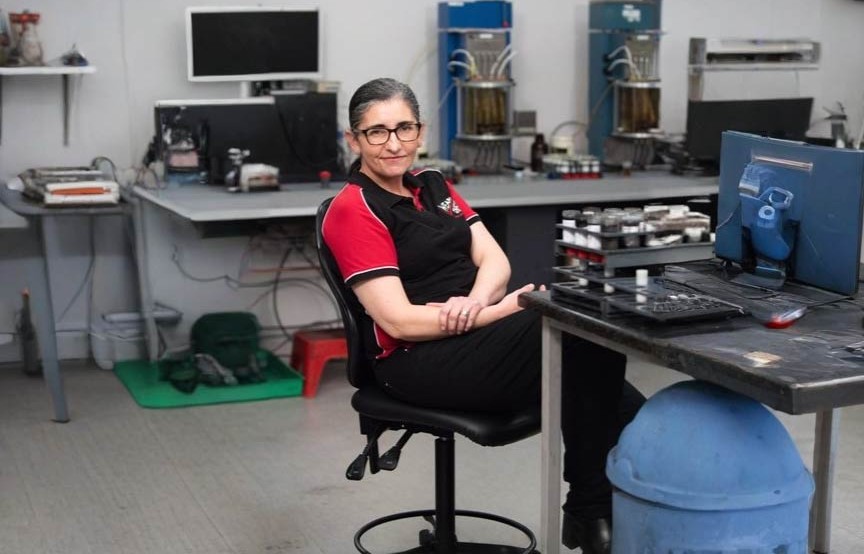
When it comes to oxidation behaviour and knowing when to intervene, WearCheck technical manager, Steven Lumey, explains that better understanding of these issues is essential to avoid costly failures.
‘Oxidation is not a sudden event – rather, it is a progressive chemical process that, if not properly monitored, leads to varnish formation, increased acidity and ultimately equipment failure,’ says Lumley.
The chemistry of turbine oil oxidation
All turbine oils are inherently susceptible to oxidation when exposed to oxygen, elevated temperatures and catalytic metals such as copper and iron. These conditions are unavoidable in operating systems. Over time, oxidative degradation results in the formation of acidic compounds, sludge and varnish deposits, which can impair lubrication and restrict oil flow.
In turbine systems these degradation by-products can lead to servo-valve sticking, filter blockage and reduced heat-transfer efficiency; ultimately compromising system reliability.
To counter this, turbine oils are formulated with antioxidant additives. These additives are sacrificial in nature, reacting preferentially with oxygen to protect the base oil. However, as oxidation progresses, these antioxidants are gradually depleted.
Lumley reflects that industry practice often suggests that turbine oils can remain in service until antioxidant levels fall to approximately 25% of their original concentration. ‘However,’ she says, ‘at WearCheck, we note that field experience and laboratory data show that varnish formation can begin much earlier, even when antioxidant levels remain above 60%.
‘Therefore, we emphasise the importance of monitoring not only additive depletion but also the onset of degradation by-products, to gain a holistic picture of the turbine oil’s condition.’
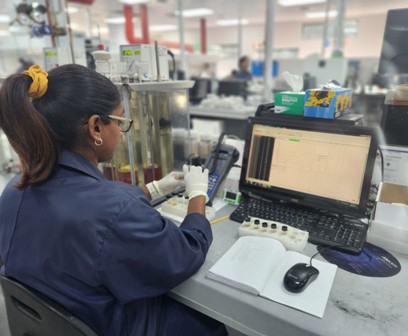
Advanced laboratory testing techniques provide critical insight into oxidation, additive depletion and remaining oil life. Here, WearCheck turbine laboratory technician, Ashleen James operates a Linear Sweep Voltammetry RULER instrument in the company’s Durban laboratory.
Monitoring oxidation
WearCheck’s turbine condition monitoring programmes rely on a combination of laboratory techniques to assess turbine oil health. These include:
- Acid number (AN) measurement, indicating the accumulation of acidic oxidation by-products
- Remaining Useful Life Evaluation Routine (RULER) testing, which quantifies remaining antioxidant levels
- Rotating Pressure Vessel Oxidation Test (RPVOT), which simulates oxidation resistance
- Membrane Patch Colorimetry (MPC), which detects the presence of insoluble degradation products that may lead to varnish build-up
Each test provides a different perspective on oil condition. When used together, they offer a comprehensive view of both current degradation and remaining oil life.
‘Too often, decisions are made based on a single parameter,’ Lumley explains. ‘For example, a rising acid number may indicate oxidation, but without understanding antioxidant depletion and varnish potential, you are only seeing part of the picture.
‘Turbine oil analysis is most powerful when results are trended over time. Rather than focusing on absolute values, trending allows maintenance teams to detect changes in degradation rate and identify abnormal behaviour early.
Lumley reports that her diagnostic team finds that oxidative degradation typically follows an exponential curve – slow initial degradation while antioxidants are active, which is followed by rapid deterioration once additive protection is exhausted. ‘By tracking parameters such as acid number, degradation indicators and antioxidant depletion, we can identify the inflection point before accelerated degradation occurs.’
This predictive approach enables timely intervention, avoiding both premature oil replacement and catastrophic failure.
Lubricant-refreshment strategies
When oxidation is detected, turbine operators have a choice of several courses of action, depending on the severity of degradation. These include:
- Full oil replacement – this is typically reserved for heavily degraded systems.
- Partial oil change (bleed and feed), where fresh oil is introduced to replenish additives.
- Reconditioning through filtration and varnish-removal technologies.
- Additive replenishment where antioxidant packages may be restored under controlled conditions.
Each strategy has its place, but selection should be based on condition monitoring data rather than fixed maintenance intervals.
‘Lubricant refreshment should be guided by data, rather than assumptions,’ advises Lumley. ‘Replacing oil too early wastes resources, while waiting too long can lead to significant damage and unplanned downtime.’

Turbine oils are critical to the reliability of rotating equipment, where oxidation and degradation can lead to costly failures if not properly monitored.
Case study
In a recent WearCheck-supported project involving a large power-generation turbine, routine oil analysis identified a gradual increase in acid number alongside moderate antioxidant depletion. At first glance, the turbine oil appeared to remain within acceptable limits.
However, further testing revealed early varnish-formation potential, supported by Membrane Patch Colorimetry (MPC) results and RULER data. Trending showed that oxidation was accelerating, indicating that the oil had reached a critical stage in its degradation curve.
Rather than proceeding with a full oil replacement, the client implemented a targeted refreshment strategy. This included varnish-removal filtration and controlled top-up with fresh oil to restore additive balance.
Subsequent analysis confirmed stabilisation of degradation indicators and improved oil condition, extending the service life of the lubricant while avoiding the cost and downtime associated with a complete oil change.
‘This is a good example of how deeper analysis and trending can change the maintenance decision entirely,’ Lumley notes. ‘Without that insight, the options would have been either to do nothing or to replace the oil unnecessarily, neither of which is an ideal choice.’
Data-backed decision-making drives reliability
Turbine oil degradation is inevitable, but failure is not. By combining advanced analytical techniques with expert interpretation, operators can gain a clear understanding of lubricant condition and make informed decisions about maintenance and refreshment.
Condition monitoring, including lubricant analysis, is a key predictive maintenance strategy, allowing faults to be identified before they impact operation.
WearCheck’s approach integrates laboratory analysis with practical engineering insight, enabling clients to optimise oil life, reduce costs and maintain system reliability.
‘Ultimately, it’s about understanding what the data is telling you’, concludes Lumley. ‘When you understand the condition of your oil, you are in control of your equipment reliability.’