

In some industrial operations, the management of spare parts inventory is fragmented.
There is a lack of coordination between critical departments, with procurement and maintenance teams sourcing their own products from OEMs or other accredited vendors.
In most cases, while well-intended, these management silos (or instances of mismanagement) result in overstocking or the procurement of parts with the wrong specifications. Eventually, they cause unplanned downtime, which affects equipment reliability.
To mitigate this situation, Pieter de Waal, Solution Advisory Specialist, Supply Chain Management at SAP Africa, suggests that maintenance and reliability heads consider adopting a comprehensive end-to-end Maintenance, Repair and Operations (MRO) system for spare parts inventory management.
By Jimmy Swira
Odd as it may seem, some organisations source all supposedly ‘critical’ spare parts on the checklist from reputable OEMs, yet still face equipment downtime due to spare parts shortages.
Management in silos
More often than not, this occurs when spare parts inventory in an organisation is managed in silos. This is what Pieter de Waal, Solution Advisory Specialist, Supply Chain Management at SAP Africa, has observed from the challenges faced by clients he has consulted extensively.
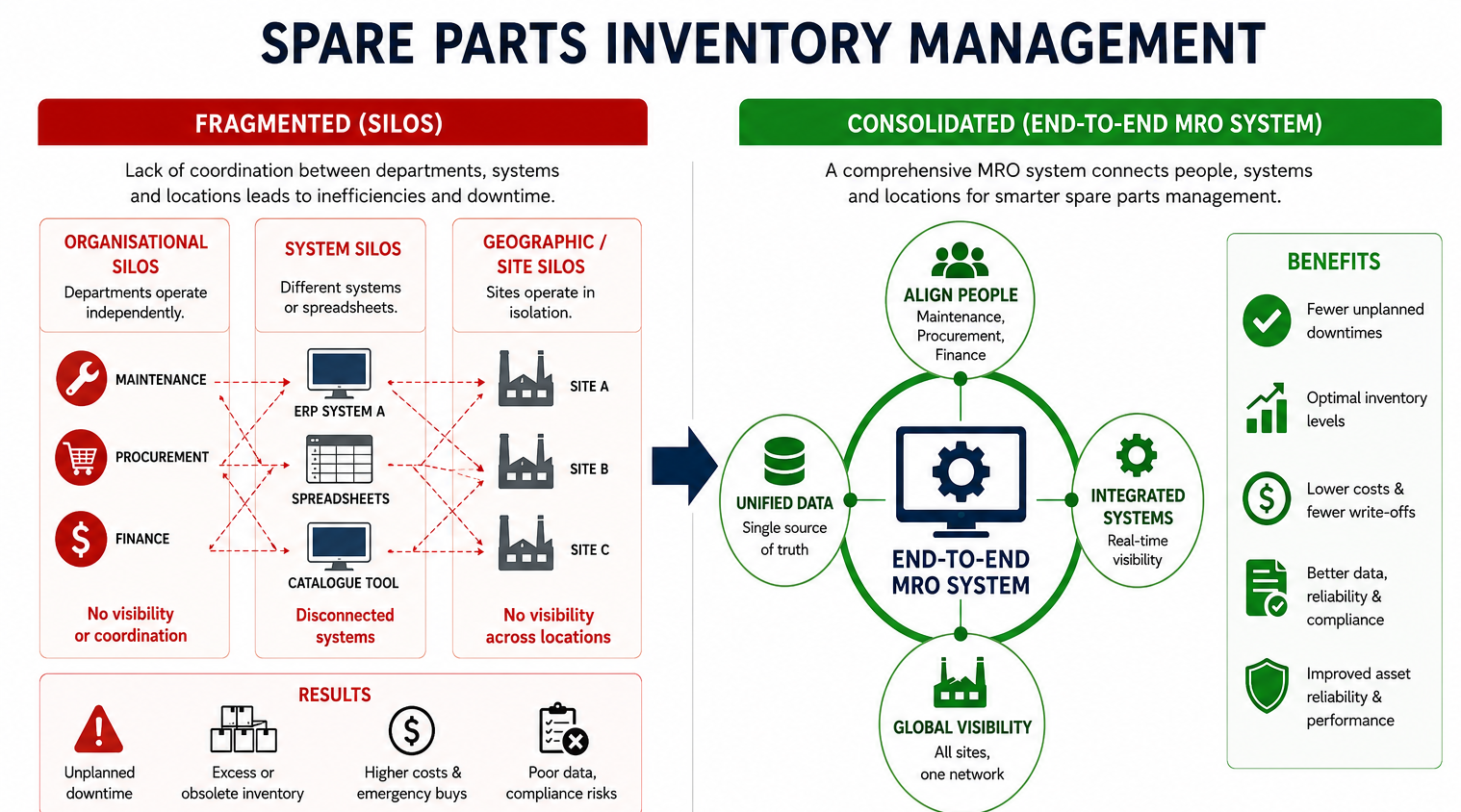
Peculiarly, silos in spare parts procurement manifest in three forms: within organisations, within systems, and geographically or site-specific.
de Waal details what each of these cases entails.
i. Organisational silos
In organisational silos, maintenance teams, procurement teams, and finance teams operate independently. A maintenance engineer may identify a failing bearing but has no visibility into what procurement has already ordered or what the warehouse already holds. Each function owns its data and its budget.
A typical example of organisational silos would be a gold refinery holding critical pump seals in three different warehouses. These pumps would have three different material numbers because each site built its own master data independently.
ii. System silos
In system silos, plants within the same company often run different inventory systems, or no system at all beyond spreadsheets.
In the first example, mining operations with 12 remote sites may have 12 different stock lists with no consolidation.
In the second, an oil refinery might have one ERP system for production planning and a separate standalone cataloguing tool for spare parts, with no live integration between them.
In the third, an oilfield services company may have different rig platforms, each managing its own supplier relationships. As a result, each platform may procure identical hydraulic fittings from four different suppliers at four different prices.
iii. Geographic and site silos
Geographic and site silos are typical in heavy industries such as mining and offshore oil and gas. These environments are characterised by physical remoteness, which reinforces data isolation.
de Waal demonstrates the confusion this brings: “A part available at one mine site is unknown to procurement at another. This leads to duplicate purchases and excess inventory globally while specific sites face shortages.”
Another example would be a coal mining company. Management may discover months’ worth of stockpiled conveyor belts at one site, while another site experiences an unplanned shutdown due to a belt shortage because neither site has visibility into the other’s inventory.
Symptomatic of poor (or no) coordination
In general, silos are symptomatic of poor or no coordination between procurement teams and maintenance planners. In cases where there is a semblance of coordination, obsolete ERP systems are used.
i. Misalignment of objectives
Where there is poor or no coordination between maintenance and procurement teams, there is a misalignment of objectives, de Waal explains:
“Procurement processes tend to be reactive, responding to short-interval demand cycles to cover imminent maintenance schedules or breakdowns already causing downtime.
Procurement teams are measured on cost savings and stock levels. Consequently, order quantities and lead times are not based on service levels, but rather on cost benefits.
On the other hand, maintenance teams plan months ahead for equipment availability.”
ii. Traditional systems fall short
In other instances, where there is reasonable coordination, the traditional ERP systems being used could fall short of meeting an organisation’s objectives.
This occurs because ERP systems normally use very basic planning tools, such as MRP (Material Requirements Planning), where safety stock levels, minimum and maximum stock levels, and economic order quantities are planned in spreadsheets by procurement teams with input from maintenance managers and then uploaded into the master data.
While ostensibly well-intentioned, this approach is structurally flawed, points out de Waal. “Most maintenance teams admit that manual adjustments are normally done only once a year. Spare parts inventory is consumed erratically and in low volumes, and this is exactly where traditional ERP systems struggle because MRP performs better with regular demand patterns.”
Silos and unplanned downtime
Generally, managing spare parts inventory in silos has a significant impact on machinery availability in industrial operations.
Preventing unplanned downtime is one of the key performance indicators used to measure maintenance performance. However, with the silo approach, meeting this objective becomes a challenge, in most cases leading to two extreme consequences.
i. Unavailability of critical spares
The first instance is when critical spares are not available at the moment of failure.
For maintenance-intensive industries, the cost can be measured in millions of rands through lost revenue resulting from production stoppages.
ii. Excess or obsolete inventory
In the opposite case, excess or obsolete inventory is purchased and never used, resulting in stock write-offs and capital being tied up in inventory.
de Waal indicates where obsolete inventory becomes problematic:”Emergency procurement processes are required to buy stock at short notice and transport it at inflated prices. Furthermore, it results in poor asset reliability data, as downtime and failure mode analysis are misaligned or even kept in separate systems.”
He continues: “Failure to track which parts were installed, when they were installed, and when the breakdown occurs will often lead to audit and compliance risks, with additional misalignment between actual breakdowns and goods issues for repairs.”
A comprehensive end-to-end MRO system
The sure-fire way industrial operations to consolidate a fragmented silo system is to adopt a comprehensive end-to-end Maintenance, Repair and Operations (MRO) system that addresses spare parts inventory challenges, among other issues, suggests de Waal.
However, he acknowledges that what constitutes an end-to-end MRO system varies from service provider to service provider. For instance, SAP’s Autonomous Enterprise combines data from SAP S/4HANA and SAP’s Supply Chain Management solution, Integrated Business Planning (IBP) for Maintenance, Repair and Operations, with AI-native applications to provide end-to-end planning solutions for spare parts.