Boiler operators in short supply
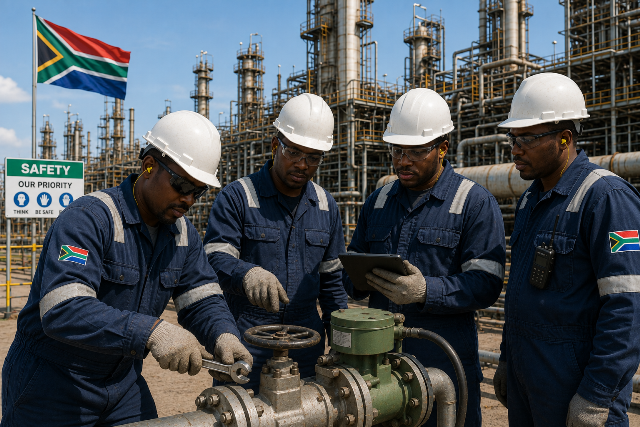
On the contrary, advanced control systems and monitoring technology is far from reducing the role of boiler operators. In fact, skilled boiler operators are typically in short supply throughout manufacturing and across many vertical industry sectors, with different skill sets required for specific boiler technologies.
AES recognises that any shortage of appropriately experienced boiler operators has a significant impact on the reliability and availability of steam boilers. In view of this, it has identified four priority areas: safety, quality, technology advancement, and the development of human capital.
Development and training on an equal opportunity basis
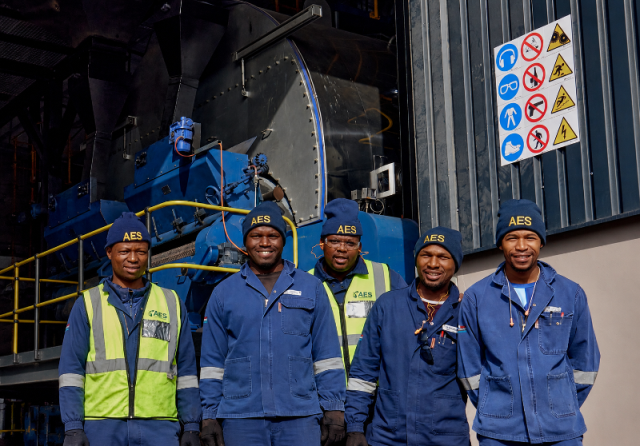
The company invests heavily in continuously developing and training talented employees on an equal opportunity basis, to become experts from within.
Equipped with the skills they acquire, boiler operators remain up to speed with clients’ evolving requirements.
Dennis Williams, Commercial Director at AES, underscores the company’s intentional approach:
“Retaining skilled people is the main mechanism through which we deliver value to our clients. Although ensuring that all the right systems and technology are in place is a priority for AES, it is ultimately our human resources which make a significant daily difference on site,” Williams states, adding that the AES approach to skills development is strategic from a boiler location standpoint.
Need for suitably skilled and capable staff
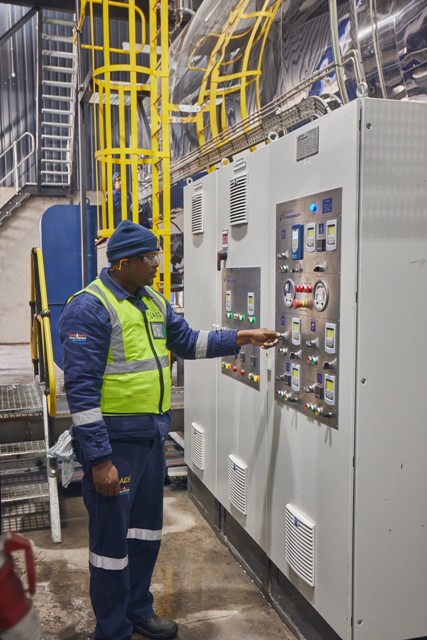
All of the company’s boilers operate remotely on clients’ sites, in line with its outsourced steam boiler operations and maintenance value-adding model. For this reason, AES requires suitably skilled and capable staff to represent the company in any eventuality – and to whom it can confidently delegate oversight.
Modern instrumentation ‘frees up’ boiler operators
To handle this magnitude of responsibility effectively, boiler operators utilise modern instrumentation, such as boiler control systems, together with AES’s own remote monitoring systems (RMS).
The boiler control systems help free up operators to add greater value through human oversight and insight, particularly on solid fuel-fired boilers, says Williams. “Gas- or liquid fuel-fired boilers use fuel with a very narrow range of specification variability, meaning less human intervention is required. However, the same does not apply to coal and biomass, which are non-uniform fuels characterised by constant fluctuations.”
Williams explains what makes coal and biomass more complicated: “One minute, moisture is low and particle size is large. The next, moisture is high and particle size is smaller.”
He continues: “These variations are not just visible, but include varying fuel quality and chemistry, which can impact combustion with significant ramifications.”
Even modern boiler control systems do not eliminate this challenge. As such, manual intervention beyond an automated fuel feed system is still required.

Checking parameters visually and via instrumentation
That is why trained staff are critical to implementing AES’s flagging system, whereby boiler operators continually check operating parameters both visually and via instrumentation. In this way, combustion is optimised and steam pressure is maintained efficiently.
In addition to advanced control systems, AES’s RMS provides skilled boiler operators with real-time data on boiler performance, enabling them to take proactive action to optimise boiler performance.
“However, every manufacturing plant has unique characteristics and requirements. The control system can only do so much, but at the end of the day, a human operator needs to do some checks and set up the boiler in line with production facility requirements,” Williams explains, adding that human intuition, experience and situational awareness are all paramount. Furthermore, with instrumentation there can also be time lags, and human intervention is often quicker.
“The flagging system demands precision. Boiler operators must therefore ensure that back-up processes are handled seamlessly by following critical steps,” Williams points out. These include monitoring combustion characteristics, emissions and critical boiler parameters, which will affect efficiency, emissions, steam quality and plant reliability.
Float operators
From the available pool of human capital it has developed, AES promotes exceptional employees to become “float operators,” says Williams. “Our float operators move from site to site across the country, operating different boilers and in some cases, even becoming training officers – sharing both theoretical and practical knowledge across our business.”
These float operators are either employees with long-standing experience on a single, complex multi-boiler site or those with knowledge gained across numerous sites. They are primarily utilised in two situations: during boiler operations switch-over at a new site and when a particularly challenging situation arises.
AES currently has 8 float operators deployed regionally, an arrangement that has given clients much needed convenience, Williams notes. “Although they usually work on different sites within a specific region, where there is a shortage of skills they may be deployed to assist in another region. For example, operators who are up to speed with biofuels have previously been deployed to a region where biofuel is being used for the first time.”
Creating an ongoing talent pool
Due to the evolving nature of its business, AES continuously develops an ongoing, cascading talent pool. Typically, the company uses boiler operator assistants to support operators on site, with a view to promoting them to become boiler operators-in-training.
When opportunities arise, these assistants can then be promoted. In this way, the company maintains a constant flow of semi-skilled and skilled boiler operators, who are consistently trained and developed across multiple operational sites. The company also retains organisational knowledge by documenting it in detailed training manuals.
Training on boiler technologies, occupational safety, process safety management and other statutory requirements is ongoing. This includes annual evaluations and three-yearly re-certification of operators across different competency levels, while the company continuously develops new boiler skills.
Key performance indicators
What about the measurable outcomes?
AES has deliberately tailored its skills development and training to the requirements of different sites and industries. Accordingly, the KPIs it develops and applies reflect this.
While the details are commercially sensitive, Williams highlights two important aspects: both operational and theoretical training and testing require regular sign-off, while operational certifications aligned with specific levels of expertise and skill sets are renewed every three years.
Regarding the primary and most important measure of success, he explains:
“The ultimate measure of the efficacy of training lies in whether the targets specified within an SLA (service level agreement) – cost management, availability of steam to the plant, overall efficiency and emissions – are met. Where cost-savings are evident, we know that the competency of employees is impacting positively on our operational performance. Where these are not met, we aim to ensure that our people’s skills and competencies are developed and utilised to address any shortcomings.”
Nowhere is the value added by AES more evident than across the manufacturing supply chain. This is reflected in risk mitigation, reduced plant downtime, cost-effective fuel procurement and logistics management, assistance with asset maintenance throughout a plant’s lifetime, improved site operations and lead times, minimised wastage and a reduced carbon footprint.
More importantly, because boiler operators work with pressure vessels, AES’s training is critical in ensuring that they follow the correct procedures at all times, and particularly during emergency situations. Training therefore serves as an essential safety measure.
Constant upgrading of training
To remain abreast of industry trends, AES continually upgrades its boiler operator training programme. The company identified a need for more comprehensively documented information, particularly regarding the combustion aspects of different boiler technologies. The training material which has subsequently been collated is both in-depth and highly detailed.
The next step will be translating this extensive body of knowledge into practical, on-the-ground application and implementation.
Williams believes this approach will be pivotal in AES’s quest to improve boiler service delivery: “The next upgraded training module – currently at an advanced stage – will combine practical and theoretical knowledge with testing, to ensure that the reasons behind the required actions and reactions of boiler operators are fully understood.”