

Some industries across Africa rely on ageing machinery with components whose spares are no longer available from OEMs. The deterioration of these components can lead to production downtime if not properly managed.
Through reverse engineering, Vector Engineering helps clients replace obsolete components to ensure the availability and reliability of their plants. Ian Garnett, the company’s managing director, sees considerable opportunities for this approach across the continent.
Benoni-based Vector Engineering manufactures customised precision engineering parts and components for clients in heavy industry, mainly manufacturing, oil and gas, and power generation. In the past few years, the company has noticed an increase in orders from clients in South Africa and the region requiring replacements for obsolete machinery components in their plants. Through reverse engineering of these components, it has helped clients keep their plants running with minimal downtime.
Bridging the gap
This approach bridges specific gaps in the component supply chain, states Ian Garnett, the Managing Director of Vector Engineering.
“A common situation companies face is that a machine can have years of productive life left when its manufacturer stops supplying a critical spare. Drawings may be unavailable, the original tooling may have been retired, and worse still, the only sample on site may be worn or damaged.”
“There are also instances where a spare part can still be sourced overseas. However, the lead time may exceed the plant’s maintenance window,” he adds, citing the example of a problem Vector Engineering helped a new client solve recently.
The new client faced potential plant downtime due to the long waiting time for a component from overseas. “The part the client required could still be ordered from the OEM, but the OEM does not keep stock. Delivery was quoted at six weeks and would have required air freight from Italy,” Ian relates.

Proactive decision-making
Having witnessed the impact of plant downtime due to a missing obsolete component through this client’s experience, Ian urges companies to be proactive and consider reverse engineering before a component fails.

“On a production line, a relatively inexpensive guide, bush or roller can determine whether the whole line runs. As a part deteriorates, the plant may see more jams, lower operating speeds or higher reject rates before it experiences a full stoppage.”
The best time to assess a critical obsolete spare is while the machine is still running and maintenance personnel can observe how the part behaves under normal conditions, recommends Ian.
“In a perfect world, a library of critical obsolete parts should be scanned, modelled and detailed technical drawings kept on hand before the inevitable breakdown. But that is not how it works in a real industrial setting.”
A reliable supply route, not an afterthought
The impact of downtime goes beyond production, resulting in lost revenue. Given this, Ian tells companies to consider reverse engineering as a reliable supply route for obsolete parts, not an afterthought, and highlights ways of getting the most out of reverse engineering.
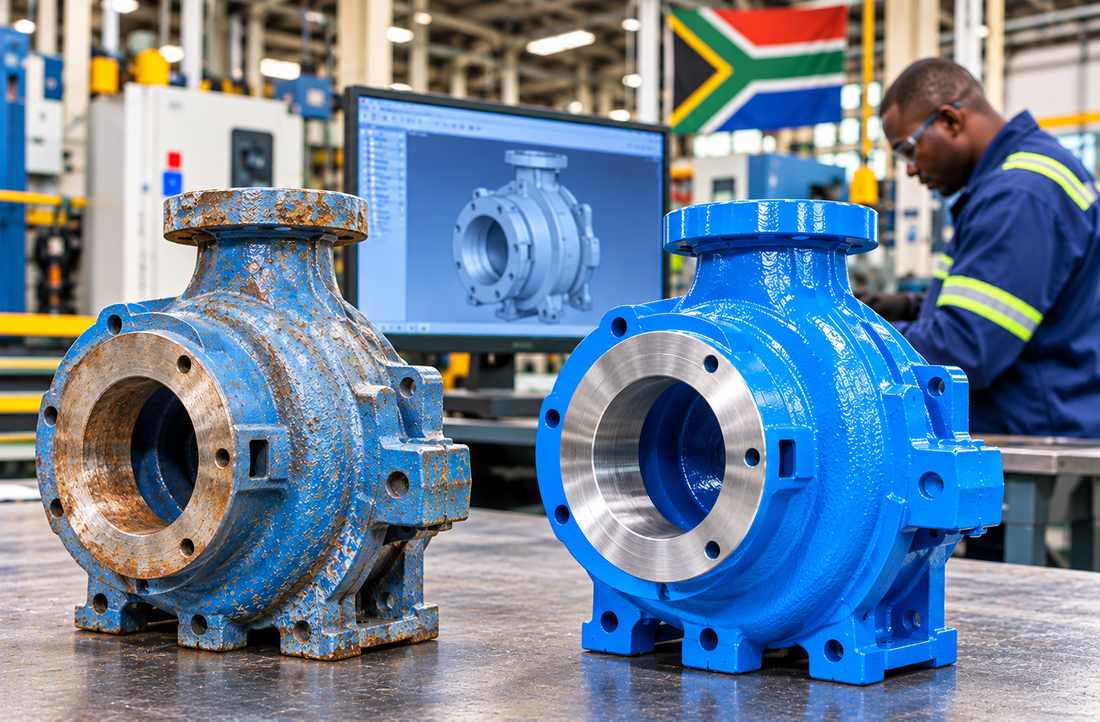
“The starting point is understanding what the component does, how it fits into the assembly, and why it wears or fails,” he suggests. “The engineering work then translates those findings into a controlled drawing, using digital scanning, together with a defined material specification and inspection criteria for future batches,” says Ian.
The experience gained from working on a component can inform areas that need to be improved. For example, where a component fails repeatedly, the same process can help identify whether a different material, surface finish or design detail would improve service life.
Ian stresses a case in point: “A harder wear guide might last longer itself while accelerating wear on the part it runs against. The objective is to improve reliability across the assembly.”
The convenience of local access
Garnett regards access to local manufacturing as particularly convenient for industries where even a short period of production downtime can be very costly across the continent. This is particularly applicable where local manufacture can shorten the feedback loop between the maintenance team and the supplier.
“Being able to inspect the machine, check a first-off part on site and make a controlled correction can be especially valuable when the original supplier is overseas. Once a replacement is qualified, the plant can use the same specification to order planned spares and reduce its exposure to emergency imports,” says Ian.
It is worth noting, however, that the viability of local manufacture depends on the part required, the available capability and the economics involved.
The supplier needs access to the right materials, manufacturing processes and inspection facilities.
The second consideration is economics: the cost of engineering and proving the part, the likely repeat demand, and the cost of waiting for a spare. Ian mentions such a situation: “A critical low-volume component can justify an investment when its failure stops an entire line or slows production down to accommodate a worn or broken part. Lengthy OEM manufacturing lead times and freight charges also play a critical role in the decision-making process.”
Once it has been decided that local manufacture should be utilised, the selected organisation should have proven experience in precision manufacturing. The organisation should be able to provide a solution more quickly and cost-effectively, with pricing in local currency, compared with a foreign OEM.
A huge untapped niche market
Looking ahead, Ian says Vector Engineering sees a huge untapped niche market for the reverse engineering of obsolete components and parts urgently needed in industrial operations. It is difficult to imagine how many plants may be sitting idle simply because the spare parts they need are no longer available on the market or because they are waiting for deliveries from OEMs in regions facing supply chain disruptions.