

When it comes to wear protection to ensure equipment reliability, informed decisions are not subject to debate: they have to be made at all costs, and meticulously at that. This is particularly true in the selection of wear parts for mission-critical equipment like crushers in mining, where reliability is the heart of operations.
That is why, when exploring materials for a particular crusher, due diligence is key.
Procurement Oversights
However, according to information from leading wear part suppliers to mining and mineral processing projects, mining companies should avoid the following two mistakes in procurement decisions:
i. Cheap is not always frugal
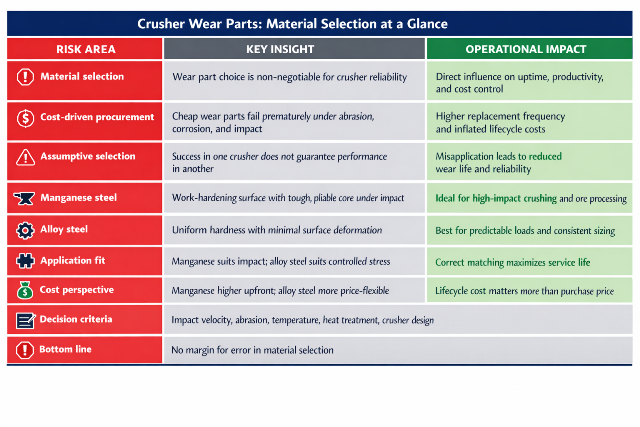
Sometimes, due to cost-cutting pressures, the common challenge maintenance and reliability heads face is buying wear parts solely based on price. Often, this results in procuring the wrong wear parts, which become a maintenance liability from two perspectives.
First, the wear parts reach their limit well ahead of planned replacement intervals when exposed to abrasion, corrosion, and impact under demanding operating conditions. As a result, they have a replacement frequency higher than what are regarded as the historical norms.

What is more, the operation incurs exorbitant costs from high replacement frequency and loss of productivity. Preposterously, the total cost of replacing the wear parts can turn out to be more than buying the most suitable product. It goes without saying that cheap is not frugal.
ii. Assumption based on limited success
Another challenge is the selection of wear part material based solely on proven performance in one crusher application. This is flawed: just because a wear part material has proved effective in one crusher enduring intense abrasion, corrosion, and impact, it does not always follow that it will be just as effective in another crusher type or duty profile.

Evidently, decisions limited to these factors must be avoided at all costs.
Thorough Consideration
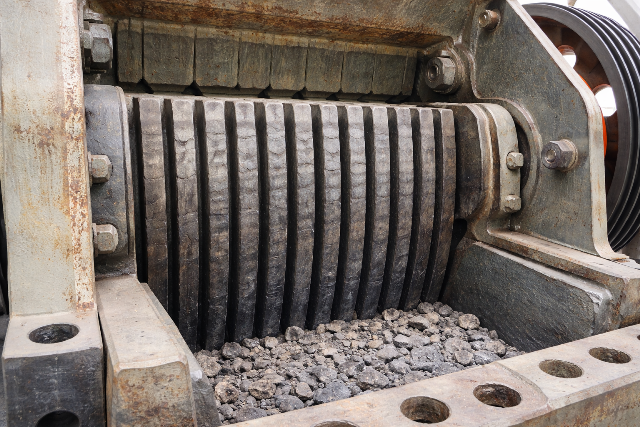
Instead, a crusher wear part that is robust and long-lasting must be selected only after a thorough consideration of the merits and demerits of identified material options. Where the crusher component has to endure intense abrasion and impact, specialised metals can be utilised in wear part construction. Examples include high-manganese steel and various steel alloys.
Examining Essential Distinctions
Ultimately, to settle on the most suitable steel type, the essential distinctions of each material must be examined and then assessed against requirements under specific conditions.
i. Manganese-based steel: hardening surface, pliable core
Typically, steels with high manganese content have manganese ranging from approximately 11% to 14%, depending on specification and application (with higher grades such as 18–24% available for certain demanding uses). When continuously exposed to sufficient impact energy and abrasive materials in crusher wear part applications, the surface of manganese-based steels hardens while the core remains relatively pliable and tough. This work-hardening property helps to extend component life: manganese steels adapt under impact loads, providing robust toughness that improves over time.
Hence, the ability to withstand repeated pounding renders manganese-enriched steels ideal for high-impact scenarios such as rock crushing or ore processing where adequate impact is present. This work-hardening effect ensures that, as the part endures stress, the contact surface solidifies further, offering superior resilience.
ii. High-strength steel alloy: minimal surface deformation
Alloy steels combine various elements such as chromium, nickel, molybdenum, and vanadium in smaller proportions. Depending on chemistry and heat treatment, high-strength steel alloys frequently excel in applications where uniform hardness is essential for precision and minimal surface deformation.
Alloy steels balance strength and hardness, derived from elements such as chromium and vanadium. These metals can be tailored to meet unique performance criteria by adjusting alloying ratios and heat-treatment processes.
Ideal Applications
Alloy steel parts often perform best in environments that require stable hardness for consistent product sizing, supporting tasks like cutting or shaping under predictable stress loads.
On the other hand, the ability to withstand repeated pounding renders manganese-enriched steels ideal for high-impact scenarios such as rock crushing or ore processing. This work-hardening effect ensures that, as the part endures stress, the contact surface solidifies further, offering superior resilience.
Settling for the Most Suitable Materials
At the end of the day, where should plant managers turn for manganese or alloy steel?
Unquestionably, all boxes must be ticked. Of course, cost cannot be ignored.
Comparatively, manganese-based steel parts can be more expensive upfront in many applications. However, in the long run, this is often offset by longevity and reduced replacement frequency where operating conditions are appropriate.
On the other hand, the price of many types of alloy steel is generally competitive. Therefore, to suit budget and performance requirements, specific chemistry modifications can be made. However, it must be clarified that selecting the correct steel grade and heat treatment is vital to achieving optimal efficiency.
All things considered, each option thrives under certain stresses. This makes it essential to analyse factors such as impact velocity, temperature fluctuations, and abrasive materials.
From a project perspective, budget, performance targets, maintenance intervals, durability, mechanical strength, and performance timelines are critical factors. Identifying the right material depends on specific project demands, anticipated stress volumes, and the desired balance between toughness and rigidity. Material performance is highly dependent on crusher design, operating conditions, and correct heat treatment.
No Margin for Error
In a word, there should be no margin for error in material selection: an oversight can have significant implications for reliability, and by extension, production and potentially revenue.
Information sourced from the following and adapted for Machinerty Maintenance Matters: