

Detecting bearing issues in mission-critical equipment early through effective monitoring can save your plant from unexpected downtime. Otherwise, anything else is just postponing the inevitable: costly failure.
By Jimmy Swira
Picture this: the team at a petrochemical plant is in full production, handling huge volumes of feedstock orders from big clients. All of a sudden, pumps stop, halting processes. This results in missed delivery deadlines, which could potentially cost the company reputational damage and the loss of future business from discontented clients.
Accordingly, a post-incident analysis is conducted. It turns out the root cause is irreparable bearing damage due to a misaligned bearing in one of the pumps, which was undetected. Further, it has to be mentioned that this occurred prematurely, outside the bearing’s intended lifespan.
It doesn’t rain, it pours.
Besides the obvious need for replacement, a bent shaft has caused major damage to other coupled equipment. Needless to say, the bearing failures could have even put workers at risk of harm. A lucky escape!
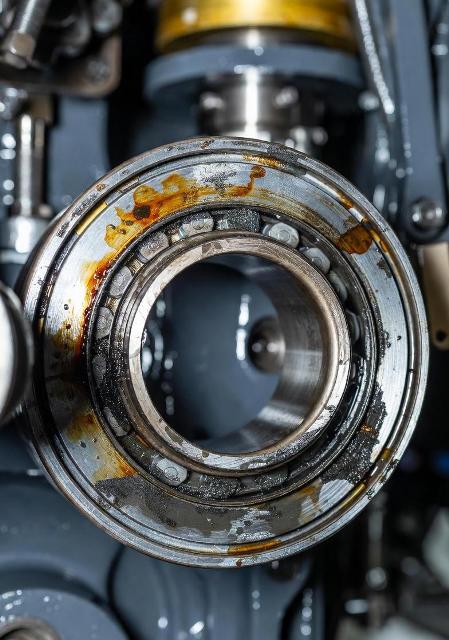
Effects of poor lubrication in a bearing
A Reality

While this is just an illustration, it is a reality that could occur at any petrochemical plant in Africa, or in other industries for that matter.
Another inescapable reality is that even robust bearings, tried and tested in harsh applications from reputable manufacturers, fail. It is always a matter of when, not if.
Effective Monitoring as a Standard Practice

Fortunately, making effective monitoring a standard practice can mitigate cases of costly failure and increase bearing uptime.
Monitoring can detect early signs or indications of failure, which can enable sound condition-based maintenance. In this way, appropriate action can be taken before minor issues turn into major breakdowns.
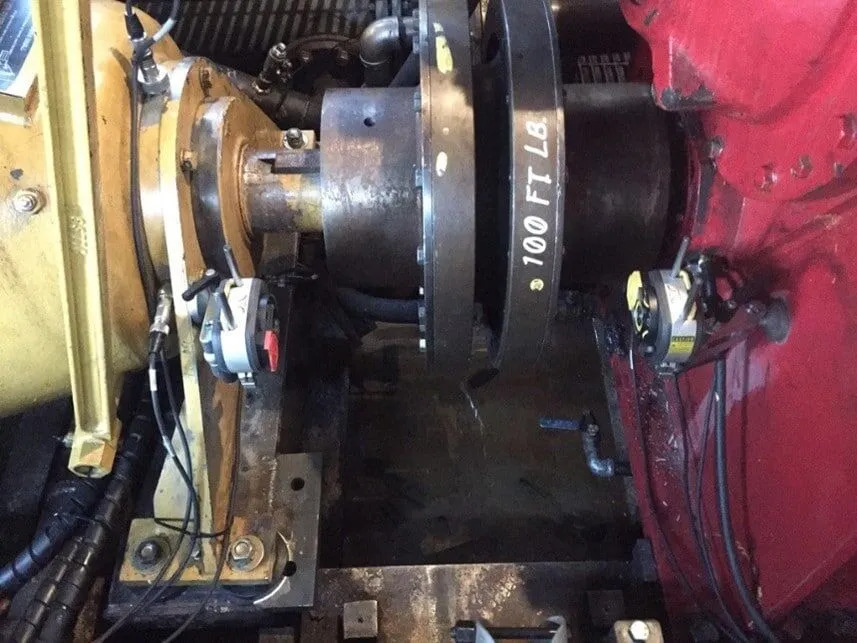
Misalignment of rotating equipment is one of the common causes of bearing failure (Image: Pruftechnik)
Early Signs
Every plant has unique cases of bearing failure. However, early signs usually emerge as high vibration levels, which can be detected using vibration sensors before failure occurs.
Typically, as defects escalate, friction generates heat and noise. And that’s where sensors come into play: progressively picking up increased temperatures together with audible changes in bearing performance.
What Early Signs Indicate
More often than not, the early signs indicate the following issues:
- Fatigue
Insufficient lubrication, misalignment, and contamination can cause bearing fatigue. With time, this evolves into flaking, spalling, and the formation of microscopic cracks. It is only a matter of time before failure hits.
- Lubrication Issues
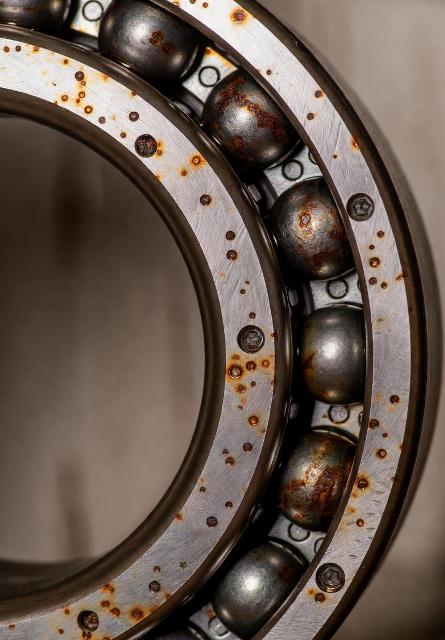
Improper lubrication – insufficient lubrication or using the wrong lubricant – is one of the causes of bearing failure. Over and above this is the degradation of lubrication due to high temperature. In most cases, this is manifested through discolouration on rolling elements and tracks, as well as overheated bearings.
- Misalignment
Thermal growth and irregular vibration can cause misalignment of rotating equipment like pumps, resulting in bearing failure. It is worth pointing out that this can happen even if bearings were correctly aligned during installation.
- Improper Installation
During a review sometime mid year, Eddie Martens of SKF South Africa noted something significant: 16 out of every 100 cases he encounters in industry (16%) are the result of improper bearing installation. That is why, during bearing installation, all critical elements have to be in order, every box ticked as much as possible. Otherwise, issues like poor lubrication, using incorrect tools, wrong fitting, dirty bearings and housing, and poor alignment contribute to bearing failure.
Incorrect fitting alone can be a source of problems. Both extremes are wrong: overly tight or excessively loose fitting can cause serious faults over time, leading to bearing failure.
- Excessive Loads
Excessive loads increase friction between the rolling element and the raceway. This causes undue wear and tear on bearings.
- Contamination
Improper installation and misalignment can lead to contamination from dirt, debris, and chemicals. This deteriorates bearings through corrosion.
Forms of Bearing Failure
Having looked at the causes, specifically, how does a failed bearing look?
Usually, bearing failure occurs in the following forms: spalling (flaking), brinelling, smearing, fretting, and fluting.
In advice to industry on best practice in bearing condition monitoring, Pruftechnik explains how each of these occurs:
- Spalling (flaking): When subsurface fatigue causes small flakes or pits to break off from the raceway or rolling elements.
- Brinelling: When a bearing becomes permanently dented.
- Smearing: Surface damage due to sliding friction under poor lubrication or heavy load, especially during start/stop cycles or misalignment.
- Fretting: Subtle vibrations between bearing parts result in wear and corrosion in localised spots.
- Fluting: When an ungrounded current passes through the bearing and causes tiny burn scars or crater-like pits lined along the raceway.
Identifying the Failures
It is one thing to understand the types of failure, but preventing them is a different obligation altogether.
The first step in minimising the above-mentioned cases of bearing failure is effective monitoring.
Of course, you can’t manage what you don’t know. For this reason, having an effective bearing monitoring programme firmly in place, centred on fatigue and lubrication, is essential. This ensures that defects are detected early to prevent costly outages and protect critical plant assets.
In an article advising industry, Pruftechnik highlights the importance of this approach: “By carrying out a bearing condition monitoring programme, you can help ensure your organisation’s maintenance strategy is preventive rather than corrective. You will catch problems before they result in asset failure, reducing maintenance costs and increasing productivity.”
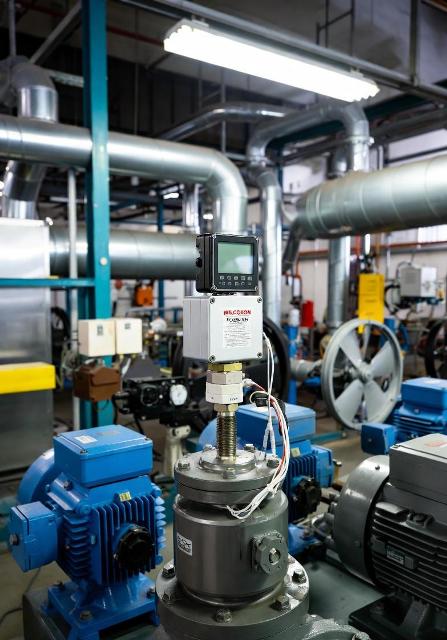
A Permamently-installed vibration sensor
With a clearly defined maintenance strategy in hand, an organisation can make the most of condition monitoring tools, which include handheld analysers and permanently installed sensors, to detect early warning signs reliably in real time. Subsequently, having gathered vibration data, analysts can employ analysis techniques to establish the nature of faults inside a machine.
Analysis Techniques Available
Pruftechnik outlines three main types of analysis techniques that vibration monitoring specialists use to determine potential faults in rotating equipment:
- Fast Fourier Transform (FFT) analysis: Converts time data into a frequency spectrum to identify if a fault is coming from a bearing or shaft, and where faults may be located.
- Time waveform analysis: Raw vibration data in the time domain is examined to detect changes in vibration frequency and amplitude. These reveal intermittent faults in machine performance, as well as conditions like loose bearings and gears.
- Envelope detection (demodulation): Suitable for early faults hidden within complex signals. Using an algorithm to extract signals from the original waveform, this enables experts to spot early bearing failure before it shows up in an FFT spectrum.
Combined, these techniques offer a wide range of practical diagnostics for rotating equipment health.
Clearly, the tools are there, thanks to advances in technology. It is up to reliability and maintenance teams in petrochemical plants to make informed decisions when needed.
So, What’s the Long and Short?
If you don’t take care of your bearings now through effective condition monitoring, you may have to bear the consequences later, and you may not be in a position to cope.