

In deep-level mining, technical compliance (TC) audits and inspections are often viewed as a safety obligation – and they are. But in practice, they are also one of the most important tools available for protecting production continuity.
When critical equipment such as winders, shaft systems, main fans, compressors, conveyors and associated electrical and mechanical protection systems is not performing exactly as intended, the consequences are rarely limited to a simple maintenance task. The result can be a safety incident, an unscheduled stoppage, or a costly interruption to production.
It is for these reasons that the real value of technical compliance work lies not only in whether an audit is completed, but in what it reveals, how it is trended over time, and how quickly those findings are converted into corrective action.
WearCheck’s Advanced Field Services (AFS) division supports mines and industrial operators with specialist services that include technical compliance (TC), non-destructive testing (NDT), and rope condition assessment (RCA), as part of the company’s broader condition monitoring and reliability support offering. WearCheck positions these services as practical tools for risk reduction, asset reliability, and operational support in demanding environments.
The TC team’s mining customers are generally the deep-level mines – coal, gold, platinum, and others – where WearCheck technicians test components in vertical shafts (people movement), incline shafts (goods movement), ropes, and other elements.

WearCheck AFS technician, Joe Kies, checks the safety circuit during a technical compliance audit
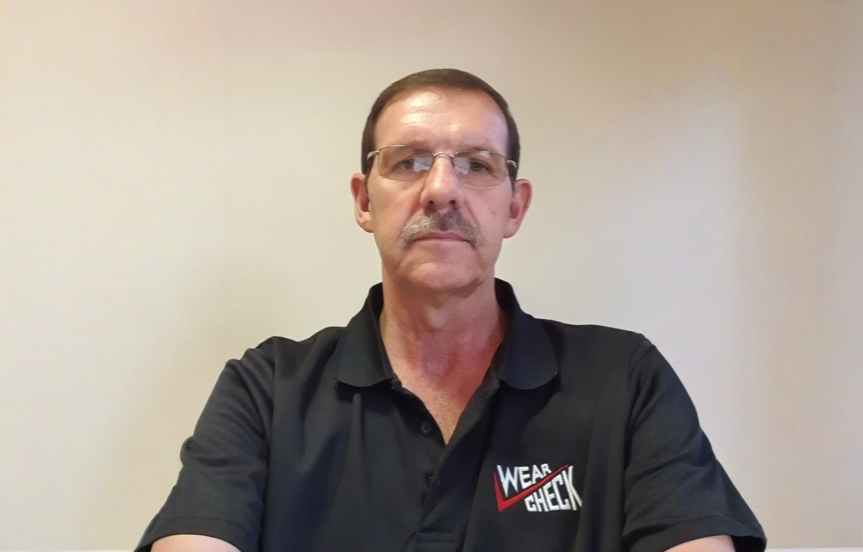
Johan Stols is the technical compliance manager for WearCheck’s Advanced Field Services (AFS) division, where he specialises in technical compliance support for safety- and production-critical equipment, particularly in mining applications. He is an experienced practitioner in field-based compliance inspections and risk-reduction support.

According to Stols, what makes technical compliance especially important in deep-level mining is the nature of the assets being tested, the operating conditions -which are often harsh, and the tightly controlled safety frameworks. TC confirms that protection systems, circuits, interlocks, and safety functions will perform correctly when they are needed most.
For Stols and his team of specialist technicians, the strongest TC programmes are built around measurable indicators.
Says Stols, ‘A pass/fail outcome on its own has limited value. What mine engineers and maintenance teams really need is a set of metrics and KPIs that helps them understand whether equipment condition is improving, stabilising, or deteriorating – and whether corrective actions are indeed working.
‘A good starting point is compliance performance at subsystem level. We believe that it is not enough to say that a machine “passed” or “failed” an audit. A machine may be broadly compliant overall, while still carrying recurring weaknesses in a particular subsystem, such as a safety circuit, lighting circuit, trip function, or control interlock. Breaking compliance results down into these areas gives a clearer view of where risk is accumulating and where maintenance attention is most urgently required.’
‘Equally important,’ insists Stols, ’is the rate and severity of non-conformances found during each audit. In a typical weekly examination, where many individual items may be tested, it is far more useful to track the density of critical findings than to rely on a general impression of “more” or “fewer” defects. Over time, this creates a practical trendline that can be compared across shafts, plants, or equipment groups. If critical findings are increasing, the site may be facing maintenance quality issues, ageing infrastructure, or recurring operational stressors that require more than routine corrective work.’
What do the KPIs tell us?
One of the most revealing KPIs in any technical compliance programme is the repeat-finding rate. When the same defect or defect type reappears after repairs have already been carried out, it usually signals a deeper problem: incomplete repairs, ineffective root-cause resolution, incorrect settings, or improper maintenance execution. A low repeat-finding rate, by contrast, is a strong indicator that both the inspection process and the maintenance response are functioning well.
Stols advises that the speed of corrective response is critical. ‘One of the most useful operational KPIs is the time taken from defect identification to repair completion and successful retest.
‘Retest performance, in turn, provides an important quality check on the repair itself. WearCheck’s approach, which includes returning to retest faulty components after maintenance teams have completed repairs, strengthens confidence in the overall process because it closes the loop between detection and verification. The percentage of repairs that pass on first retest tells a lot about maintenance workmanship, planning quality and the effectiveness of root-cause interventions. If too many repaired items fail their first retest, downtime can stretch unnecessarily and the reliability of the maintenance process comes into question.’
Integrity and performance
The integrity of protection systems and safety circuits warrants specific attention as a KPI category in its own right. It is not sufficient for a trip or interlock to operate “more or less correctly”. It must operate at the right threshold, in the correct sequence and in line with the design and safety requirements of that particular installation. Here, TC moves beyond routine inspection and becomes a core part of accident prevention and risk management.
Schedule adherence
For equipment such as licensed winders that require periodic physical or dynamic testing within defined intervals, failure to test on time creates its own risk, regardless of the equipment’s actual condition. Mines therefore benefit from tracking compliance windows as a KPI – what is due, what is overdue, and what is approaching deadline. Often, this is the difference between a well-managed compliance programme and one that becomes reactive under production pressure.

Joe Kies conducts brake drop timing test on a winder.
Trend visibility
A single audit result is merely a snapshot, while a sequence of audits becomes intelligence. When current findings are reviewed alongside previous audit outcomes and recent repairs, engineers can start to identify patterns – systems that are steadily improving, those that remain stable, and those showing signs of deterioration. This trend-based view helps maintenance teams plan interventions more effectively.
Stols warns, however, that not all defects should be weighted equally when performance is reported to management. A failed safety trip, a malfunctioning protection circuit and a minor ancillary fault do not carry the same consequence. Therefore, a risk-weighted compliance view is more meaningful than a simple pass percentage.
‘Furthermore,’ says Stols, ‘each critical machine can have its own operating logic and protection philosophy. While standard checklists are useful, they are insufficient on their own. Effective TC auditing requires familiarity with the specific asset, its history, its maintenance profile and the unique configuration of its protection systems.
‘WearCheck’s TC technicians take into account the field-based context, combining specialist inspection disciplines with reporting and follow-up to support the mine’s engineering and maintenance teams.
‘Ultimately, the most valuable TC programme is one that improves decisions. It should help a mine answer practical questions with confidence: Are our critical defects becoming less frequent? Are repairs being completed and verified quickly enough? Are repeat failures pointing to deeper maintenance issues? Are we staying inside required compliance windows? And, most importantly, are we reducing risk while protecting uptime?
When these questions are answered through robust metrics and well-structured KPIs, TC is not merely a procedural obligation – rather, it is a measurable contributor to reliability-centred maintenance. In deep-level mining, where safety and production are inseparable, that shift is not just useful – it is essential.’
WearCheck’s TC team comprises six winder inspectors, who have more than 150 years’ combined experience between them. They are supported by three trainee technicians, who are currently learning the proven practices and audit methodology of technical compliance audits on vertical-shaft rotating machinery from the experienced inspectors, to ensure a solid succession plan.