

In the Distributed Control System (DCS), ABB Process Automation has unlocked the perfect solution to address the challenge of the non-interoperability of equipment in process industries, a common headache for plant managers. The transformation of ArcelorMittal’s steel manufacturing operation speaks volumes about its efficacy in the sound implementation of maintenance programmes.
By Jimmy Swira
Typically, process plants have maintenance platforms across different mission-critical competitor OEM equipment brands. These are meant to provide data as and when needed to inform predictive maintenance tasks and ensure equipment availability for optimal production.
Ideally, the expectation, or the desire, is that this process will be seamless and glitch free. However, reality hits differently: running maintenance programmes of equipment across different platforms becomes a challenge due to non-interoperability of systems.
A critical challenge
Reflecting on experiences from engaging with clients, Jehrene Devagopaul, Automation Product Manager at ABB Process Automation South Africa, calls non-interoperability “a critical challenge in today’s process industries”.
“Diverse equipment from multiple OEMs often results in fragmented systems and siloed data. This can slow response times, increase maintenance costs, and lead to more unplanned downtime,” he explains, illustrating how non-interoperability impacts implementation of maintenance programmes.
Isn’t it odd that having different state-of-the-art equipment becomes a burden instead of a benefit?
So, is there a way out of this conundrum for maintenance teams?
ABB’s DCS Solution: One cohesive unit
Devagopaul assures there is a reliable solution for non-interoperability, referencing ABB Process Automation’s Distributed Control System (DCS). “We have designed our Distributed Control System, System 800xA, to overcome these barriers of non-interoperability by enabling seamless integration and unified visibility across all assets, regardless of brand. Our approach goes beyond simply controlling. It connects operations and asset health into one cohesive system.”
‘Agility, insight, and flexibility’
DCS breaks down silos. In this way, it empowers operators with the agility, insight, and flexibility needed to optimise maintenance, mitigate risks, and protect profitability. Besides, it supports sustainable growth in an increasingly complex environment.
Furthermore, worth mentioning is the pivotal role of ABB Process Automation System 800xA platform in enabling brand-agnostic integration for years. It achieves support for open standards and protocols that connect equipment from multiple vendors into a unified, intelligent automation environment,” Devagopaul states.
Tangible business benefits
Ultimately, the integrated approach results in the following tangible business benefits for process plants: reducing downtime through early issue detection, lowering maintenance costs by enabling predictive strategies, improving productivity with better-informed decisions, and extending equipment life via proactive monitoring. This is based on feedback from managers at process plants where DCS has been deployed.
A recent experience at ArcelorMittal South Africa‘s Steelworks plant in Newcastle, KwaZulu-Natal Province, South Africa further substantiates DCS’s effectiveness in solving interoperability challenges.
Case study: From a Fragmented System to an Integrated Success
ArcelorMittal’s plant in Newcastle, KwaZulu-Natal in South Africa is a classic case of how a unified approach can transform challenges experienced with maintenance due to non-interoperability of equipment systems from different OEMs. In comparing the situation before and after DCS deployment, there is a marked improvement in maintenance, confirms Devagopaul.
The previous situation
Previously, the plant had been operating with a mix of systems and devices from various vendors, particularly around its blast furnace, one of the most critical assets in steel production. “The absence of a centralised control and maintenance system meant that operators had limited visibility into equipment health. Maintenance was largely reactive, relying on alarms or failures rather than real-time condition monitoring. Unplanned downtime was frequent, asset life was difficult to manage, and maintenance costs were steadily rising,” Devagopaul reminisces.
ABB Intervention
ABB’s intervention has radically transformed the situation. Devagopaul relates how this was achieved: “We deployed the System 800xA platform as the core of a modernised automation environment. Without needing to replace all existing field devices, ABB was able to integrate over 7,000 I/O points and hundreds of third-party instruments using open protocols such as PROFIBUS and HART. The system brought all data – from temperature to vibration, from interlocks to control loops – into one accessible, intelligent interface.”
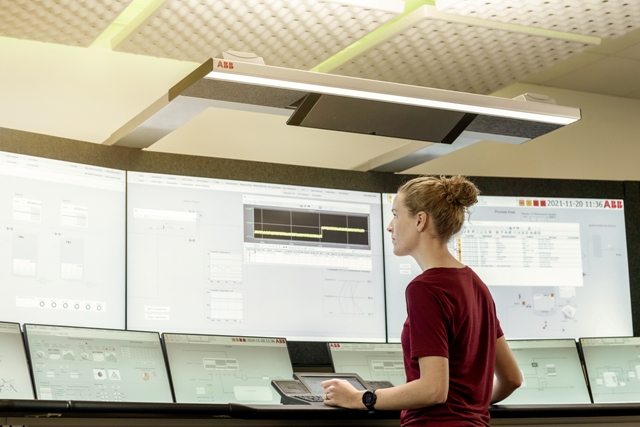
Following the deployment, operators and maintenance teams could now see the full picture, in real time, of equipment condition. On top of things, they were able to identify emerging issues before they caused disruptions, plan maintenance based on actual equipment condition, and coordinate interventions with unprecedented efficiency.
And the results were striking: a 12% increase in liquid iron production, reduced unplanned downtime, and a significant uplift in overall equipment effectiveness. Perhaps most impressively, the system went live with zero post-commissioning program changes. This demonstrated ABB’s ability to deliver right-first-time solutions in complex environments.
There is no doubt that the success at ArcelorMittal’s plant proves that ABB Process Automation’s DCS are fit –for-purpose in addressing equipment system non-interoperability often encountered in contemporary process plants. The company is eager to replicate this success in other plants in Africa by giving maintenance teams the edge.
What‘s next?
Asked about what’s next for process plant maintenance solutions at ABB Process Automation, Devagopaul confidently reveals: “ABB Process Automation’s vision for the DCS of tomorrow is already taking shape: one that is modular, open, and future-ready, enabling seamless IT/OT convergence, real-time data insights, and lifecycle flexibility. We are actively supporting global initiatives like OPAF and NAMUR Open Architecture, and our customers are already benefiting from improved visibility, faster decision-making, and more agile operations.”
Overview of the Steel Plant Implementation
Site:
ArcelorMittal Steelworks, Newcastle, KwaZulu-Natal, South Africa
Solution:
ABB System 800xA Distributed Control System (DCS)
Key Features:
- 7,000 I/O points
- 7 redundant AC800M controllers
- Integration of 300+ Profibus PA and 200 HART devices
- Comprehensive alarm and asset management features
Implementation Highlights:
- Upgrade of blast furnace control system
- Seamless integration of multi-vendor field devices
- On-site training for maintenance personnel
- Ongoing system support and optimisation
Outcomes:
- 12% increase in liquid iron production
- Significant reduction in unplanned downtime
- Improved equipment availability
- Enhanced maintenance efficiency and decision-making