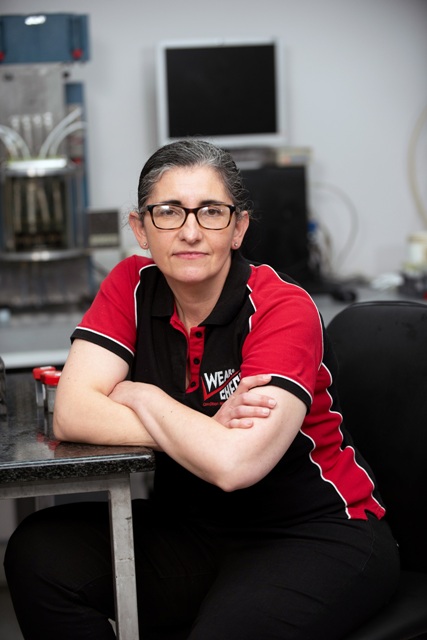


From hydroelectric projects in the Democratic Republic of Congo (DRC) to coastal towers in East Africa and food plants in South Africa, corrosion expert Greg Combrink of Total Corrosion Control tackles some of the continent’s toughest industrial corrosion challenges. He has decades of hands-on experience and a passion for problem-solving.
As Director of Total Corrosion Control (TCC SA) and a member of the Corrosion Institute of South Africa (CorrISA) and also of the Corrosion Hub, solving corrosion issues and assessing whether corrosion has occurred is second nature to Greg Combrink. He thrives on unlocking solutions to complex corrosion challenges in the most unforgiving industrial environments across Africa.
Combrin has been there, done that, and still hungers for more. Now, he sees opportunities opening up in new industries.
Currently, activity in mining, oil and gas, and power generation is ramping up. Corrosion-related component wear is a growing concern. Sometimes, this leads to costly downtime of mission-critical equipment.

Pump Corrosion at a water treatment plant
Replicating Milestones
Combrink is relishing the fresh challenges and is committed to delivering customer satisfaction. He is eager to replicate – and even exceed – milestones achieved in corrosion control on projects across Africa.
- Democratic Republic of Congo: Hydroelectric Penstock
One of the projects etched in his memory took place along the Congo River in the Democratic Republic of Congo (DRC) several years ago. Combrink was contracted to assess internal corrosion in a hydroelectric penstock.
“This was heading for litigation,” he recalls. “We were brought in to determine the cause and extent of the damage. You can imagine the urgency.”
For Combrink, the experience became a crash course in hands-on project management in a complex environment. He had to overcome claustrophobia to manually examine corrosion damage.
The inspection was carried out manually by visually inspecting the inner surface of the penstock and measuring pits as he worked his way down the 3-metre diameter pipe. With only five days to complete the job, the two-man team could not conduct a full 100 percent survey, but the client was satisfied with the results.
“Come to think of it,” he reflects, “this was before the advent of all the modern gadgetry. Today, the same task can be done using robots and 3D scanners. A full scan showing all pits and issues could be completed in half a day, with AI assessment taking another half. How incredible is that?”
- East Africa: Mixed-Use Building
The second project was uniquely groundbreaking.
A successful intervention in a mixed-use building showcased TCC SA’s versatility beyond heavy industry.
Combrink and his team investigated corrosion on powder-coated aluminium window and door frames on two 16-storey office and residential towers located 250 metres from the sea on the East African coast.
“We calculated how many samples had to be taken from the building to provide a 90 percent confidence interval with a 5 percent error probability,” he explains.
Samples were selected using a random number generator per floor. Two test specimens were taken from each location: one for coating thickness evaluation and one for plan view analysis to check for cracks or coating damage.
“Yes, despite my fear of heights, I was up there on the outside of the buildings,” he adds.
An optical microscope and a scanning electron microscope with microanalysis were used. Simulations were conducted to test for potential corrosive agents, such as window cleaning solutions.
“The results were conclusive,” Combrink recounts. “The coating was too thin and, in many places, failed to meet required specifications. In addition, some surface cracking was visible, though it had not penetrated the coating.”
And the result? Full replacement of all aluminium frames on both towers at a cost of $7 million.
- South Africa: Chemical Plant
In a third scenario, sulphur emissions from a nearby landfill site flowed directly through and around a chemical plant, causing aggressive and rapid corrosion.
Accordingly, exposure coupons were deployed to assess the corrosion rate.
“It was so aggressive that even tripling the normal dosage of vapour-phase corrosion inhibitors had no effect,” Combrink recalls.
Following a site visit, a multi-pronged solution was confidently developed and implemented. It successfully resolved the issue.
- South Africa: Hamburger Patty Manufacturer
The fourth case was in the food-processing sector. A hamburger patty manufacturer discovered black spots on patties emerging from the production line. This was unacceptable to clients who expected stringent adherence to phytosanitary standards.
A thorough root cause analysis traced the problem to wear on a conveyor belt made of 316L stainless steel. The worn particles were settling on patties due to a faulty ventilation system.
Once the ventilation issue was corrected, the problem disappeared entirely.
Keen for New Challenges
Looking ahead, Combrink is keen to apply insights gathered from recent projects to address emerging corrosion challenges in heavy industry. He is excited about the capabilities that the ongoing upgrade of Total Corrosion’s in-house analytical services will bring to the corrosion industry.
A One-Stop Laboratory Convenience
On the decision to upgrade the laboratory, Combrink states: “You really can’t tackle corrosion investigations efficiently without the need to actually ‘see’ what you are dealing with.”
“For the ‘seeing’ part, a good, sound and efficient analytical backup and field testing ability, coupled with knowledge and experience, is needed.”
So, it is about meeting an urgent need.
Currently, Total Corrosion’s corrosion and materials laboratory handles most basic analyses. However, it has been outsourcing more sophisticated testing tasks.
While outsourcing hasn’t affected turnaround times, Combrink believes having full in-house analysis will enable Total Corrosion to offer the convenience of a one-stop service. “It is far better to do everything ourselves to serve the corrosion industry better.”
With sophisticated instruments such as EDX, EDS, SEM-EDX, exposure cabinets, and electrochemical testing equipment, the upgraded laboratory will be world-class. “The laboratory will greatly improve our ability to investigate corrosion issues, improve turnaround times, and result in better reporting. Anyone with a corrosion issue will benefit greatly from using our services,” Greg enthuses.
It has always been Total Corrosion’s firm belief that, for industry to effectively mitigate corrosion, it must be more proactive than reactive. “Fighting corrosion isn’t just about finding out what happened, but also about developing new and innovative ways of preventing it in the first place. Hence, once the upgraded laboratory is fully operational – coupled with our expertise and partnerships with consultants – we will be well equipped to help clients across the continent achieve Total Control over Corrosion,”he affirms.