



On the African continent, industries are converting their DOL machinery to speed-controlled systems. Unfortunately, this transition is triggering unintended spikes in harmonic distortions — posing a serious risk of equipment failure. Worsening matters, most organisations are ill-equipped to tackle this challenge, VoltVision laments, identifying the need to increase awareness.
By Jimmy Swira
In Africa, mines and other industries are embracing new innovations to achieve the following objectives: improve efficiency, reduce OPEX, enhance safety, and lower emissions in their operations. One such innovation involves switching from direct-on-line equipment to alternatives that use electronic speed controls.

Unintended consequences – harmonic distortions
Ideally, this transition is expected to usher in a seamless, glitch-free experience in mission-critical equipment. Unfortunately, unbeknown to most mining managers, there are unintended consequences — chief among them being an increase in harmonic distortions in their mission-critical equipment.
Worse still, often unnoticed or casually dismissed, the effects of these distortions may appear benign but become malignant over time, potentially resulting in costly equipment failure. Even more concerning, they are only identified after significant damage has occurred.
Food for thought: isn’t it ironic that a transition that is supposed to bring efficiency may have the opposite effect?
Lack of awareness
Manoli Yannaghas, Founder and Managing Director of VoltVision, attributes the lax attitude towards harmonic distortions to a pervasive lack of awareness. Urging industry players to tackle this issue with utmost urgency, he highlights the prevalence of distortion issues, prevailing attitudes towards mitigation, and proposes sound mitigation measures.
Exaggerated or pervasive?
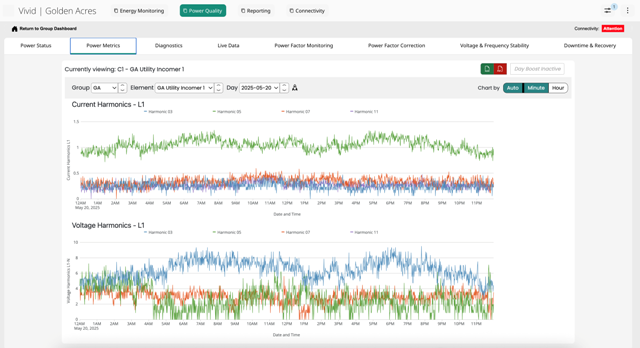
VoltVision monitors harmonic distortions and shares the data with its clients. Based on the company’s findings, the high risk industries face from these distortions is not exaggerated — it is pervasive. Yannaghas is not being alarmist but highlighting a growing trend informed by recent developments.
Noteworthy, older mining operations typically rely on direct-on-line (DOL) equipment, which produces far fewer harmonic distortions. As a result, such operations tend to experience fewer events compared to newer mines that use frequency-based control systems more extensively.
By contrast, there is a large number of Variable Speed Drives (VSDs) and electronic control systems being used in newer equipment in the mining industry. These are the major sources of harmonic distortions. “Basically, any piece of equipment that controls speed by changing the frequency — generating a frequency that’s different from the main source — is going to create harmonic distortions. That’s why, as industries adopt more digital and electronic systems, especially in mining, there is a corresponding increase in distortion-related issues,” elaborates Yannaghas.
Interestingly, he has noticed a unique pattern in harmonic distortions: major contributors include speed control systems, soft starters, drives, and winder controllers, particularly the front ends.
Low priority
Unfortunately, despite the potential impact of harmonic distortions on equipment availability, Yannaghas laments that clients do not pay much attention to the issue. Relating VoltVision’s experience, he says: “Currently, their primary focus is on power consumption and overall energy management, so awareness of harmonic distortions tends to be quite low. Even when we highlight the presence of distortions in their systems, it rarely prompts concern — it’s not seen as a top priority.”
Even more intriguing, the general impression is that with many electrical professionals in the organisations, containing harmonic distortions should be a top priority.
Yannaghas is not entirely surprised by the apparent indifference to the risk of harmonic distortions in industries. “While many electrical professionals learn about the theory of harmonic distortions during their studies, the critical aspects in practical application — such as monitoring, measuring, or filtering them — are often overlooked. So, even though the concept is familiar, the impact is not well understood. As a result, clients typically don’t address the issue unless it leads to visible or immediate problems.”

Measures fall short
On a positive note, there are signs of improvement: organisations are starting to install harmonic filters. This can be considered a step in the right direction. However, the most common approach to mitigating high harmonic levels is the installation of filters. Unfortunately, this rarely solves the problem effectively. Usually, filters are installed based on a one-time evaluation, which poses a risk. Yannaghas points out, “The filters get installed and then aren’t updated. So, when more VSDs are added later, or when conversions happen — like switching from AC to DC winders — the filters are not adjusted to match the new conditions. That is when high levels of harmonic distortions start to show up.”
The correct approach
Instead, the correct approach is updating filters to match conditions when more VSDs are added, or when converting from AC to DC winders, Yannaghas suggests.
The rallying cry to industry is: prioritise harmonics management. The last thing any operation can experience is encountering downtime to equipment at the peak of production — especially for a problem that could have been addressed.
Research and development update
Yannaghas reveals that in a research and development breakthrough, VoltVision has developed equipment that induces harmonic cancellation frequencies. Could this be a step towards smarter real-time mitigation?


