


In equipment inspection, some areas are difficult, dangerous, or impossible for technicians to reach. That is where drones are bridging the gap. Equipped with advanced sensors, high-resolution cameras, and LiDAR, they detect hidden defects and provide precise data, helping plants prevent failures, reduce downtime, and cut maintenance costs. They are already making a difference in African heavy industry, as a case study from Steinmüller Africa shows.
Ask any reliability engineer or manager: in maintenance, not knowing about a potential problem with mission-critical equipment is a problem in itself.
Regular inspection
Regular inspection is the sure-fire way of assessing equipment health, which informs the most effective approach to increasing reliability and availability. However, this works only when it is conducted thoroughly in every square millimetre of critical areas.
The traditional method
Usually, the traditional method involves sending technicians with suitable tools to conduct nondestructive testing (NDT) of components to detect possible structural defects.
This kind of inspection achieves considerable success in some areas. However, in other areas it falls short, particularly in hazardous, difficult-to-access areas or those requiring high precision. These could be nooks and crannies, for instance blades of turbines and some sections of boilers where there may be defects.
That’s where potential risks could be lurking. And this is the worrying part for reliability engineers.
If not detected timeously, minor defects in inaccessible areas could escalate with time, causing equipment failure and halting production. This is the last thing a plant engineer at a petrochemical plant in Mozambique or a copper processing plant in Zambia would be prepared to face at peak production.
There is nothing worse than experiencing a fire accident, leakage of hazardous gases, or even flooding.
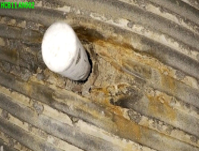
Furnace Inspection
Deploying drones
Conveniently, process industries can forestall potential failure caused by defects in inaccessible areas by deploying drones to complement the role of technicians. These prevent human exposure to hazards.
The inspection drones are able to perform their required tasks due to their features.
Equipped with advanced sensors and high-resolution cameras, the drones are able to perform tasks beyond human capability. Through thermal imaging, vibration analysis, and LiDAR mapping, they are able to gather high-resolution inspection data of issues such as – but not confined to – subtle wear, misalignment, or structural deformation from critical components with millimetre-level accuracy.
LiDAR cameras are what make drones more effective, as they do not need lighting. This is due to LiDAR’s ability to penetrate dust and smog, which is a common feature in rugged environments where heavy equipment is found, especially in mining, oil, and gas industries.
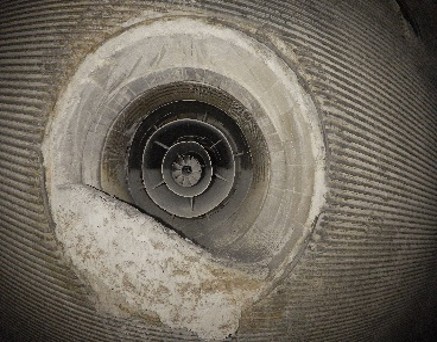
Burner Inspection
The Elios 3 Drone
A perfect example of a commercial-scale inspection drone is the Elios 3, which Steinmüller Africa uses to meet the needs of clients in different industries. One of the applications for which it is ideal is inspection at power stations.
Project information Steinmüller Africa shared with Machinery Maintenance Matters several weeks ago indicates that the drone delivers high-resolution imagery and enables precise 3D mapping – even underground – in real time. With this capability, the drone enables the creation of accurate digital twins of inspected assets.
What is more, uniquely, the Elios 3 is equipped with advanced flight-path detection. With this feature, it autonomously navigates complex, GPS-denied environments with precision.
Remotely, with the Elios 3, inspectors are able to monitor live feeds and use live data gathered on asset conditions to make informed decisions.
Largely, Aswegen said using the drone allows the company to cut downtime by as much as 50 percent through the accurate data, identifying damage locations with greater accuracy and accessibility. Besides, the drones eliminate the necessity of applying for permits that are required for human inspection, installation of scaffolding, and sky climbers. In this way, the drone cuts down maintenance and repair costs.