

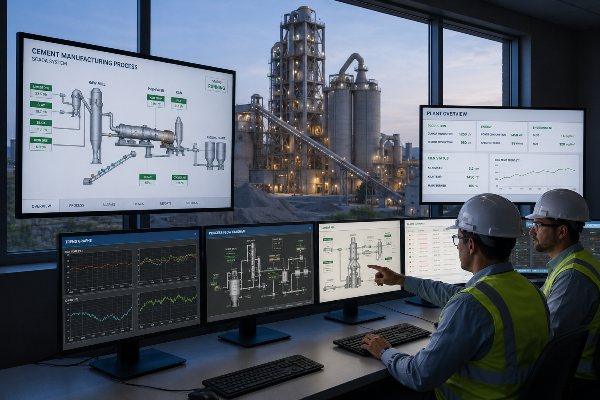

The cement industry operates in one of the most demanding industrial environments in the world. Every stage of production – from quarry operations and raw material handling to kiln management, packaging and distribution – relies on accurate data, reliable processes and continuous optimisation.
As producers face increasing pressure to improve efficiency, reduce energy consumption and meet sustainability objectives, digital technologies are playing a growing role in supporting operational performance in cement production.
SCADA and IIoT Provide Visibility
Digital systems such as SCADA (Supervisory Control and Data Acquisition) and Industrial Internet of Things (IIoT) platforms are increasingly used in cement plants to provide visibility into operations. These systems enable operators to monitor processes in real time, support decision-making and improve overall plant performance.
According to Jan-Hendrick Rust, Technical & Sales Engineer at Adroit Technologies, the cement sector has long been an environment where efficiency and operational discipline are critical. “Many of the challenges faced by cement producers ultimately come down to efficiency, energy optimisation and sustainability,” he says. “While the processes may differ from one industry to another, those core objectives remain remarkably consistent.”
Turning data into operational intelligence
Historically, one of the key challenges in industrial operations has been capturing, centralising and effectively using plant data. Modern cement facilities generate large volumes of information from equipment, production lines and utility systems, but the value of that data depends on how it is analysed and applied.
SCADA platforms provide a centralised view of operations, allowing plant personnel to monitor production performance, track equipment status and identify potential issues before they affect output. “The focus today is not only on collecting data, but on making that data useful,” says Rust. “Operations require actionable information that supports productivity, reduces downtime and improves decision-making.”
This visibility extends beyond production metrics. Energy consumption, equipment performance and process stability can also be monitored, providing insights into operational efficiency.

Driving continuous improvement
Over time, industrial operators have developed approaches to address recurring operational challenges, often using data-driven systems. In some cases, functionality such as alarm management has been refined to reduce alarm overload and improve response to critical events.
When implemented effectively, alarm management systems can help maintenance teams identify recurring equipment issues before they lead to failures. This contributes to improved reliability and reduced unplanned downtime.

Production efficiency monitoring and Overall Equipment Effectiveness (OEE) measurement are also widely used in manufacturing environments to assess asset performance and identify inefficiencies.
By combining operational data with analytics, cement producers can better understand production bottlenecks, equipment utilisation and process performance, enabling targeted improvements.
Supporting energy efficiency and sustainability
Energy consumption is one of the largest operating costs in cement production, making efficiency a key focus area. Real-time monitoring of energy use allows producers to compare consumption with production output and identify areas for improvement.
“Manufacturers are continuously looking for ways to optimise resources while maintaining production quality,” says Rust. “Understanding energy usage at a detailed level supports more informed operational decisions.”
The industry’s increasing use of alternative fuels and evolving production methods further emphasises the need for reliable monitoring and control systems. Visibility into complex processes helps operators maintain consistency while adapting to changing conditions.
Cross-industry application of technologies
Technologies and methodologies developed in one industrial sector are often applied in others. Approaches used in cement production have also been adopted in sectors such as water and wastewater treatment, where similar requirements for efficiency, energy management and operational visibility exist.
At the same time, lessons from other industries are frequently incorporated into cement manufacturing practices. The underlying principles of process understanding, performance measurement and continuous improvement remain consistent across sectors.
Preparing for the future
As industrial operations continue to adopt digital technologies, areas such as advanced analytics, IIoT connectivity and artificial intelligence are expected to play a larger role. In many cases, the effective use of these technologies depends on the quality and consistency of operational data.
“The better the data foundation, the better prepared organisations will be for future technologies,” says Rust. “Digitalisation is an ongoing process of improving visibility, efficiency and decision-making within operations.”
For cement producers operating under increasing economic and environmental pressure, data-driven decision-making is becoming an important factor in maintaining competitiveness and operational resilience.