


South Africa is a water-scarce country, beset by ageing municipal water infrastructure and water outages. Water tariffs have soared by over 500% since 2009 – approximately six times faster than inflation. Saving water is not only the next sustainability frontier, but an effective way to curb rising input costs.
This is according to Chris Paterson, Managing Director of AES, South Africa’s go-to industrial steam operations and project company.
Water only part of the solution
Saving water is complex, as every site and manufacturing process is different. AES therefore works closely with clients to better understand their water chemistry.
Not only does municipal water quality differ regionally, but companies are increasingly using boreholes to reduce their dependence on municipal water. However, water high in total dissolved solids (TDS), iron and silica is not suited for boilers.
“It depends on whether water is drawn from a clean aquifer. We have seen borehole water with very high TDS – and some which is better than municipal water. Companies intending to sink boreholes must get water tested and analysed. If iron or silica levels are high, additional investment is required to remove that. Borehole water also changes. You need monthly or even daily monitoring of the TDS,” Paterson advises.
Pre-treatment and water loss
All boiler types need to blow down to control the TDS inside, and ensure safe and stable operations. The majority of installations then route the resulting waste water to drain.

To minimise blowdowns and save water, TDS must be monitored and reduced: “Do boiler operators know the limits at which they need to be operating? Do clients have the right automated blowdown equipment to ensure they are not blowing down excessively?” asks Paterson.
Where the TDS in water is high, companies often install reverse osmosis (RO) plants: “However, an RO plant comes at a cost of some 30% of the water being treated – which then goes to effluent. Only if you can use that higher TDS water somewhere else – maybe to flush toilets or water gardens – can you offset the water loss,” he suggests.

AES Commercial Director Dennis Williams concurs, adding that even if a company uses this RO water elsewhere, the net water cycle across the RO and the boiler may still be more costly than municipal usage.
Williams notes that there may be simpler solutions, as was demonstrated when AES assisted a food manufacturer which had switched from an electrical to a biomass boiler: “AES changed the water preparation, replacing the RO plant with a simple water softener, resulting in a water savings of 25%,” he explains.
Counting on condensate
Once TDS is under control, the focus shifts to boiler operations and returning condensate for re-use in boiler feedwater. However, client steam operations determine the quality and quantity of condensate. Importantly, the client’s process and manufacturing plant design – for example ‘dead leg’ piping which is not used and causing condensate wastage – also affects the percentage of condensate return.
“To understand how to maximise condensate return, steam users should measure the steam at critical points in the process. As many companies no longer have in-house skills to do this, AES adds value by conducting steam trap surveys or walking the lines to understand where steam is going, or to identify leaks,” Williams advises.
Steam traps play a significant role in condensate management, he adds: “For a manufacturer using a heat exchanger, steam traps ensure that the heat exchange system is working optimally without steam wastage, or ‘flooding’ with condensate. Many of these condensate systems fail when steam traps are not sized correctly, not maintained or have been damaged by operators opening valves too quickly. This results in a rush of steam into systems, damaging the systems internally.”
At the boiler house, AES measures and informs clients how much condensate is returned: “Without measuring and understanding the status of condensate return, clients do not know how much they can potentially save. For example, we can demonstrate how, between January and March a client had a 75% condensate return. Then something happened, and now they are down to 30%. We can then quantify how much that is costing – in terms of water and energy – which may motivate them to make changes,” Paterson advises.
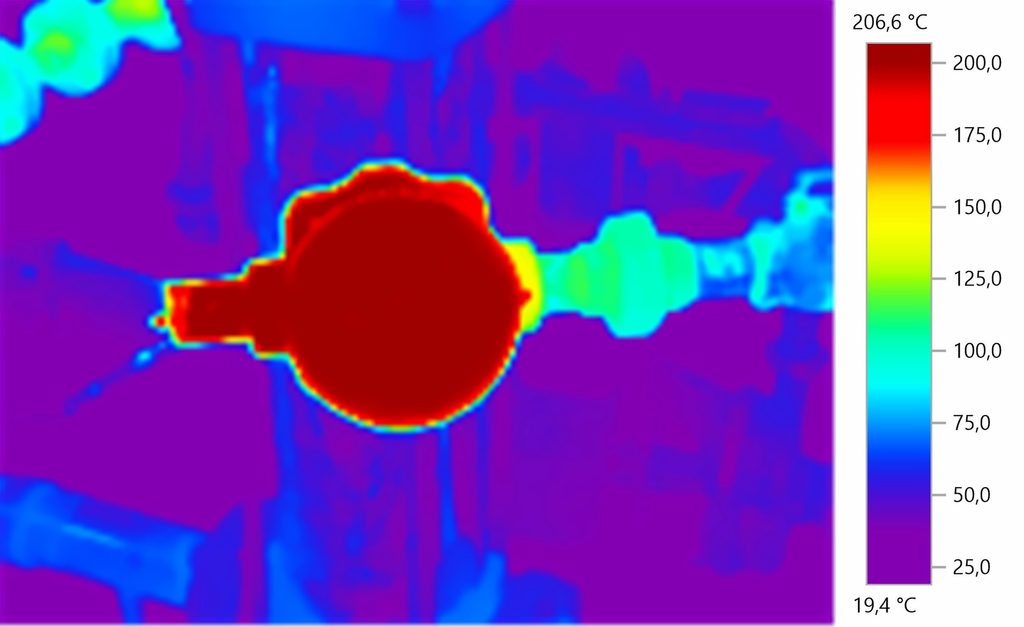
Thermal image for thermal checking by AES
Pumping up savings
Clients struggle most with high pressure condensate, he observes: “The system design must be correct. You have to collect the condensate under pressure. To pump it, line designs and pumps must be correct. Otherwise there can be water or steam hammer in the lines, causing damage.”
Pumps with specially designed impellers and mechanical seals are required, and the pressure going into the pump – and the pipe work surrounding the pump – needs to be correct.
“You cannot use just any pump, because of the higher pressures and the temperatures of the condensate. It can flash and cavitate easily: damaging the impellers and compromising the reliability of the pump at significant cost to the manufacturer,” Paterson warns.
Pump repair delays necessitate dumping the condensate to drain, doing exactly the opposite of what capturing condensate for reuse does – wasting water.
Then, there is the challenge of ensuring that the returned condensate is suitable for use in the boilers. PH is also important: “There is a pH range for boilers, and this is one of the parameters which should be checked, as some pH correction may be required. Alternatively, the pH level may be corrected once the condensate is in the boiler hot well.”
“Boiler water savings do not stop at water. If the condensate does not need treatment – and the use of more condensate means that less raw water needs to be treated – there is a potential saving on chemicals too. Most significantly, the thermal energy contained in hot condensate return reduces fuel use,” Paterson concludes.