

Vibrating screens operate under continuous dynamic loading. This places significant demands on bolted joints. Gearbox mountings are particularly sensitive to changes in bolt preload, fastener loosening and joint movement, which can result in maintenance interventions and equipment downtime.
South African mining operation
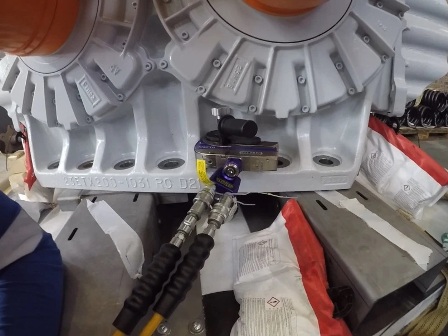
At a South African mining operation, maintenance personnel required a method of fastening a gearbox on a large vibrating screen where vibration and restricted access presented challenges. The application was assessed using a hydraulic torque tool and a reaction-free fastening system.
According to John Fairhurst, Corporate Account Manager: Africa at HYTORC, the system was selected for its compact arrangement and the ability to carry out controlled tightening in restricted areas.
Managing vibration and restricted access
Vibrating screens are subjected to repeated cyclic loads during operation. If bolt preload is not maintained, movement within a joint can contribute to loosening and fatigue. Maintaining the required clamp load is therefore an important part of gearbox mounting maintenance.
The maintenance team had to consider four requirements:
1. Preload retention: Maintain the required clamp load under cyclic loading.
2. Access: Allow fastening work to be carried out around the gearbox where clearance was restricted.

3. Operator safety: Reduce exposure to hazards associated with reaction arms and tool movement.
4. Maintenance time: Complete the fastening sequence within planned maintenance and outage periods.

Conventional hydraulic torque tools generally use a reaction arm to counter the applied torque. In confined spaces, positioning the reaction arm can complicate tool setup and introduce pinch points.
Reaction-free hydraulic fastening
The mine selected a STEALTH low-clearance hydraulic torque wrench in combination with the HYTORC Nut.
The HYTORC Nut incorporates an inner sleeve, outer sleeve and hardened washer. The arrangement transfers the reaction forces within the fastening system rather than requiring a conventional external reaction point on adjacent equipment.
This configuration allowed the technicians to tighten the gearbox mounting bolts from one side of the joint while working within the available clearance around the gearbox.
The hydraulic system also provided controlled torque application, allowing the specified tightening procedure to be repeated across the fastening sequence.
Installation and bolting procedure
HYTORC specialists worked with the mine’s engineering team during the installation to establish the fastening procedure.
Application-specific guidance included the tightening sequence and the method used to achieve consistent loading across the gearbox flange. The low-clearance tool and fastening arrangement allowed access to bolts that would otherwise have required more complex reaction-arm positioning.
Controlled tightening is particularly relevant to gearbox mounting applications because uneven bolt loading can affect the distribution of load across the joint. A defined tightening sequence helps ensure that the specified load is applied consistently.
Maintenance implications
The application illustrates several considerations for bolted joints on vibrating equipment.
Maintaining clamp load
The objective of controlled fastening is to establish and maintain the required clamp load in the joint. On vibrating machinery, loss of preload can allow relative movement between components and contribute to loosening or fatigue.
Working in restricted spaces
Gearboxes, guards, structural members and other components can leave limited space for conventional torque tooling. Tool dimensions and the location of the reaction point therefore need to be considered during maintenance planning.
Repeatable tightening
Hydraulic torque tooling provides a controlled method of applying torque to multiple fasteners. When combined with an appropriate tightening sequence and specified torque values, this can improve repeatability between individual fasteners.
Reducing maintenance time
A fastening arrangement that does not require an external reaction arm can simplify tool positioning and reduce setup requirements. This can be useful during planned shutdowns where access and available maintenance time are constrained.
Application considerations
The case highlights the importance of treating bolted joints as part of the overall reliability of vibrating equipment rather than as a routine installation detail.
For gearbox mountings on vibrating screens, maintenance planning should consider the expected dynamic loading, joint design, required bolt preload, access for torque equipment and the appropriate tightening sequence.
Controlled fastening is one part of the process. Inspection of the joint, verification of bolt and washer specifications, correct torque or tension values, and subsequent monitoring of the mounting during operation remain important to maintaining joint integrity.
Read the original article by Hytorc