


As one of Africa’s leading condition monitoring specialists, WearCheck has spent more than 50 years helping customers identify and manage contamination before it develops into an expensive maintenance problem. Through laboratory analysis, on-site reliability services and expert diagnostics, the company enables maintenance teams to make informed, data-driven decisions based on the actual condition of their equipment.
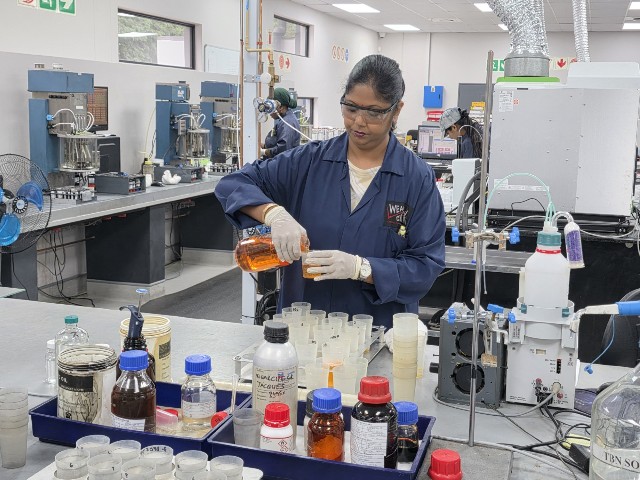
Shireen Brijlall, a laboratory assistant at WearCheck’s Durban laboratory, conducts TAN (Total Acid Number) testing on oil samples using a Dosimat instrument. An increasing TAN (higher acid levels) can be an indirect indicator that contamination or degradation has occurred.

The unseen threat
WearCheck managing director, Neil Robinson, explains that lubricants perform several vital functions. ‘They reduce friction, dissipate heat, protect against corrosion and remove wear particles from moving components. However, once contaminants enter the lubrication system, they compromise all of these functions.’
He says that even microscopic contaminants can have a significant impact. ‘Hard particles suspended in lubricating oil can scratch and abrade metal surfaces, while moisture promotes corrosion, reduces lubricant performance and accelerates oxidation. Fuel dilution reduces lubricant viscosity, diminishing the protective oil film, while coolant contamination can rapidly damage bearings and other precision components.’

In industries such as mining, manufacturing, agriculture, construction, power generation and transport, the equipment often operates in harsh environments where dust, dirt, moisture and fluctuating temperatures create ideal conditions for contamination.
Small particles, major consequences
Robinson warns that many contaminants are invisible to the naked eye. ‘A particle measuring just a few microns in size can be sufficient to damage hydraulic valves, bearings and precision-machined components,’ he says.
Hydraulic systems are particularly vulnerable. Modern hydraulic equipment operates with extremely fine clearances, making it highly susceptible to abrasive particles. Likewise, bearings, gearboxes and diesel engines rely on clean lubricants to maintain protective oil films between moving surfaces.
As contamination increases, so does wear. The result is shortened component life, increased maintenance costs and, ultimately, unexpected equipment failure.
Contamination takes many forms
Robinson outlines the many ways in which industrial lubricants can become polluted. ‘We see evidence of contamination from numerous sources, including airborne dust entering reservoirs and breathers; water ingress through damaged seals or condensation; coolant leaks into engine oil; fuel dilution caused by injector or combustion problems; process contamination from chemicals or production materials; metal wear particles generated during equipment operation; incorrect handling or storage of lubricants, and cross-contamination through mixing incompatible lubricants.
‘While some contamination is unavoidable, much of it can be prevented through good maintenance practices and effective monitoring.’
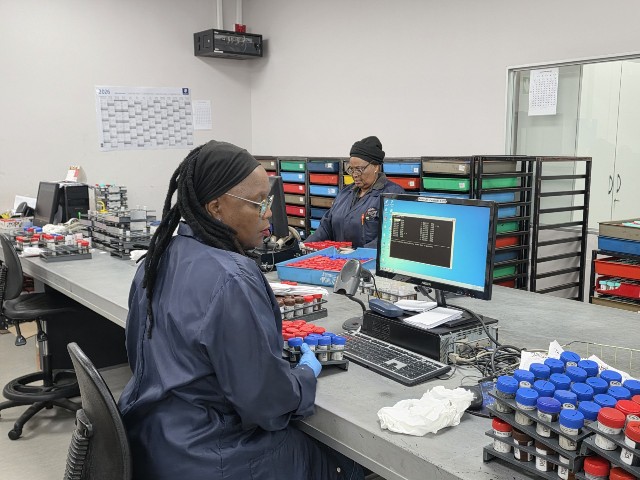
Each year, WearCheck’s laboratory technicians analyse more than 800 000 samples of used oil and other industrial fluids, testing for contaminants that can lead to disastrous machinery failure if not addressed. Here, sample room assistant Lindiwe Nibe is seen racking samples in the laboratory.
Detection before failure
One of the greatest advantages of condition monitoring is its ability to detect contamination long before machinery performance begins to deteriorate.
Routine oil analysis provides valuable insight into the health of both the lubricant and the machine. WearCheck technicians examine lubricant samples in specialised laboratories, where they can identify abnormal contamination, monitor wear trends and detect developing problems at an early stage.
WearCheck’s laboratories analyse a range of parameters, including:
- Particle contamination
- Water content
- Fuel dilution
- Coolant contamination
- Oxidation and lubricant degradation
- Wear metals
- Additive depletion
- Viscosity changes
Together, these results provide a comprehensive picture of equipment condition. This data is assessed by WearCheck’s highly experienced diagnosticians, and reported to maintenance teams, empowering them to take corrective action before serious damage occurs.
Importantly, says Robinson, oil analysis should never be viewed as a once-off exercise. ‘Years of experience has taught us that the true value lies in trend analysis. Monitoring changes over time allows diagnosticians to distinguish between normal operating conditions and developing faults, providing early warning of potential failures.’
The importance of cleanliness
Many organisations invest heavily in high-quality lubricants yet overlook the importance of keeping those lubricants clean.
Contamination can be introduced before the lubricant even enters the machine through poor storage practices, dirty transfer containers or contaminated dispensing equipment.
Robinson suggests some simple improvements that can significantly reduce contamination risks, including storing lubricants in clean, sealed containers; using dedicated dispensing equipment; installing high-quality breathers and filtration systems; maintaining effective seal integrity; filtering new oil before use; keeping storage areas clean and dry, and training maintenance personnel in correct lubricant handling procedures
‘These relatively inexpensive measures can deliver substantial improvements in equipment reliability,’ says Robinson, ‘and WearCheck’s lubricant-enabled reliability (LER) team can assist with implementing an effective, customised lubricant-management system.’
Sampling matters
Accurate laboratory results depend on obtaining representative oil samples.
Poor sampling techniques can introduce contamination or produce misleading results, leading to incorrect maintenance decisions. Samples should always be taken from designated sampling points while equipment is operating at normal temperature, using clean sampling equipment and consistent procedures.
Routine sampling intervals also play a critical role. Consistency enables meaningful trend analysis and allows maintenance teams to detect gradual changes before they become critical.
Maintenance teams can attend one of WearCheck’s regular oil analysis courses to learn good sampling practice. Alternatively, the company offers an on-site sampling service, where trained technicians come and take the lubricant sample.
From reactive to predictive maintenance
Traditional maintenance strategies often rely on repairing equipment after failure or servicing machinery at fixed intervals. Condition monitoring offers a far more effective approach.
Rather than waiting for equipment to fail, maintenance decisions are based on actual machine condition. By identifying contamination early, organisations can schedule maintenance at the most appropriate time, avoiding unnecessary repairs while reducing the risk of catastrophic failures.
This predictive approach delivers measurable benefits, which include reduced unplanned downtime; extended component life; lower maintenance costs; improved equipment availability; better maintenance planning; increased operational reliability, and enhanced workplace safety.
For many organisations, contamination control becomes one of the quickest ways to improve maintenance performance without significant capital investment.
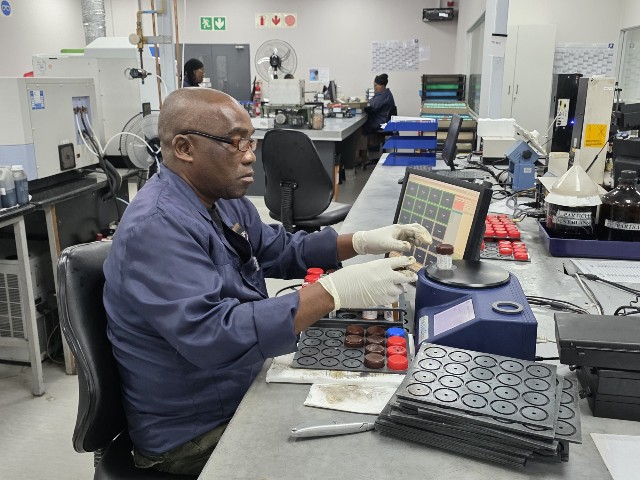
Here, WearCheck recycling assistant, Aaron Mchunu, conducts particle quantification to determine the PQ in the oil. PQ (Particle Quantifier) determination measures the amount of magnetisable ferrous material in a used oil sample.
Working with the experts
While laboratory technology has advanced significantly, effective condition monitoring depends as much on expert interpretation as it does on accurate test results.
WearCheck’s nine experienced diagnosticians, who boast a combined 200 years of experience, evaluate multiple condition indicators together rather than relying on individual test results in isolation. By combining laboratory data with operating history, equipment type and maintenance trends, they provide practical recommendations that help customers make informed maintenance decisions.
Beyond laboratory analysis, WearCheck also offers a wide range of asset reliability care solutions that help customers establish comprehensive contamination-control strategies across their operations.
Protecting valuable assets
Contamination may be invisible, but its effects are not. Every contaminated lubricant carries the potential to reduce equipment life, increase maintenance costs and compromise operational efficiency.
By combining good housekeeping practices with structured condition monitoring and expert laboratory analysis, organisations can detect contamination early. The result is improved reliability and longer equipment life.
After more than 50 years of supporting industry across Africa, WearCheck continues to help customers protect their valuable assets through world-class condition monitoring services, enabling maintenance teams to move beyond reactive maintenance and towards smarter, data-driven reliability.
For further information, please visit www.wearcheck.co.za, email marketing@wearcheck.co.za, or call WearCheck on +27 (31) 700-5460.