


Timely testing prevents rope failures that could lead to costly downtime in gold and platinum environments. That is why WearCheck’s Asset Reliability Care Unit offers Rope Condition Assessment (RCA), which has become an essential component of modern predictive maintenance programmes.
When a mine winder stops unexpectedly, production doesn’t simply slow down – it stops.
Whether transporting personnel, ore or materials, mine winders are among the most safety-critical and operationally important assets in underground mining. At gold and platinum operations in particular, where shafts may extend several kilometres below the surface, the integrity of the steel wire ropes supporting these systems is fundamental to both operational continuity and worker safety.
For this reason, Rope Condition Assessment (RCA) has become an essential component of modern predictive maintenance programmes.
Condition monitoring specialist company, WearCheck, offers RCA as part of its extensive selection of testing and assessment services for asset reliability maintenance in the industrial sector. RCA forms part of the company’s specialist asset reliability care services and includes one of South Africa’s largest teams of qualified rope inspectors.
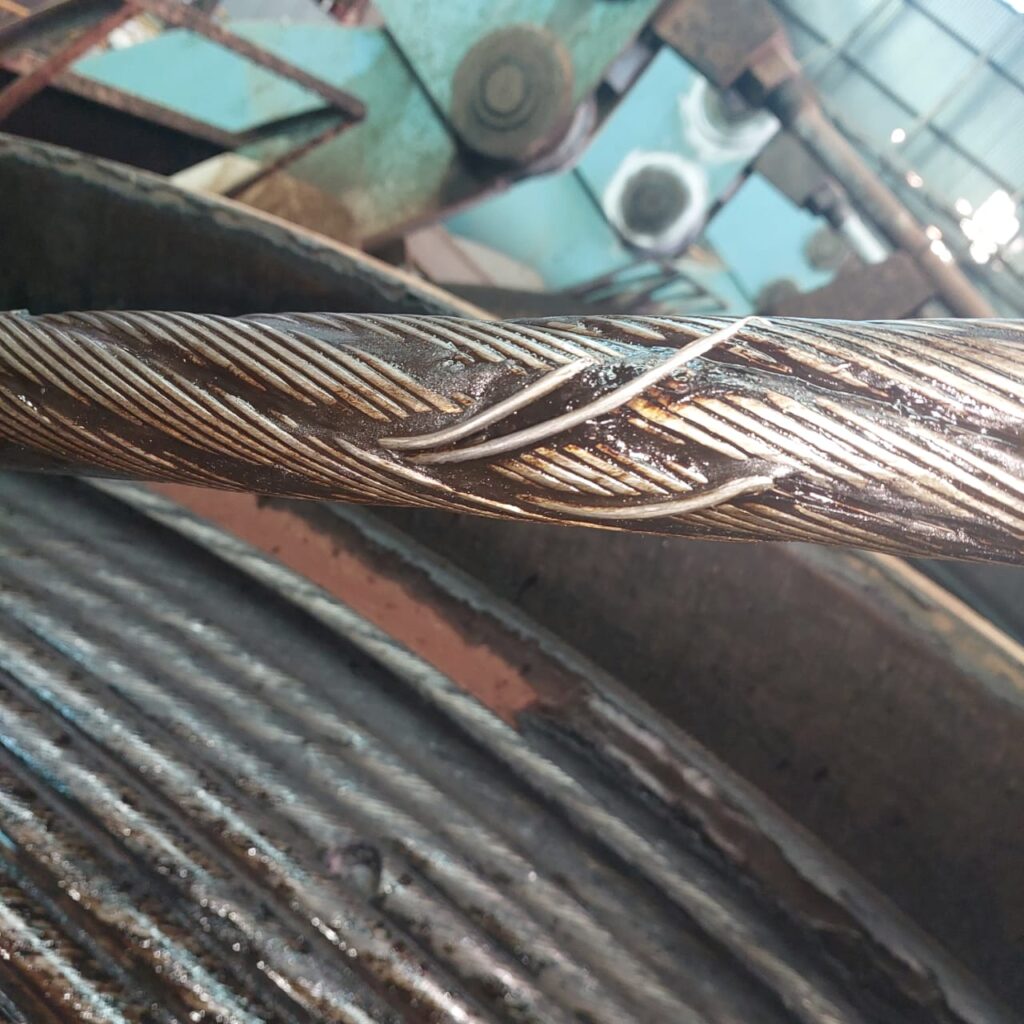
Multiple broken wires are visible on one strand of this steel wire rope. Rope Condition Assessment (RCA) assists in identifying and monitoring such defects before they compromise the rope’s condition.
A proactive approach to rope integrity
Steel wire ropes operate in exceptionally demanding environments, performing their duties on heavy loads – lifting, lowering, pulling, restraining and suspending, safely and reliably.
Roger Henwood is part of WearCheck’s Asset Reliability Care unit, where he is the technical manager of the Rope Condition Assessment team. He shares the insights he has gained from many years of experience. ‘Steel wire ropes are subjected to constant tensile loading, bending stresses, abrasion, corrosion, fatigue and environmental contamination throughout their service lives. Although these deterioration mechanisms often develop gradually, they can ultimately compromise the structural integrity of the rope if left undetected.’
Henwood notes that the challenge is that many critical defects originate inside the rope, making them impossible to detect through routine visual inspections alone. This is where Rope Condition Assessment provides significant value.
He explains how the process works. ‘Using advanced non-destructive testing techniques, WearCheck’s qualified inspectors assess the internal and external condition of steel wire ropes, enabling mine maintenance teams to identify deterioration long before it develops into a safety risk or causes costly production interruptions.
‘Rather than replacing ropes according to conservative time intervals, operators can base replacement decisions on the actual condition of the rope.’
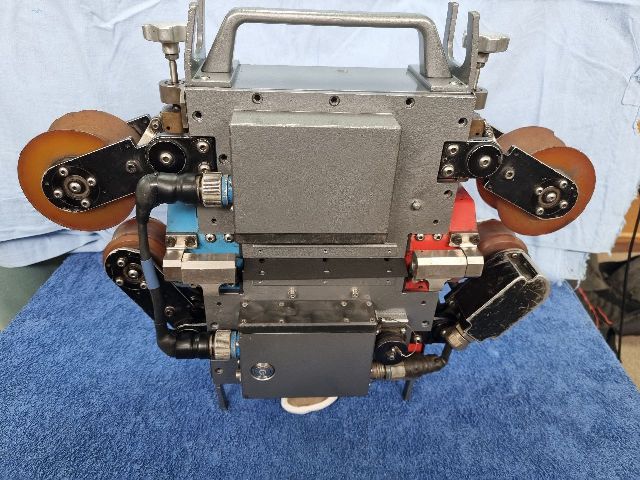
WearCheck’s RCA inspectors use an electromagnetic rope-testing inspection head (pictured), which magnetises the rope using powerful permanent magnets and sensors to detect disturbances in the magnetic field. The system measures loss of metallic area (LMA), which may indicate internal corrosion, wear or general deterioration. It also detects localised faults (LF), records rope position and distance and assesses the rope’s magnetic signature to help evaluate its overall condition.
Beyond compliance
South African mines operate within a stringent regulatory framework governing the inspection and maintenance of steel wire ropes.
WearCheck’s Rope Condition Assessment programme complies with the relevant SANS Codes of Practice, OEM recommendations and internationally recognised standards, ensuring that inspections meet both legislative and operational requirements. Routine testing of licensed mine winders is typically undertaken every 30 days, with inspection intervals for other installations determined by the responsible engineer in accordance with applicable legislation and operating conditions.
‘However,’ says Henwood, ‘the greatest benefit extends well beyond regulatory compliance.
‘Condition monitoring provides maintenance teams with objective engineering data that supports informed maintenance planning, reduces unnecessary rope replacements and minimises the risk of unplanned outages.’
In an industry where every hour of downtime can significantly impact production, early fault detection provides both operational and financial benefits.
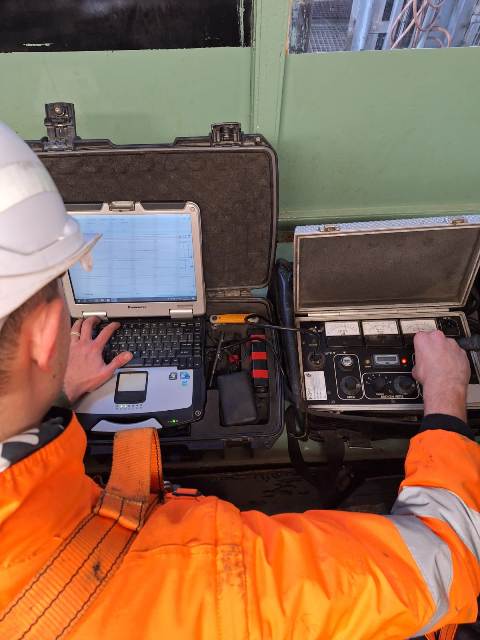
WearCheck RCA team member Kevin Henwood interprets the output signals generated during an electromagnetic rope test, assessing the condition of the steel wire rope over its entire length.
Looking inside the rope
Unlike conventional visual examinations, magnetic rope testing evaluates the internal condition of the rope without affecting its operation.
A specialised magnetic rope-testing instrument is fitted around the moving rope, magnetising the steel wires and continuously measuring changes in the magnetic field as the rope passes through the sensor.
The system identifies anomalies including broken wires, corrosion, wear, loss of metallic cross-sectional area, plastic deformation and other internal defects that may not yet be visible externally. These results are analysed by experienced inspectors, who determine whether the rope continues to meet the applicable discard criteria or whether corrective action is required.
Because the inspection is completely non-destructive, healthy ropes remain in service with confidence, while deteriorating ropes can be replaced before failure becomes a possibility.
Turning inspection data into maintenance decisions
Henwood emphasises that collecting data is only the first step. ‘The real value lies in understanding what that information means for the operation of the mine,’ he says.
WearCheck’s inspectors combine sophisticated instrumentation with extensive practical experience, allowing maintenance managers to understand not only what defects exist, but how rapidly they are developing and what actions should be taken.
This enables maintenance work to be incorporated into planned shutdowns rather than emergency repairs, reducing disruption to production schedules and improving resource planning.
For reliability engineers, Rope Condition Assessment forms an important part of a broader condition-monitoring strategy alongside used oil analysis, vibration analysis, thermography and other predictive maintenance technologies.
Together, these techniques provide a comprehensive picture of asset health.
Expertise that cannot be replaced
Few engineering disciplines demand greater specialist knowledge than rope inspection.
The qualification process is rigorous, requiring formal technical qualifications, extensive supervised field experience and successful completion of demanding written and practical examinations before inspectors are certified.
South Africa has only a small number of qualified Rope Condition Assessment inspectors, and WearCheck employs one of the country’s largest specialist teams. Their experience spans mine winders, chairlifts, elevators and other critical steel wire rope applications across the mining industry.
This depth of expertise allows customers to rely not only on accurate measurements, but also on practical engineering recommendations developed through years of field experience.
Supporting the future of mining
Modern mining operations increasingly depend on predictive maintenance to improve reliability while controlling operating costs.
Rather than responding to failures after they occur, maintenance teams seek to identify developing problems early enough for corrective action to be planned and scheduled. Rope Condition Assessment aligns perfectly with this philosophy.
By providing objective information about rope health, it enables maintenance decisions to be based on measurable condition rather than assumptions or fixed replacement intervals.
The result is improved safety, greater equipment availability, lower lifecycle costs and increased confidence in one of the mine’s most critical mechanical systems.
Fifty years of reliability leadership
Although WearCheck is widely recognised for its leadership in scientific oil analysis, the company’s Asset Reliability Care division reflects its broader commitment to helping customers maximise equipment reliability through condition monitoring.
Today, WearCheck provides a comprehensive range of reliability services across Africa, including used oil analysis, transformer oil analysis, scientific water analysis, lubricant-enabled reliability, vibration analysis, thermography, non-destructive testing and Rope Condition Assessment. This integrated approach allows customers to monitor virtually every aspect of asset health using a single trusted partner.
As WearCheck celebrates 50 years of innovation, its focus remains unchanged: providing customers with the information they need to make better maintenance decisions before failures occur.
In mining, where the reliability of a single rope can influence both production and safety, that philosophy continues to deliver measurable value every day.
After all, predictive maintenance is not simply about identifying equipment that is failing. It is about identifying equipment that still has time to be repaired before failure ever becomes a possibility – and that is precisely what Rope Condition Assessment is designed to achieve. After 50 years of checking ropes, oils and machines, one thing remains constant: it’s always better to find a problem before gravity does.
For further information, please visit www.wearcheck.co.za, email marketing@wearcheck.co.za, or call WearCheck on +27 (31) 700-5460